Bellas R E, FitzGerald M J, Fausto N, Sonenshein G E
Department of Biochemistry, Boston University School of Medicine, Massachusetts 02118, USA.
Am J Pathol. 1997 Oct;151(4):891-6.
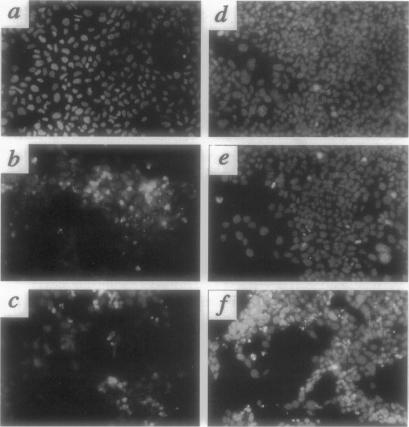
Recently we have demonstrated that inhibition of the nuclear factor (NF)-kappa B/Rel family of transcription factors induces apoptosis of B cells. Interestingly, mice lacking the relA gene encoding the p65 subunit of NF-kappa B exhibit embryonic lethality at days 15 to 16 of gestation, accompanied by massive destruction of liver via apoptosis. To determine whether p65 protein plays a direct role in hepatocyte survival, we employed a nontransformed murine hepatocyte (NMH) cell line, which maintains to a high degree the differentiated hepatocyte phenotype. Exponentially growing NMH cells were found to possess a constitutive level of functional classical (p50/p65) NF-kappa B as assayed by electrophoretic mobility shift analysis, antibody supershift, and transient transfection assays. Treatment of NMH cells with the proteasome inhibitor lactacystin, which prevents degradation of the NF-kappa B inhibitor proteins I kappa B, induced apoptosis. Direct inhibition of the endogenous NF-kappa B activity by microinjection of NMH cells with purified specific inhibitor I kappa B-alpha-glutathione-S-transferase fusion protein or an antibody against p65 protein induced apoptosis. These findings suggest that expression of NF-kappa B/Rel activity in murine hepatocytes acts directly to promote survival of these cells and suggest that apoptosis observed in hepatocytes of mice lacking relA is a direct effect of p65 deficiency.
最近我们已经证明,抑制转录因子核因子(NF)-κB/Rel家族可诱导B细胞凋亡。有趣的是,缺乏编码NF-κB p65亚基的relA基因的小鼠在妊娠第15至16天表现出胚胎致死性,同时伴有肝脏通过凋亡发生的大规模破坏。为了确定p65蛋白是否在肝细胞存活中起直接作用,我们采用了一种未转化的小鼠肝细胞(NMH)细胞系,该细胞系高度维持分化的肝细胞表型。通过电泳迁移率变动分析、抗体超迁移和瞬时转染试验检测发现,指数生长的NMH细胞具有组成水平的功能性经典(p50/p65)NF-κB。用蛋白酶体抑制剂乳胞素处理NMH细胞,该抑制剂可防止NF-κB抑制蛋白IκB的降解,从而诱导细胞凋亡。通过向NMH细胞显微注射纯化的特异性抑制剂IκB-α-谷胱甘肽-S-转移酶融合蛋白或抗p65蛋白抗体直接抑制内源性NF-κB活性,可诱导细胞凋亡。这些发现表明,小鼠肝细胞中NF-κB/Rel活性的表达直接作用于促进这些细胞的存活,并表明在缺乏relA的小鼠肝细胞中观察到的凋亡是p65缺乏的直接效应。