
婴儿紧急气管插管:喉镜叶片设计有影响吗?
Emergency intubation of infants: does laryngoscope blade design make any difference?
作者信息
Whittaker J D, Moulton C
机构信息
Accident and Emergency Department, Royal Bolton Hospital.
出版信息
J Accid Emerg Med. 1998 Sep;15(5):308-11. doi: 10.1136/emj.15.5.308.
OBJECTIVE
To compare intubation times and ease of use for a range of infant laryngoscope blades in the hands of accident and emergency (A&E) personnel.
METHODS
Seven different blades were compared in terms of intubation times and ease of use scores in the hands of 30 A&E senior house officers (SHOs) and nurses using a standard infant manikin.
RESULTS
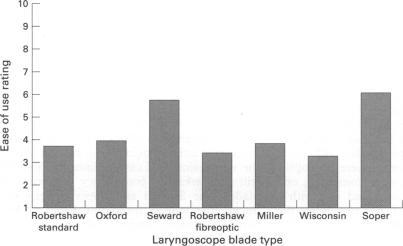
There was a significant difference in intubation times between the seven blades (p < 0.001). Intubation with two blade designs (Seward and Soper) took almost twice as long as for the other blades (p < 0.05). Subjective ease of use scoring also identified the Seward and Soper blades as being the most difficult to use (p < 0.05). There were no significant differences between SHO and nurse intubation times or ease of use scoring. Successful intubation was achieved within 30 seconds in 90% of attempts. All but two of the subjects used an incorrect levering technique for intubation despite all having previously received training in infant intubation.
CONCLUSIONS
No current standard exists regarding the utilisation of infant laryngoscope blades in the A&E department. The first line blade available should be a C shaped blade (Miller, Oxford, Robert-shaw, or Wisconsin). Other blade designs should be kept for use only by more experienced personnel or in difficult intubation situations. Intubation training must focus on correct technique and regular assessment is essential.
目的
比较急诊(A&E)人员使用一系列婴儿喉镜叶片时的插管时间和易用性。
方法
30名急诊高级住院医师(SHOs)和护士使用标准婴儿人体模型,对七种不同的叶片在插管时间和易用性评分方面进行比较。
结果
七种叶片的插管时间存在显著差异(p < 0.001)。两种叶片设计(Seward和Soper)的插管时间几乎是其他叶片的两倍(p < 0.05)。主观易用性评分也表明Seward和Soper叶片最难使用(p < 0.05)。SHO和护士的插管时间或易用性评分之间没有显著差异。90%的尝试在30秒内成功插管。除两名受试者外,所有受试者尽管之前都接受过婴儿插管培训,但插管时使用的杠杆技术均不正确。
结论
急诊部门在使用婴儿喉镜叶片方面目前没有标准。一线可用的叶片应为C形叶片(Miller、Oxford、Robert-shaw或Wisconsin)。其他叶片设计仅应由经验更丰富的人员使用或在困难插管情况下使用。插管培训必须注重正确技术,定期评估至关重要。

 Zotero 插件