Miller R K, Matheos D, Rose M D
Department of Molecular Biology, Lewis Thomas Laboratory, Princeton University, Princeton, New Jersey 08544, USA.
J Cell Biol. 1999 Mar 8;144(5):963-75. doi: 10.1083/jcb.144.5.963.
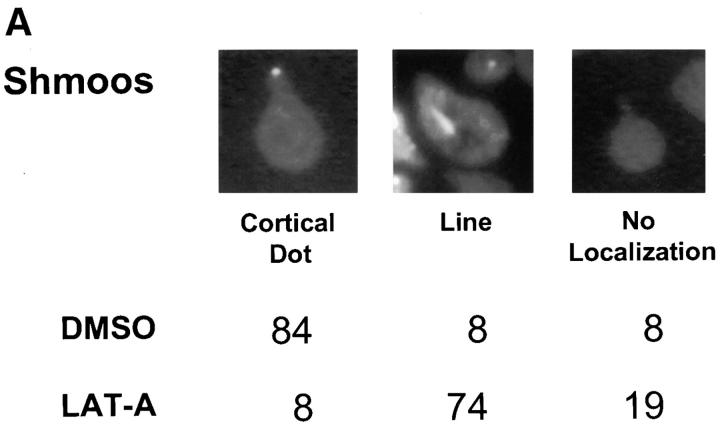
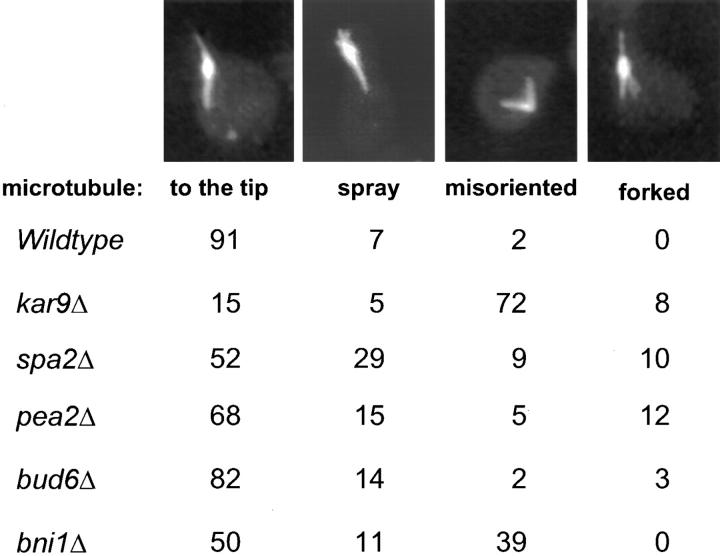
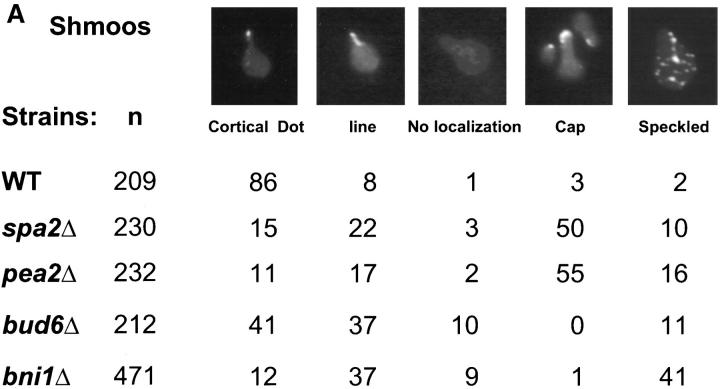
In the yeast Saccharomyces cerevisiae, positioning of the mitotic spindle requires both the cytoplasmic microtubules and actin. Kar9p is a novel cortical protein that is required for the correct position of the mitotic spindle and the orientation of the cytoplasmic microtubules. Green fluorescent protein (GFP)- Kar9p localizes to a single spot at the tip of the growing bud and the mating projection. However, the cortical localization of Kar9p does not require microtubules (Miller, R.K., and M.D. Rose. 1998. J. Cell Biol. 140: 377), suggesting that Kar9p interacts with other proteins at the cortex. To investigate Kar9p's cortical interactions, we treated cells with the actin-depolymerizing drug, latrunculin-A. In both shmoos and mitotic cells, Kar9p's cortical localization was completely dependent on polymerized actin. Kar9p localization was also altered by mutations in four genes, spa2Delta, pea2Delta, bud6Delta, and bni1Delta, required for normal polarization and actin cytoskeleton functions and, of these, bni1Delta affected Kar9p localization most severely. Like kar9Delta, bni1Delta mutants exhibited nuclear positioning defects during mitosis and in shmoos. Furthermore, like kar9Delta, the bni1Delta mutant exhibited misoriented cytoplasmic microtubules in shmoos. Genetic analysis placed BNI1 in the KAR9 pathway for nuclear migration. However, analysis of kar9Delta bni1Delta double mutants suggested that Kar9p retained some function in bni1Delta mitotic cells. Unlike the polarization mutants, kar9Delta shmoos had a normal morphology and diploids budded in the correct bipolar pattern. Furthermore, Bni1p localized normally in kar9Delta. We conclude that Kar9p's function is specific for cytoplasmic microtubule orientation and that Kar9p's role in nuclear positioning is to coordinate the interactions between the actin and microtubule networks.
在酿酒酵母中,有丝分裂纺锤体的定位需要细胞质微管和肌动蛋白。Kar9p是一种新型的皮质蛋白,对于有丝分裂纺锤体的正确定位以及细胞质微管的定向是必需的。绿色荧光蛋白(GFP)-Kar9p定位于正在生长的芽尖和交配突起处的单个位点。然而,Kar9p的皮质定位并不需要微管(Miller,R.K.,和M.D. Rose. 1998. J. Cell Biol. 140: 377),这表明Kar9p在皮质处与其他蛋白相互作用。为了研究Kar9p的皮质相互作用,我们用肌动蛋白解聚药物latrunculin-A处理细胞。在酵母接合细胞和有丝分裂细胞中,Kar9p的皮质定位完全依赖于聚合的肌动蛋白。Kar9p的定位也因四个基因spa2Δ、pea2Δ、bud6Δ和bni1Δ的突变而改变,这些基因对于正常的极化和肌动蛋白细胞骨架功能是必需的,其中bni1Δ对Kar9p定位的影响最为严重。与kar9Δ一样,bni1Δ突变体在有丝分裂期间和酵母接合细胞中表现出核定位缺陷。此外,与kar9Δ一样,bni1Δ突变体在酵母接合细胞中表现出细胞质微管定向错误。遗传分析将BNI1置于KAR9核迁移途径中。然而,对kar9Δbni1Δ双突变体的分析表明,Kar9p在bni1Δ有丝分裂细胞中保留了一些功能。与极化突变体不同,kar9Δ酵母接合细胞具有正常的形态,二倍体以正确的双极模式出芽。此外,Bni1p在kar9Δ中正常定位。我们得出结论,Kar9p的功能对于细胞质微管定向是特异性的,并且Kar9p在核定位中的作用是协调肌动蛋白和微管网络之间的相互作用。