Grosman C, Salamone F N, Sine S M, Auerbach A
Department of Physiology and Biophysics, State University of New York at Buffalo, Buffalo, New York 14214, USA.
J Gen Physiol. 2000 Sep;116(3):327-40. doi: 10.1085/jgp.116.3.327.
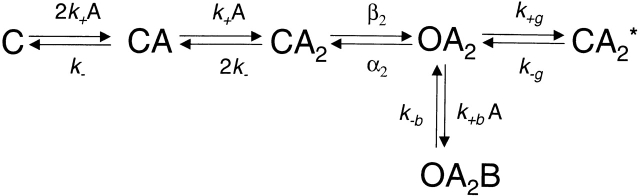
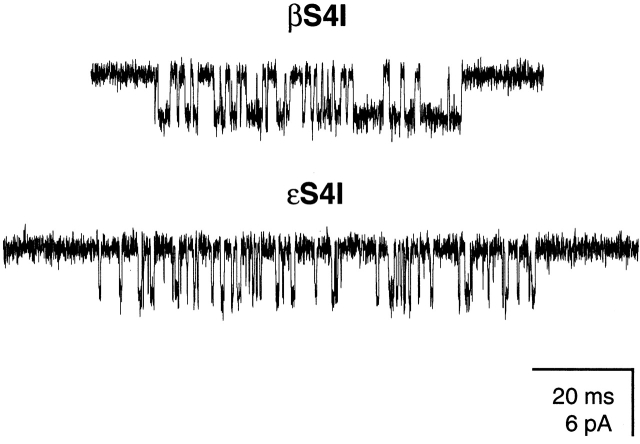
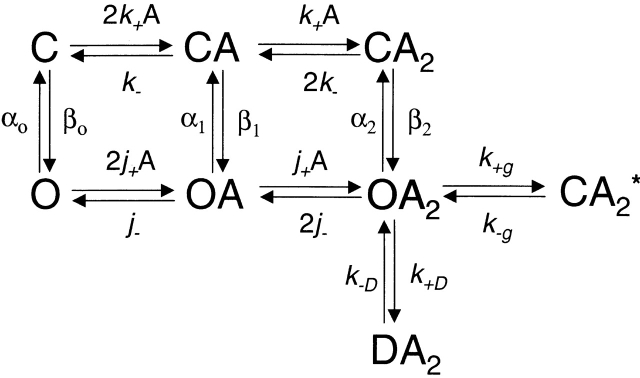
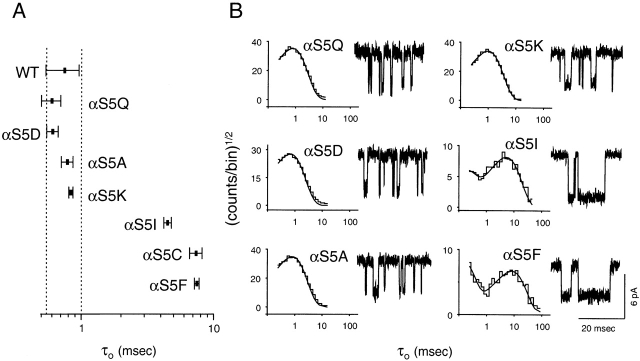
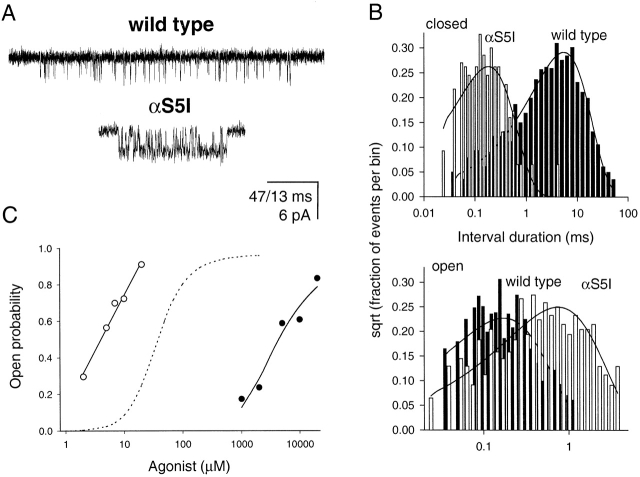
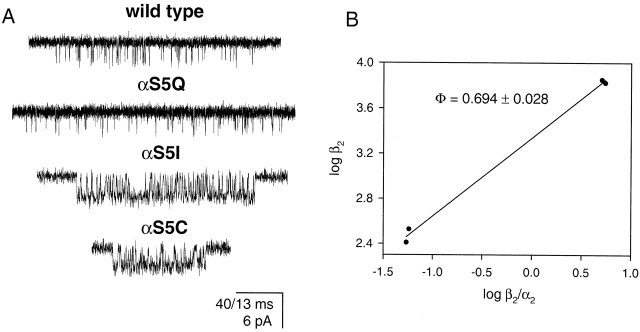
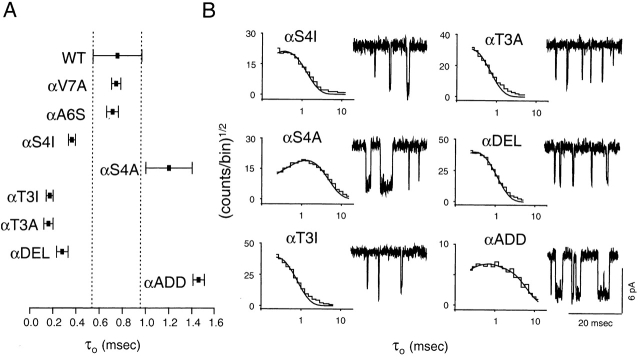
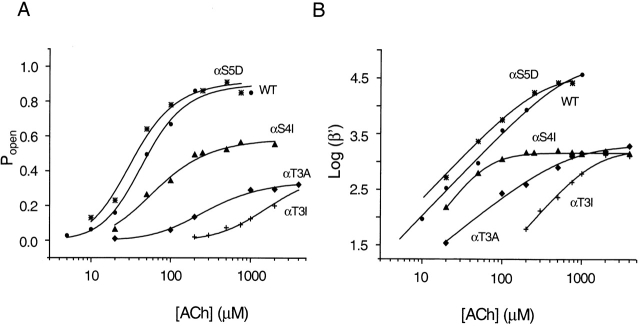
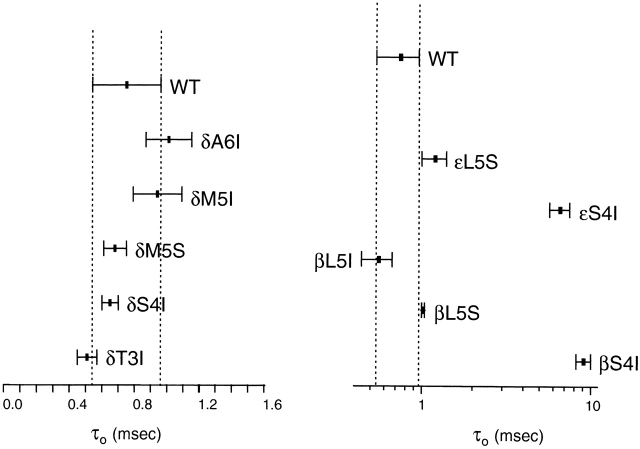
We describe the functional consequences of mutations in the linker between the second and third transmembrane segments (M2-M3L) of muscle acetylcholine receptors at the single-channel level. Hydrophobic mutations (Ile, Cys, and Phe) placed near the middle of the linker of the alpha subunit (alphaS269) prolong apparent openings elicited by low concentrations of acetylcholine (ACh), whereas hydrophilic mutations (Asp, Lys, and Gln) are without effect. Because the gating kinetics of the alphaS269I receptor (a congenital myasthenic syndrome mutant) in the presence of ACh are too fast, choline was used as the agonist. This revealed an approximately 92-fold increased gating equilibrium constant, which is consistent with an approximately 10-fold decreased EC(50) in the presence of ACh. With choline, this mutation accelerates channel opening approximately 28-fold, slows channel closing approximately 3-fold, but does not affect agonist binding to the closed state. These ratios suggest that, with ACh, alphaS269I acetylcholine receptors open at a rate of approximately 1.4 x 10(6) s(-1) and close at a rate of approximately 760 s(-1). These gating rate constants, together with the measured duration of apparent openings at low ACh concentrations, further suggest that ACh dissociates from the diliganded open receptor at a rate of approximately 140 s(-1). Ile mutations at positions flanking alphaS269 impair, rather than enhance, channel gating. Inserting or deleting one residue from this linker in the alpha subunit increased and decreased, respectively, the apparent open time approximately twofold. Contrary to the alphaS269I mutation, Ile mutations at equivalent positions of the beta, straightepsilon, and delta subunits do not affect apparent open-channel lifetimes. However, in beta and straightepsilon, shifting the mutation one residue to the NH(2)-terminal end enhances channel gating. The overall results indicate that this linker is a control element whose hydrophobicity determines channel gating in a position- and subunit-dependent manner. Characterization of the transition state of the gating reaction suggests that during channel opening the M2-M3L of the alpha subunit moves before the corresponding linkers of the beta and straightepsilon subunits.
我们在单通道水平描述了肌肉乙酰胆碱受体第二和第三跨膜片段之间连接区(M2-M3L)突变的功能后果。位于α亚基连接区中部附近的疏水突变(异亮氨酸、半胱氨酸和苯丙氨酸)(αS269)会延长低浓度乙酰胆碱(ACh)引发的明显开放时间,而亲水突变(天冬氨酸、赖氨酸和谷氨酰胺)则无此作用。由于在存在ACh的情况下αS269I受体(一种先天性肌无力综合征突变体)的门控动力学太快,因此使用胆碱作为激动剂。这揭示了门控平衡常数增加了约92倍,这与在存在ACh的情况下EC50降低约10倍一致。对于胆碱,该突变使通道开放加速约28倍,使通道关闭减慢约3倍,但不影响激动剂与关闭状态的结合。这些比率表明,对于ACh,αS269I乙酰胆碱受体以约1.4×10⁶ s-1的速率开放,并以约760 s-1的速率关闭。这些门控速率常数,连同在低ACh浓度下测得的明显开放持续时间,进一步表明ACh以约140 s-1的速率从双配体开放受体上解离。αS269侧翼位置的异亮氨酸突变损害而非增强通道门控。在α亚基的该连接区插入或缺失一个残基分别使明显开放时间增加和减少约两倍。与αS突变相反,β、ε和δ亚基等效位置的异亮氨酸突变不影响明显的开放通道寿命。然而,在β和ε中,将突变向NH2末端移动一个残基会增强通道门控。总体结果表明,该连接区是一个控制元件,其疏水性以位置和亚基依赖性方式决定通道门控。门控反应过渡态的特征表明,在通道开放期间,α亚基的M2-M3L在β和ε亚基的相应连接区之前移动。