Kovalchuk A L, Qi C F, Torrey T A, Taddesse-Heath L, Feigenbaum L, Park S S, Gerbitz A, Klobeck G, Hoertnagel K, Polack A, Bornkamm G W, Janz S, Morse H C
Laboratory of Genetics, National Cancer Institute, National Institutes of Health, Bethesda, Maryland 20892, USA.
J Exp Med. 2000 Oct 16;192(8):1183-90. doi: 10.1084/jem.192.8.1183.
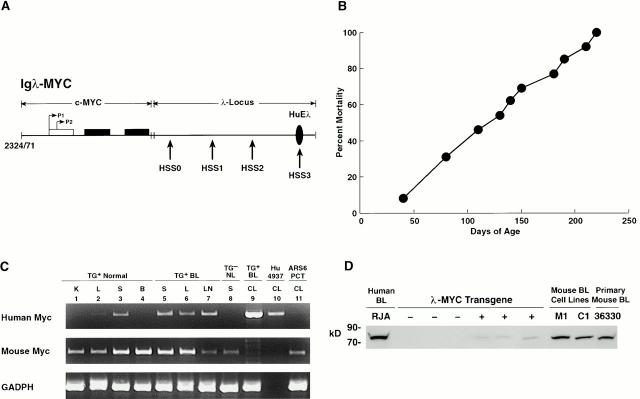
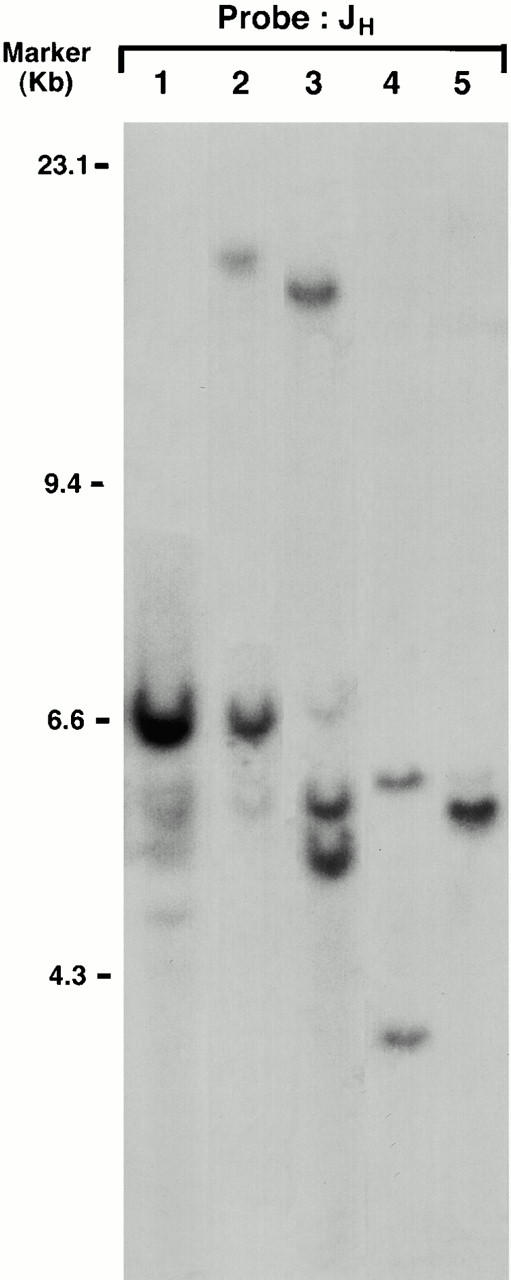
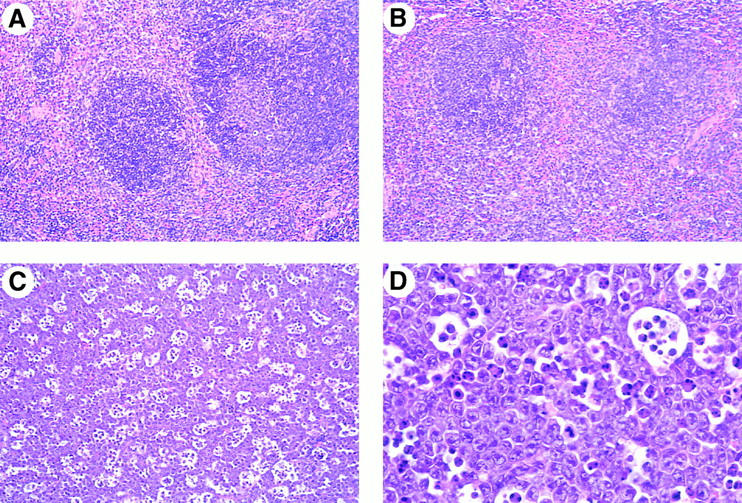
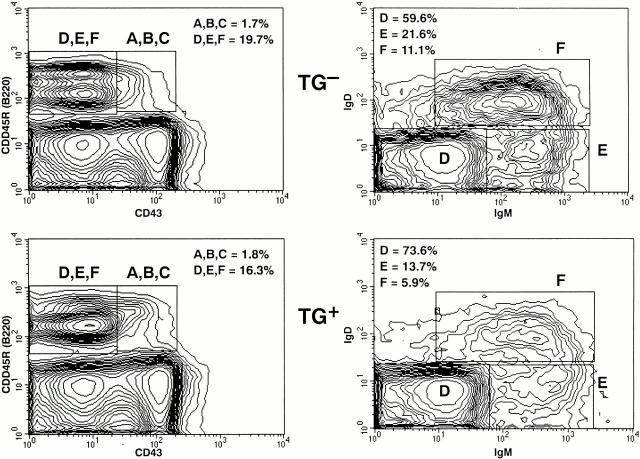
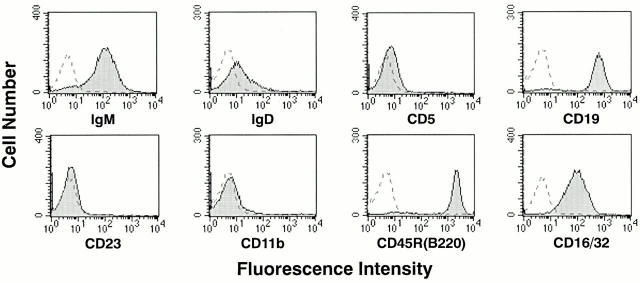
Chromosomal translocations juxtaposing the MYC protooncogene with regulatory sequences of immunoglobulin (Ig) H chain or kappa (Ig kappa) or lambda (Ig lambda) L chain genes and effecting deregulated expression of MYC are the hallmarks of human Burkitt lymphoma (BL). Here we report that lymphomas with striking similarities to BL develop in mice bearing a mutated human MYC gene controlled by a reconstructed Ig lambda locus encompassing all the elements required for establishment of locus control in vitro. Diffusely infiltrating lymphomas with a typical starry sky appearance occurred in multiple founders and an established line, indicating independence from positional effects. Monoclonal IgM(+)CD5(-)CD23(-) tumors developed from an initially polyclonal population of B cells. These results demonstrate that the phenotype of B lineage lymphomas induced by MYC dysregulation is highly dependent on cooperativity among the regulatory elements that govern expression of the protooncogene and provide a new system for studying the pathogenesis of BL.
染色体易位使MYC原癌基因与免疫球蛋白(Ig)重链或κ(Igκ)或λ(Igλ)轻链基因的调控序列并列,并导致MYC表达失调,这是人类伯基特淋巴瘤(BL)的标志。我们在此报告,在携带由重建的Igλ基因座控制的突变人类MYC基因的小鼠中,会发生与BL具有显著相似性的淋巴瘤,该Igλ基因座包含体外建立基因座控制所需的所有元件。多个奠基小鼠和一个已建立的品系中出现了具有典型星空外观的弥漫性浸润性淋巴瘤,表明其不受位置效应影响。单克隆IgM(+)CD5(-)CD23(-)肿瘤由最初的多克隆B细胞群体发展而来。这些结果表明,MYC失调诱导的B系淋巴瘤表型高度依赖于控制原癌基因表达的调控元件之间的协同作用,并为研究BL的发病机制提供了一个新系统。