Rajah J, Riera-Fanego J, Keeton J, Ramjee A, Bhana R, Lasersohn L, Hon H
University of the Witwatersrand, Johannesburg, South Africa.
Crit Care. 2000;4(5):314-8. doi: 10.1186/cc714. Epub 2000 Aug 21.
Classic laryngotrachoebronchitis (LTB) is an inflammatory process, with oedema and secretions that involve the entire laryngotracheobronchial tree. The severity of lower airway disease in African children with LTB has previously been documented. The aim of the present study was to determine whether steroids prevent reintubation in African children with classic LTB.
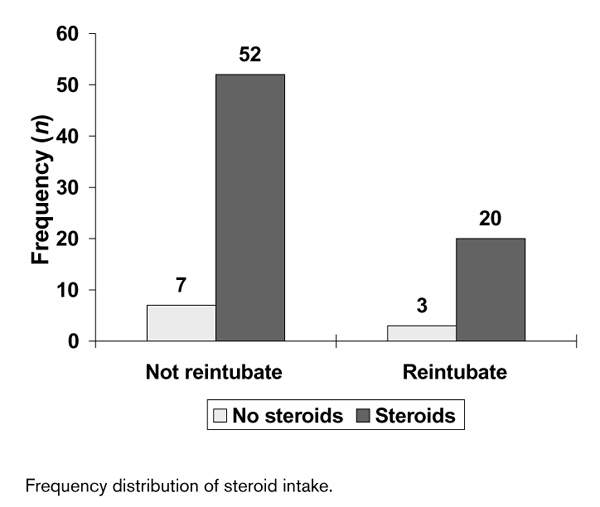
The study was a retrospective analysis from January 1993 to December 1996. Eighty-two black children with LTB were mechanically ventilated in the intensive care unit (ICU). By univariate regression, the estimated B coefficients for variables such as age, pneumonia, days of intubation, arterial partial oxygen tension (PaO2) : fractional inspired oxygen (FIO2) ratio, atelectasis and antibiotic use were not statistically significant (P > 0.05) as predictors for reintubation. Using multiple regression (all independent variables in combination), none of the variables acted as predictors of reintubation (P = 0.25). Steroids were shown to have no effect alone or in association with other variables in altering reintubation rates. An increase in the days of intubation showed a tendency towards reintubation (P = 0.06) in the univariate analysis (odds ratio 1.00-1.14), but showed no statistically significant difference in multivariate analysis. Of the variables used as predictors of reintubation, none acted either as a preventive factor or as a risk factor.
The present results suggest that steroids should not be recommended at any stage in treatment of intubated patients with classic LTB. Prospective studies should evaluate the major risk factors for reintubation: duration of intubation, trauma to the airway at intubation and during ICU stay, and dose and timing of steroids. They should also evaluate whether upper airway disease is present alone or in association with lower airway disease.
经典的喉气管支气管炎(LTB)是一种炎症过程,伴有水肿和分泌物,累及整个喉气管支气管树。先前已有文献记载非洲儿童LTB患者下呼吸道疾病的严重程度。本研究的目的是确定类固醇是否能预防非洲经典LTB儿童再次插管。
本研究是对1993年1月至1996年12月期间进行的回顾性分析。82名患有LTB的黑人儿童在重症监护病房(ICU)接受机械通气。通过单因素回归分析,年龄、肺炎、插管天数、动脉血氧分压(PaO2)与吸入氧分数(FIO2)的比值、肺不张和抗生素使用等变量作为再次插管预测指标的估计B系数无统计学意义(P>0.05)。采用多因素回归分析(所有自变量组合),没有一个变量可作为再次插管的预测指标(P=0.25)。结果显示,类固醇单独使用或与其他变量联合使用对改变再次插管率均无影响。在单因素分析中,插管天数增加显示出再次插管的趋势(P=0.06)(优势比为1.00 - 1.14),但在多因素分析中无统计学显著差异。在用作再次插管预测指标的变量中,没有一个可作为预防因素或危险因素。
目前的结果表明,在经典LTB插管患者治疗的任何阶段都不应推荐使用类固醇。前瞻性研究应评估再次插管的主要危险因素:插管持续时间、插管时及在ICU住院期间气道的创伤、类固醇的剂量和使用时机。还应评估上呼吸道疾病是单独存在还是与下呼吸道疾病并存。