Reiss M, Viebig N, Brecht S, Fourmaux M N, Soete M, Di Cristina M, Dubremetz J F, Soldati D
Center for Molecular Biology, University of Heidelberg, Heidelberg D-63120, Germany.
J Cell Biol. 2001 Feb 5;152(3):563-78. doi: 10.1083/jcb.152.3.563.
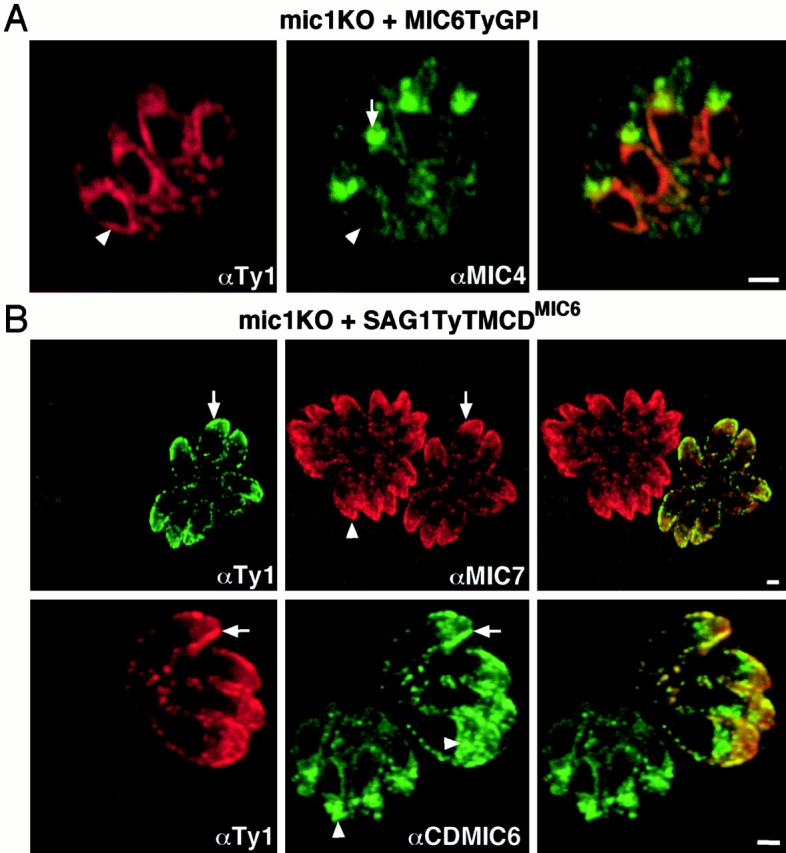
The intracellular protozoan parasite Toxoplasma gondii shares with other members of the Apicomplexa a common set of apical structures involved in host cell invasion. Micronemes are apical secretory organelles releasing their contents upon contact with host cells. We have identified a transmembrane micronemal protein MIC6, which functions as an escorter for the accurate targeting of two soluble proteins MIC1 and MIC4 to the micronemes. Disruption of MIC1, MIC4, and MIC6 genes allowed us to precisely dissect their contribution in sorting processes. We have mapped domains on these proteins that determine complex formation and targeting to the organelle. MIC6 carries a sorting signal(s) in its cytoplasmic tail whereas its association with MIC1 involves a lumenal EGF-like domain. MIC4 binds directly to MIC1 and behaves as a passive cargo molecule. In contrast, MIC1 is linked to a quality control system and is absolutely required for the complex to leave the early compartments of the secretory pathway. MIC1 and MIC4 bind to host cells, and the existence of such a complex provides a plausible mechanism explaining how soluble adhesins act. We hypothesize that during invasion, MIC6 along with adhesins establishes a bridge between the host cell and the parasite.
细胞内原生动物寄生虫刚地弓形虫与顶复门的其他成员一样,具有一组共同的参与宿主细胞入侵的顶端结构。微线体是顶端分泌细胞器,在与宿主细胞接触时释放其内容物。我们鉴定出一种跨膜微线体蛋白MIC6,它作为一种护送蛋白,可将两种可溶性蛋白MIC1和MIC4准确靶向到微线体。MIC1、MIC4和MIC6基因的破坏使我们能够精确剖析它们在分选过程中的作用。我们已经在这些蛋白质上定位了决定复合物形成和靶向到细胞器的结构域。MIC6在其细胞质尾部带有一个分选信号,而它与MIC1的结合涉及一个腔内表皮生长因子样结构域。MIC4直接与MIC1结合,表现为一个被动的货物分子。相比之下,MIC1与一个质量控制系统相连,并且是复合物离开分泌途径早期区室所绝对必需的。MIC1和MIC4与宿主细胞结合,这种复合物的存在为解释可溶性黏附素如何发挥作用提供了一个合理的机制。我们假设在入侵过程中,MIC6与黏附素一起在宿主细胞和寄生虫之间建立一座桥梁。