Weiskirchen R, Kneifel J, Weiskirchen S, van de Leur E, Kunz D, Gressner A M
Institute of Clinical Chemistry and Pathobiochemistry, Central Laboratory, RWTH-University Hospital, Aachen, Germany.
BMC Cell Biol. 2000;1:4. doi: 10.1186/1471-2121-1-4. Epub 2000 Dec 19.
The hepatic stellate cell is the primary cell type responsible for the excessive formation and deposition of connective tissue elements during the development of hepatic fibrosis in chronically injured liver. Culturing quiescent hepatic stellate cells on plastic causes spontaneous activation leading to a myofibroblastic phenotype similar to that seen in vivo. This provides a simple model system for studying activation and transdifferentiation of these cells. The introduction of exogenous DNA into these cells is discussed controversially mainly due to the lack of systematic analysis. Therefore, we examined comparatively five nonviral, lipid-mediated gene transfer methods and adenoviral based infection, as potential tools for efficient delivery of DNA to rat hepatic stellate cells and their transdifferentiated counterpart, i.e. myofibroblasts. Transfection conditions were determined using enhanced green fluorescent protein as a reporter expressed under the transcriptional control of the human cytomegalovirus immediate early gene 1 promoter/enhancer.
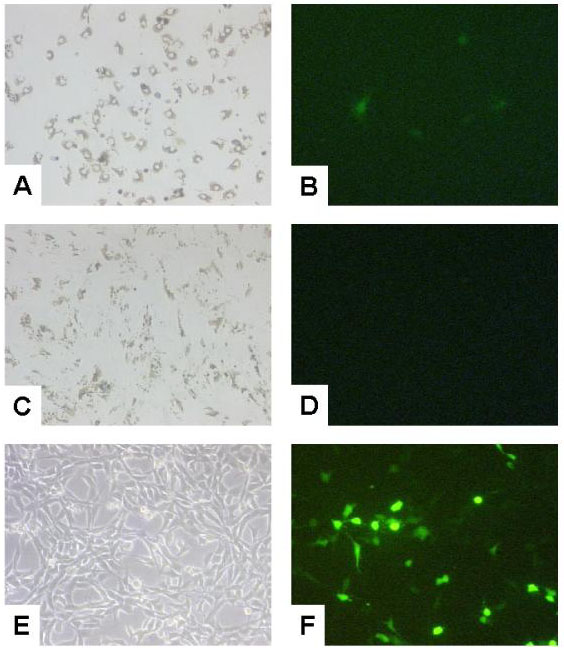
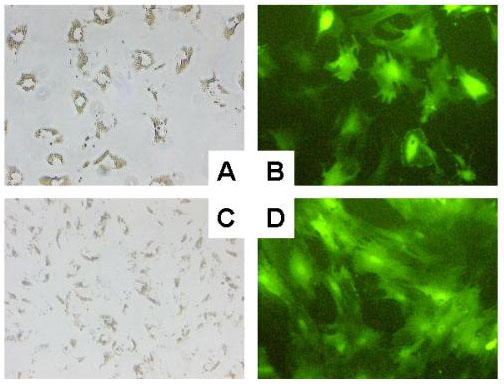
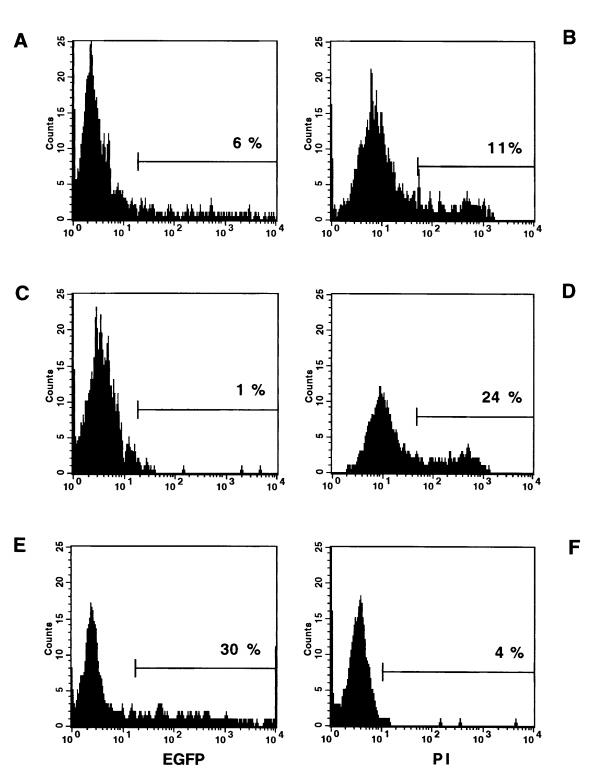
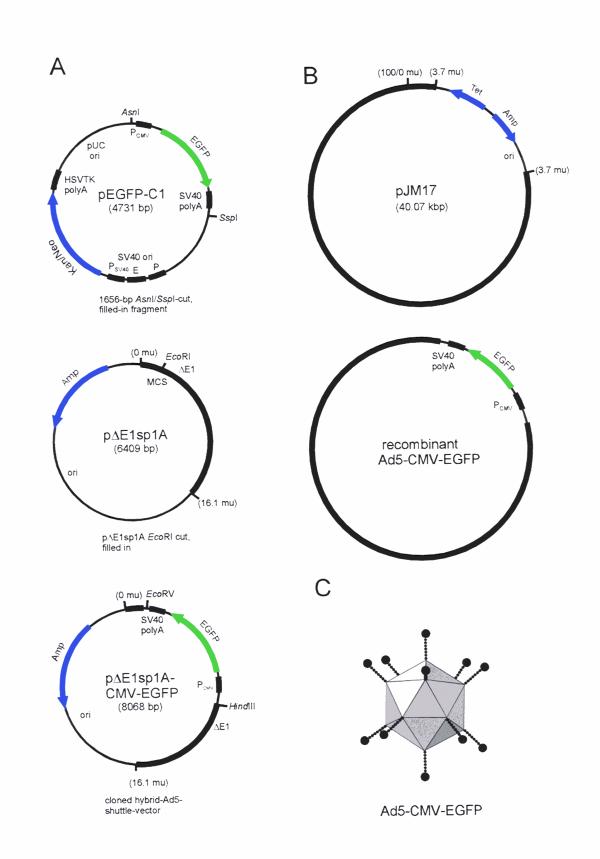
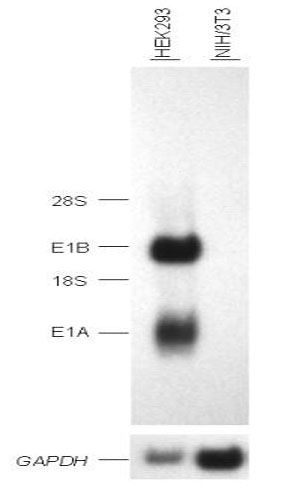
With the use of chemically enhanced transfection methods, the highest relative efficiency was obtained with FuGENE6 gene mediated DNA transfer. Quantitative evaluation of representative transfection experiments by flow cytometry revealed that approximately 6% of the rat hepatic stellate cells were transfected. None of the transfection methods tested was able to mediate gene delivery to rat myofibroblasts. To analyze if rat hepatic stellate cells and myofibroblasts are susceptible to adenoviral infection, we have inserted the transgenic expression cassette into a recombinant adenoviral type 5 genome as replacement for the E1 region. Viral particles of this replication-deficient Ad5-based reporter are able to infect 100% of rat hepatic stellate cells and myofibroblasts, respectively.
Our results indicate that FuGENE6-based methods may be optimized sufficiently to offer a feasible approach for gene transfer into rat hepatic stellate cells. The data further demonstrate that adenoviral mediated transfer is a promising approach for gene delivery to these hepatic cells.
肝星状细胞是慢性损伤肝脏发生肝纤维化过程中,负责结缔组织成分过度形成和沉积的主要细胞类型。在塑料培养皿上培养静止的肝星状细胞会导致其自发激活,从而产生类似于体内所见的肌成纤维细胞表型。这为研究这些细胞的激活和转分化提供了一个简单的模型系统。将外源DNA导入这些细胞存在争议,主要原因是缺乏系统分析。因此,我们比较研究了五种非病毒脂质介导的基因转移方法以及基于腺病毒的感染方法,作为将DNA有效递送至大鼠肝星状细胞及其转分化对应细胞(即肌成纤维细胞)的潜在工具。使用在人巨细胞病毒立即早期基因1启动子/增强子转录控制下表达的增强型绿色荧光蛋白作为报告基因来确定转染条件。
使用化学增强转染方法时,FuGENE6基因介导的DNA转移获得了最高的相对效率。通过流式细胞术对代表性转染实验进行定量评估发现,约6%的大鼠肝星状细胞被转染。所测试的转染方法均无法介导基因递送至大鼠肌成纤维细胞。为了分析大鼠肝星状细胞和肌成纤维细胞是否易受腺病毒感染,我们已将转基因表达盒插入重组5型腺病毒基因组中以取代E1区。这种基于复制缺陷型Ad5的报告病毒颗粒能够分别感染100%的大鼠肝星状细胞和肌成纤维细胞。
我们的结果表明,基于FuGENE6的方法可能经过充分优化,可为将基因导入大鼠肝星状细胞提供一种可行的方法。数据进一步证明,腺病毒介导的转移是一种有前景的向这些肝细胞递送基因的方法。