Jones S, Sgouros J
Computational Genome Analysis Laboratory, Imperial Cancer Research Fund, 44 Lincoln's Inn Fields, London, WC2A 3PX, UK.
Genome Biol. 2001;2(3):RESEARCH0009. doi: 10.1186/gb-2001-2-3-research0009. Epub 2001 Mar 6.
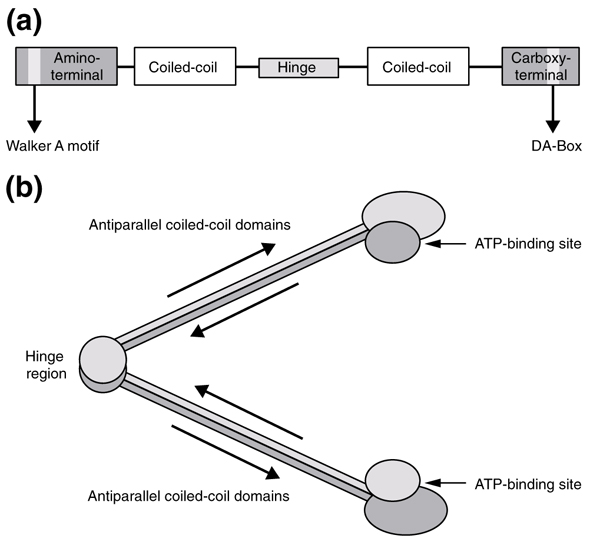
Cohesin is a macromolecular complex that links sister chromatids together at the metaphase plate during mitosis. The links are formed during DNA replication and destroyed during the metaphase-to-anaphase transition. In budding yeast, the 14S cohesin complex comprises at least two classes of SMC (structural maintenance of chromosomes) proteins - Smc1 and Smc3 - and two SCC (sister-chromatid cohesion) proteins - Scc1 and Scc3. The exact function of these proteins is unknown.
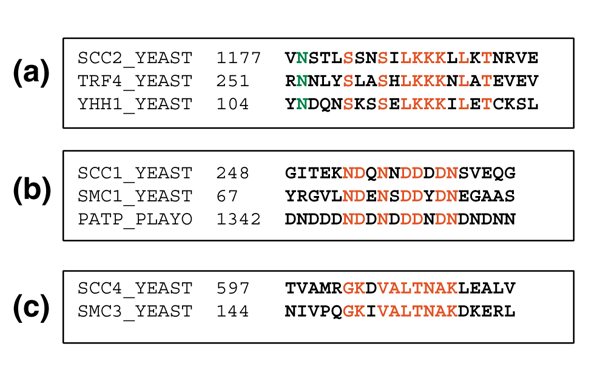
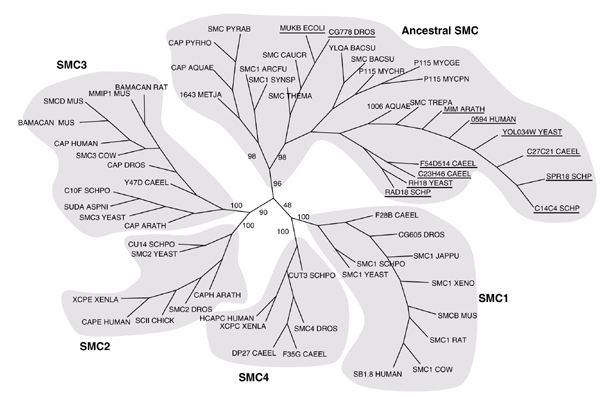
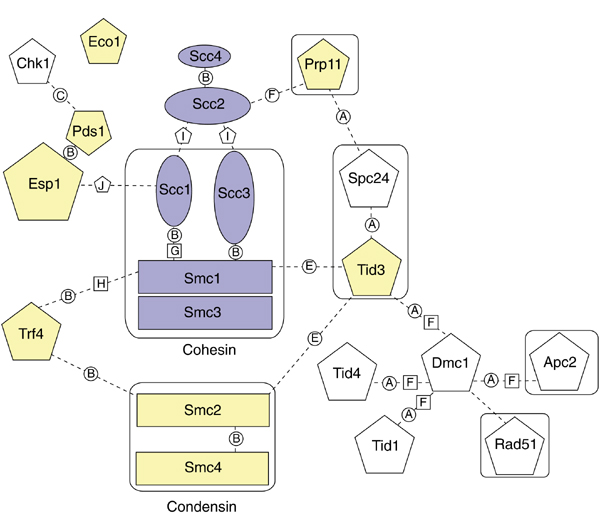
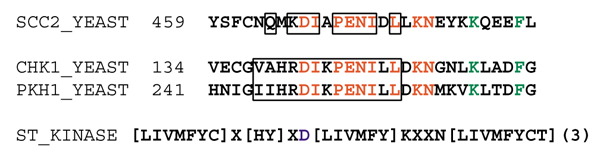
Searches of protein sequence databases have revealed new homologs of cohesin proteins. In mouse, Mmip1 (Mad member interacting protein 1) and Smc3 share 99% sequence identity and are products of the same gene. A phylogenetic tree of SMC homologs reveals five families: Smc1, Smc2, Smc3, Smc4 and an ancestral family that includes the sequences from the Archaea and Eubacteria. This ancestral family also includes sequences from eukaryotes. A cohesion interaction network, comprising 17 proteins, has been constructed using two proteomic databases. Genes encoding six proteins in the cohesion network share a common upstream region that includes the MluI cell-cycle box (MCB) element. Pairs of the proteins in this network share common sequence motifs that could represent common structural features such as binding sites. Scc2 shares a motif with Chk1 (kinase checkpoint protein), that comprises part of the serine/threonine protein kinase motif, including the active-site residue.
We have combined genomic and proteomic data into a comprehensive network of information to reach a better understanding of the function of the cohesin complex. We have identified new SMC homologs, created a new SMC phylogeny and identified shared DNA and protein motifs. The potential for Scc2 to function as a kinase - a hypothesis that needs to be verified experimentally - could provide further evidence for the regulation of sister-chromatid cohesion by phosphorylation mechanisms, which are currently poorly understood.
黏连蛋白是一种大分子复合物,在有丝分裂期间于中期板处将姐妹染色单体连接在一起。这些连接在DNA复制过程中形成,并在中期到后期的转变过程中被破坏。在芽殖酵母中,14S黏连蛋白复合物至少包含两类SMC(染色体结构维持)蛋白——Smc1和Smc3,以及两类SCC(姐妹染色单体黏连)蛋白——Scc1和Scc3。这些蛋白质的确切功能尚不清楚。
对蛋白质序列数据库的搜索揭示了黏连蛋白的新同源物。在小鼠中,Mmip1(Mad成员相互作用蛋白1)和Smc3的序列同一性为99%,是同一基因的产物。SMC同源物的系统发育树揭示了五个家族:Smc1、Smc2、Smc3、Smc4以及一个包括古细菌和真细菌序列的祖先家族。这个祖先家族也包括真核生物的序列。利用两个蛋白质组数据库构建了一个由17种蛋白质组成的黏连相互作用网络。黏连网络中编码六种蛋白质的基因共享一个包含MluI细胞周期框(MCB)元件的共同上游区域。该网络中的蛋白质对共享可能代表共同结构特征(如结合位点)的共同序列基序。Scc2与Chk1(激酶检查点蛋白)共享一个基序,该基序包含丝氨酸/苏氨酸蛋白激酶基序的一部分,包括活性位点残基。
我们将基因组和蛋白质组数据整合到一个全面的信息网络中,以更好地理解黏连蛋白复合物的功能。我们鉴定了新的SMC同源物,创建了新的SMC系统发育,并鉴定了共享的DNA和蛋白质基序。Scc2作为激酶发挥作用的可能性——这一假设需要通过实验验证——可能为目前了解甚少的通过磷酸化机制调节姐妹染色单体黏连提供进一步证据。