Gerrard J M, Kindom S E, Peterson D A, Peller J, Krantz K E, White J G
Am J Pathol. 1979 Aug;96(2):423-38.
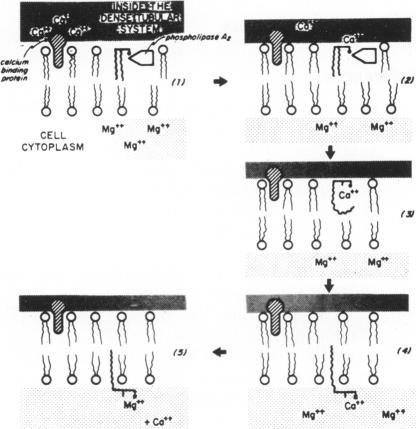
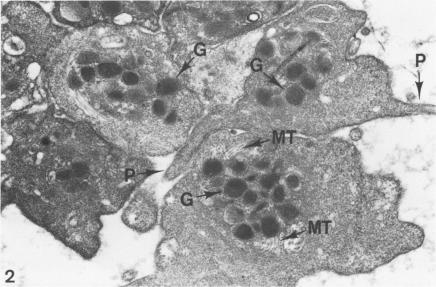
Decanoyl-, palmitoyl-, and oleoyl-lysophosphatidic acid (LPA) were studied for their effects on platelet aggregation and intracellular calcium flux. Palmitoyl-LPA and oleoyl-LPA both caused a concentration-dependent aggregation of human blood platelets at concentrations of 12--300 microM. Aggregation by adenosine diphosphate (ADP) was enhanced at slightly lower concentrations. First-wave aggregation induced by these LPAs was not blocked by aspirin, indomethacin, or heparin, suggesting similarities to ADP aggregation. However, in washed platelets with a high calcium concentration, no serotonin secretion was observed, even though full aggregation occurred, suggesting that aggregation was not due to released ADP. This concept was supported by studies of platelets deficient in the storage pool of ADP and serotonin, which had a normal first-wave aggregation response to palmitoyl-LPA. Aggregation induced by palmitoyl LPA was inhibited by prostaglandin E1 (PGE1), theophylline, and ethylenediaminotetraacetate (EDTA), though in the presence of EDTA shape change occurred. Aggregation stimulated by palmitoyl-LPA or oleoyl-LPA was characterized by changes in the shape of the platelets with development of pseudopods and centralization of granules closely surrounded by contractile microfilaments and supporting microtubules. The addition of palmitoyl-LPA and oleoyl-LPA, but not decanoyl-LPA, caused the release of calcium from a platelet membrane fraction that contains elements of the intracellular calcium storage system and actively concentrates this cation in the presence of adenosine triphosphate (ATP) and magnesium. It is suggested that LPAs cause aggregation by stimulating the release of calcium intracellularly.
研究了癸酰基、棕榈酰基和油酰基溶血磷脂酸(LPA)对血小板聚集和细胞内钙通量的影响。棕榈酰-LPA和油酰-LPA在12 - 300微摩尔浓度下均引起人血小板浓度依赖性聚集。二磷酸腺苷(ADP)诱导的聚集在稍低浓度时增强。这些LPA诱导的第一波聚集不受阿司匹林、吲哚美辛或肝素的阻断,提示与ADP聚集相似。然而,在高钙浓度的洗涤血小板中,即使发生完全聚集也未观察到5-羟色胺分泌,提示聚集不是由于释放的ADP所致。对缺乏ADP和5-羟色胺储存池的血小板的研究支持了这一概念,这些血小板对棕榈酰-LPA有正常的第一波聚集反应。棕榈酰LPA诱导的聚集受前列腺素E1(PGE1)、茶碱和乙二胺四乙酸(EDTA)抑制,不过在EDTA存在下会发生形态改变。棕榈酰-LPA或油酰-LPA刺激的聚集特征是血小板形态改变,出现伪足,颗粒集中,周围紧密围绕着收缩微丝和支持微管。添加棕榈酰-LPA和油酰-LPA而非癸酰-LPA会导致从含有细胞内钙储存系统成分的血小板膜组分中释放钙,并且在三磷酸腺苷(ATP)和镁存在下能主动浓缩这种阳离子。提示LPA通过刺激细胞内钙释放而导致聚集。