Kulys J, Ziemys A
Department of Enzyme Chemistry, Institute of Biochemistry, Mokslininku 12, Vilnius, 2600, Lithuania.
BMC Struct Biol. 2001;1:3. doi: 10.1186/1472-6807-1-3. Epub 2001 Aug 28.
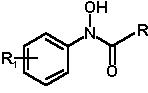
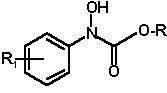
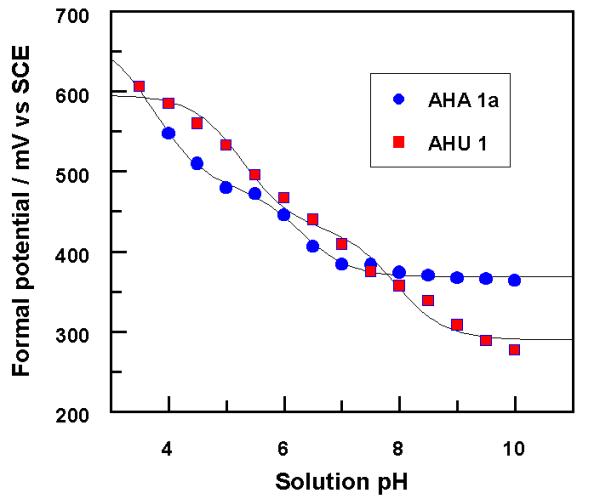
Previous kinetic investigations of fungal-peroxidase catalyzed oxidation of N-aryl hydroxamic acids (AHAs) and N-aryl-N-hydroxy urethanes (AHUs) revealed that the rate of reaction was independent of the formal redox potential of substrates. Moreover, the oxidation rate was 3-5 orders of magnitude less than for oxidation of physiological phenol substrates, though the redox potential was similar.
To explain the unexpectedly low reactivity of AHAs and AHUs we made ab initio calculations of the molecular structure of the substrates following in silico docking in the active center of the enzyme.
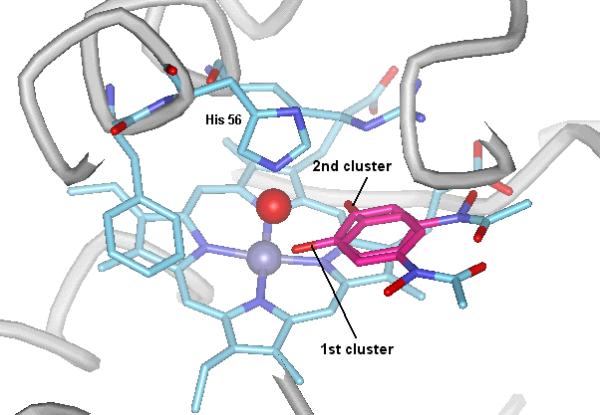
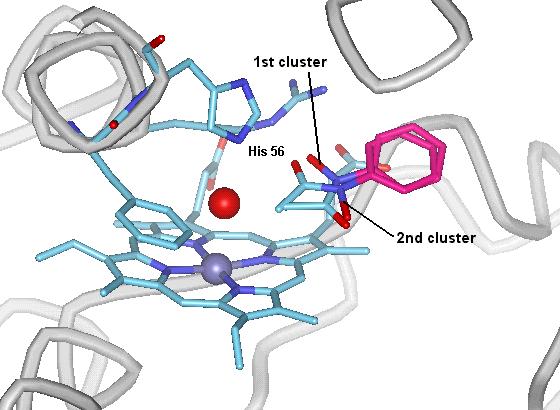
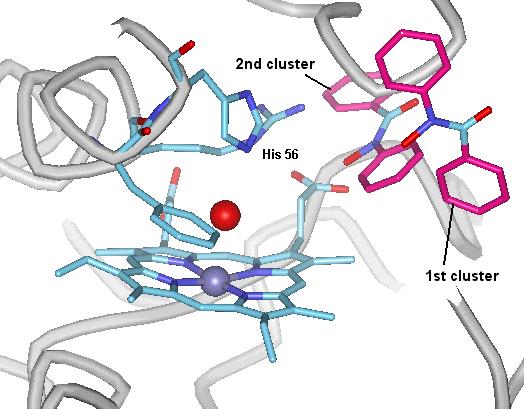
AHAs and AHUs were docked at the distal side of heme in the sites formed by hydrophobic amino acid residues that retarded a proton transfer and finally the oxidation rate. The analogous phenol substrates were docked at different sites permitting fast proton transfer in the relay of distal His and water that helped fast substrate oxidation.
先前对真菌过氧化物酶催化氧化N - 芳基异羟肟酸(AHAs)和N - 芳基 - N - 羟基脲(AHUs)的动力学研究表明,反应速率与底物的形式氧化还原电位无关。此外,尽管氧化还原电位相似,但氧化速率比生理酚类底物的氧化速率低3 - 5个数量级。
为了解释AHAs和AHUs出人意料的低反应活性,我们在酶的活性中心进行计算机对接后,对底物的分子结构进行了从头计算。
AHAs和AHUs对接在血红素的远端,位于由疏水氨基酸残基形成的位点,这些位点阻碍了质子转移,最终降低了氧化速率。类似的酚类底物对接在不同的位点,允许在远端组氨酸和水的传递中快速质子转移,这有助于底物的快速氧化。