Mahall B E, Callaway R M
Department of Biological Sciences, University of California, Santa Barbara, CA 93106, USA.
Proc Natl Acad Sci U S A. 1991 Feb 1;88(3):874-6. doi: 10.1073/pnas.88.3.874.
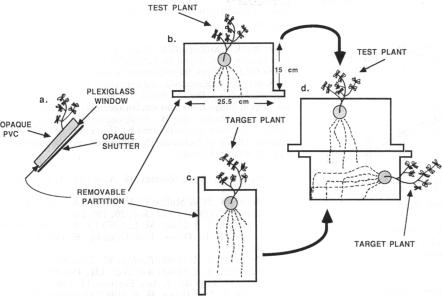
Descriptive and experimental studies of desert shrub distributions have revealed important questions about the mechanisms by which plants interact. For example, do roots interact by mechanisms other than simple competition for limiting resources? We investigated this question using the desert shrubs Ambrosia dumosa and Larrea tridentata grown in chambers that allowed observation of roots during intraplant and intra- and interspecific interplant encounters. Two types of root "communication" were revealed. Ambrosia root systems appear to be capable of detecting and avoiding other Ambrosia root systems, whereas Larrea roots inhibit Larrea and Ambrosia roots in their vicinity.
对沙漠灌木分布的描述性和实验性研究揭示了有关植物相互作用机制的重要问题。例如,根系是否通过除简单竞争有限资源之外的机制相互作用?我们使用生长在室内的沙漠灌木多毛豚草和三齿拉瑞阿来研究这个问题,在室内可以观察植物内部以及种内和种间植株相遇时的根系。揭示了两种类型的根系“交流”。多毛豚草的根系似乎能够检测并避开其他多毛豚草的根系,而三齿拉瑞阿的根系会抑制其附近的三齿拉瑞阿和多毛豚草的根系。