Thiagarajah Jay R, Griffiths Nina M, Pedley Kevin C, Naftalin Richard J
Division of Physiology, School of Biomedical Sciences, King's College London, Guys Campus, London, UK.
BMC Gastroenterol. 2002;2:4. doi: 10.1186/1471-230x-2-4. Epub 2002 Feb 12.
Absorption of water and Na+ in descending colonic crypts is dependent on the barrier function of the surrounding myofibroblastic pericryptal sheath. Here the effects of high and low Na+ diets and exposure to whole body ionising radiation on the growth and activation of the descending colonic pericryptal myofibroblasts are evaluated. In addition the effect of a post-irradiation treatment with the angiotensin converting enzyme inhibitor Captopril was investigated.
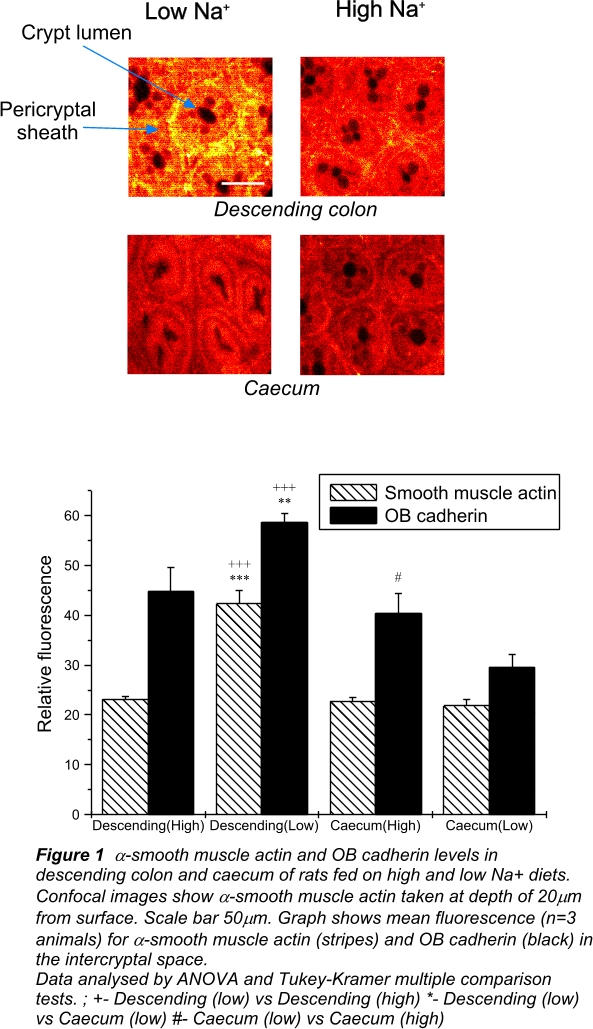
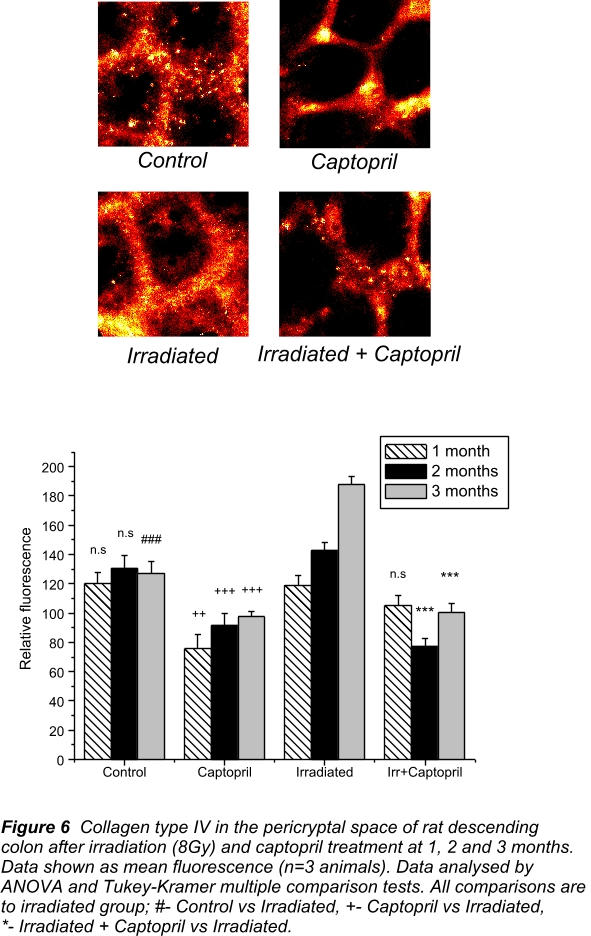
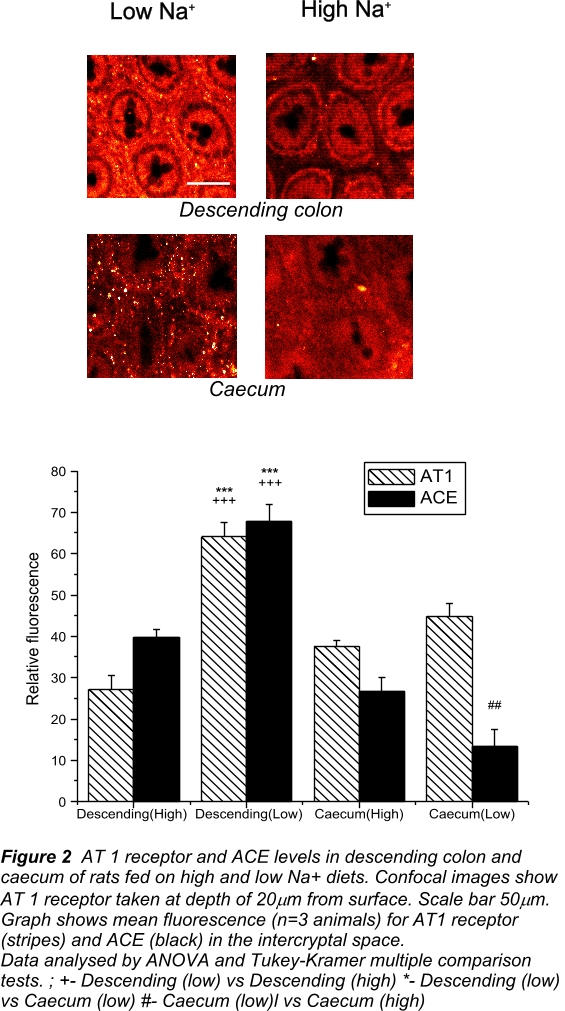
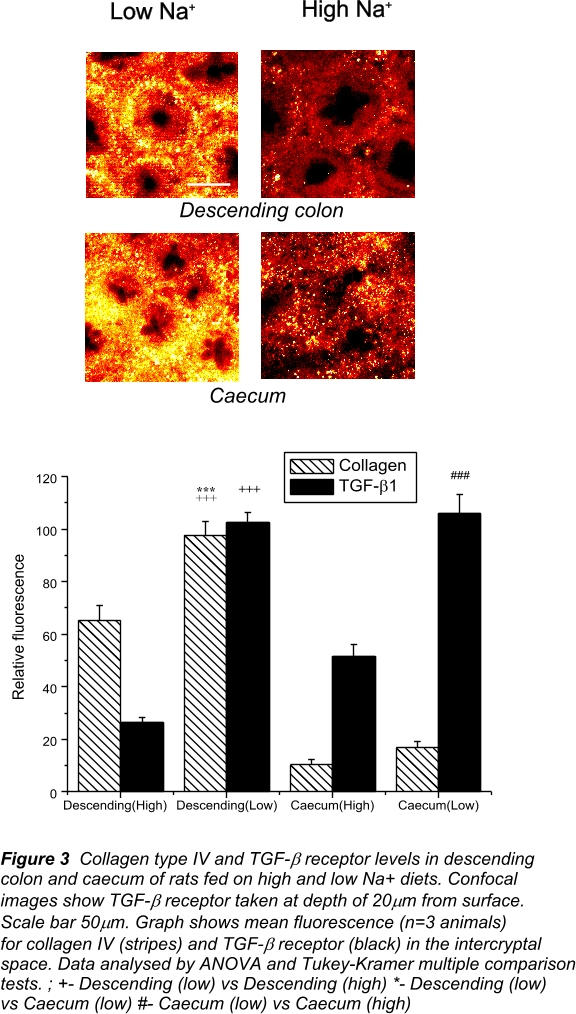
The levels of Angiotensin II type 1 receptor (AT1), ACE, collagen type IV, transforming growth factor-beta type 1 receptor (TGF-betaR1), OB cadherin and alpha-smooth muscle actin in both descending colon and caecum were evaluated, using immunocytochemistry and confocal microscopy, in rats fed on high and low Na+ diets (LS). These parameters were also determined during 3 months post-irradiation with 8Gy from a 60Co source in the presence and absence of the angiotensin converting enzyme inhibitor, Captopril.
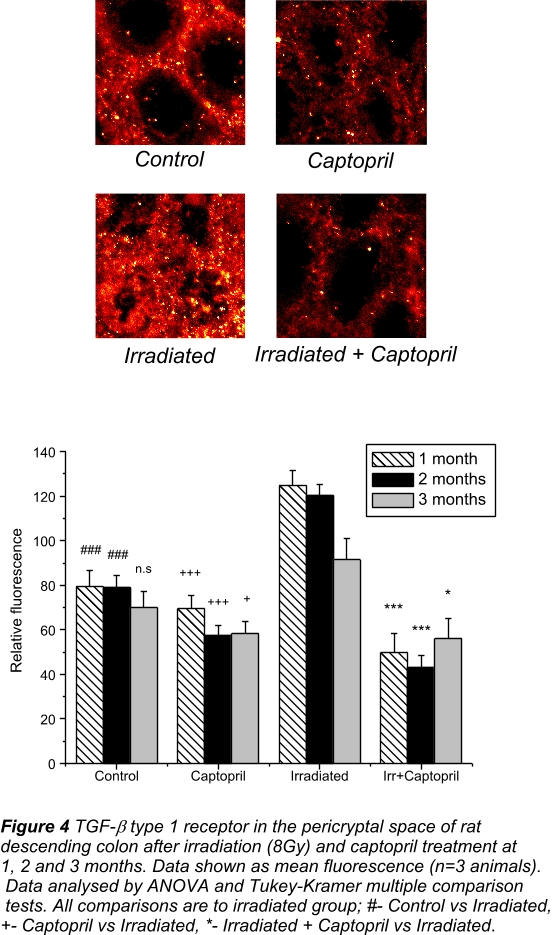
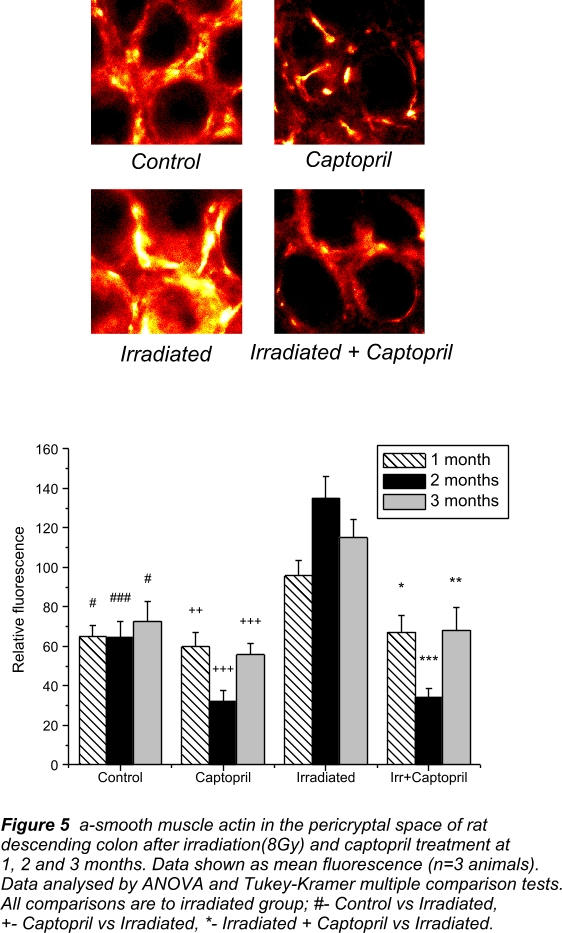
Increases in AT1 receptor (135.6% +/- 18.3, P < 0.001); ACE (70.1% +/- 13.1, P < 0.001); collagen type IV (49.6% +/- 15.3, P < 0.001); TGF-+/-beta1 receptors (291.0% +/- 26.5, P < 0.001); OB-cadherin (26.3% +/- 13.8, P < 0.05) and alpha-smooth muscle actin (82.5% +/- 12.4, P < 0.001) were observed in the pericryptal myofibroblasts of the descending colon after LS diet. There are also increases in AT1 receptor and TGF-beta1 receptor, smooth muscle actin and collagen type IV after irradiation. Captopril reduced all these effects of irradiation on the pericryptal sheath and also decreased the amount of collagen and smooth muscle actin in control rats (P < 0.001).
These results demonstrate an activation of descending colonic myofibroblasts to trophic stimuli, or irradiation, which can be attenuated by Captopril, indicative of local trophic control by angiotensin II and TGF-beta release.
降结肠隐窝对水和钠离子的吸收依赖于周围肌成纤维细胞性隐窝周鞘的屏障功能。本文评估了高钠和低钠饮食以及全身电离辐射对降结肠隐窝周肌成纤维细胞生长和激活的影响。此外,还研究了用血管紧张素转换酶抑制剂卡托普利进行辐照后治疗的效果。
使用免疫细胞化学和共聚焦显微镜,评估高钠和低钠饮食(LS)喂养的大鼠降结肠和盲肠中血管紧张素II 1型受体(AT1)、血管紧张素转换酶(ACE)、IV型胶原、转化生长因子-β1型受体(TGF-βR1)、OB钙黏蛋白和α-平滑肌肌动蛋白的水平。在60Co源8Gy辐照后的3个月内,在有和没有血管紧张素转换酶抑制剂卡托普利的情况下,也测定了这些参数。
在LS饮食后,降结肠隐窝周肌成纤维细胞中AT1受体(135.6%±18.3,P<0.001)、ACE(70.1%±13.1,P<0.001)、IV型胶原(49.6%±15.3,P<0.001)、TGF-β1受体(291.0%±26.5,P<0.001)、OB钙黏蛋白(26.3%±13.8,P<0.05)和α-平滑肌肌动蛋白(82.5%±12.4,P<0.001)水平升高。辐照后AT1受体、TGF-β1受体、平滑肌肌动蛋白和IV型胶原也增加。卡托普利减轻了辐照对隐窝周鞘的所有这些影响,并且还降低了对照大鼠中胶原和平滑肌肌动蛋白的量(P<0.00可替换为<P<0.001)。
这些结果表明降结肠肌成纤维细胞对营养刺激或辐照有激活作用,而卡托普利可减弱这种作用,这表明血管紧张素II和TGF-β释放存在局部营养控制。