Seo Bo Kyoung, Oh Yu Whan, Kim Hyung Rae, Kim Hong Weon, Kang Chang Ho, Lee Nam Joon, Kim Jung Hyuk, Park Bum Jin, Cho Kyu Ran, Lee June Young, Lee Ki Yeoul, Bae Jeoung Won
Department of Diagnostic Radiology, Korea University Anam Hospital, 126-1 Anam-dong 5-ga, Sungbuk-gu, Seoul 136-705, Korea.
Korean J Radiol. 2002 Jan-Mar;3(1):38-44. doi: 10.3348/kjr.2002.3.1.38.
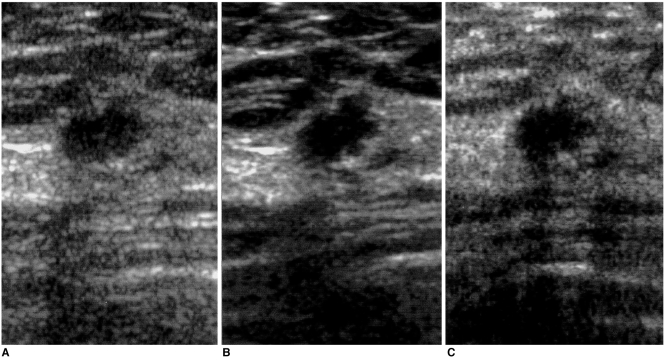
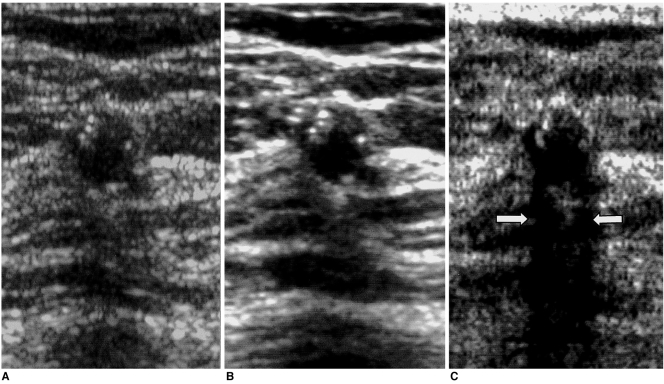
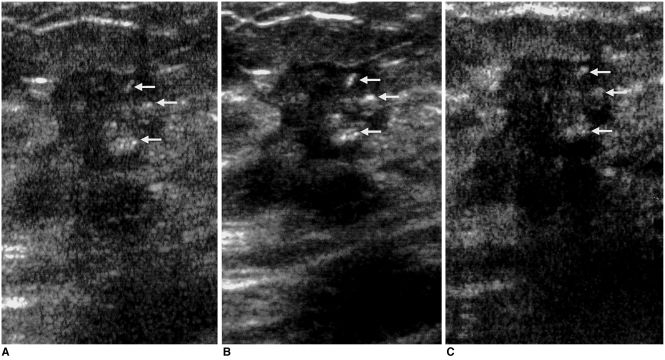
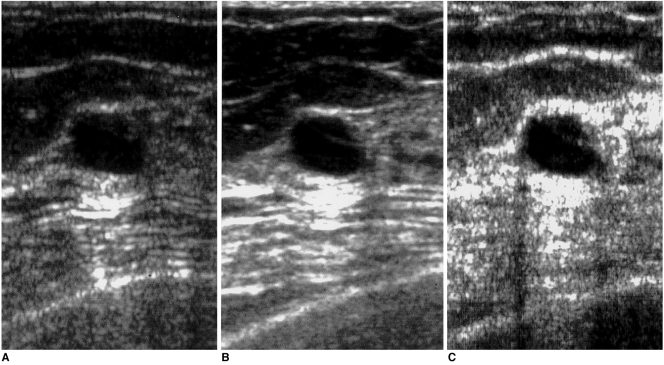
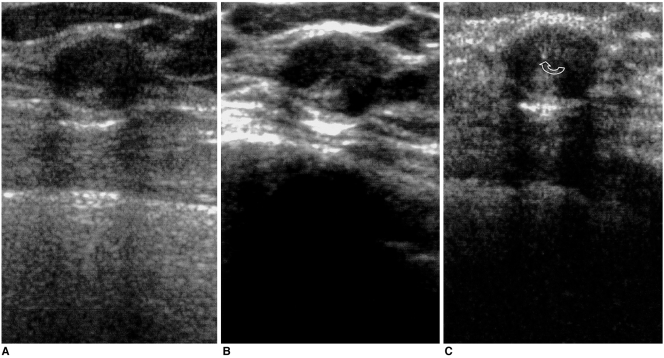
To compare the use of conventional, real-time compound, and pulse-inversion harmonic imaging in the evaluation of breast nodules.
Fifty-two breast nodules were included in this study, conducted between May and December 2000, in which conventional, real-time compound, and pulse-inversion harmonic images were obtained in the same plane. Three radiologists, each blinded to the interpretations of the other two, evaluated the findings, characterizing the lesions and ranking the three techniques from grade 1, the worst, to grade 3, the best. Lesion conspicuity was assessed, and lesions were also characterized in terms of their margin, clarity of internal echotexture, and clarity of posterior echo pattern. The three techniques were compared using Friedman's test, and interobserver agreement in image interpretation was assessed by means of the intraclass correlation coefficient.
With regard to lesion conspicuity, margin, and internal echotexture of the nodules, real-time compound imaging was the best technique (p < 0.05); in terms of posterior echo pattern, the best was pulse-inversion harmonic imaging (p < 0.05). Real-time compound and pulse inversion harmonic imaging were better than conventional sonography in all evaluative aspects. Interobserver agreement was greater than moderate.
Real-time compound and pulse-inversion harmonic imaging procedures are superior to conventional sonography in terms of both lesion conspicuity and the further characterization of breast nodules. Real-time compound imaging is the best technique for evaluation of the margin and internal echotexture of nodules, while pulse-inversion harmonic imaging is very effective for the evaluation of the posterior echo patterns.
比较传统成像、实时复合成像和脉冲反转谐波成像在乳腺结节评估中的应用。
本研究纳入了52个乳腺结节,研究于2000年5月至12月进行,在同一平面获取传统成像、实时复合成像和脉冲反转谐波图像。三名放射科医生分别对其他两人的解读不知情,对检查结果进行评估,对病变进行特征描述,并将这三种技术从最差的1级到最好的3级进行排序。评估病变的清晰度,还从病变边缘、内部回声纹理清晰度和后方回声模式清晰度方面对病变进行特征描述。使用Friedman检验比较这三种技术,并通过组内相关系数评估观察者间在图像解读方面的一致性。
在结节的病变清晰度、边缘和内部回声纹理方面,实时复合成像为最佳技术(p<0.05);在后方回声模式方面,最佳的是脉冲反转谐波成像(p<0.05)。在所有评估方面,实时复合成像和脉冲反转谐波成像均优于传统超声检查。观察者间的一致性大于中等程度。
在病变清晰度和乳腺结节的进一步特征描述方面,实时复合成像和脉冲反转谐波成像程序优于传统超声检查。实时复合成像是评估结节边缘和内部回声纹理的最佳技术,而脉冲反转谐波成像在评估后方回声模式方面非常有效。