Magné N, Fischel J L, Dubreuil A, Formento P, Poupon M-F, Laurent-Puig P, Milano G
Department of Oncopharmacology, Centre Antoine Lacassagne, 33 Avenue de Valombrose, 06189 Nice Cedex 2, France.
Br J Cancer. 2002 May 6;86(9):1518-23. doi: 10.1038/sj.bjc.6600299.
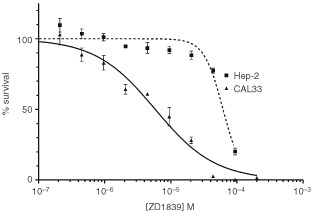
of ZD1839 ("Iressa") is an orally active, selective epidermal growth factor receptor-tyrosine kinase inhibitor (EGFR-TKI), which blocks signal transduction pathways implicated in proliferation and survival of cancer cells, and other host-dependent processes promoting cancer growth. Permanent downstream activation of the mitogen-activated protein kinase pathway can theoretically bypass the upstream block of epidermal growth factor receptor-dependent mitogen-activated protein kinase activation at the epidermal growth factor receptor level. We investigated the impact of epidermal growth factor receptor content, p53 status and mitogen-activated protein kinase signalling status on ZD1839 sensitivity in a panel of human tumour cell lines: seven head and neck cancer cell lines and two colon cancer cell lines (LoVo, HT29) with derivatives differing only by a specific modification in p53 status (LoVo p53 wt + p53 mut cells, HT29 p53 mut + p53 wt rescued cells). The antiproliferative activity of ZD1839 was evaluated by the 3-(4,5-dimethylthiazol-2-yl)-2,5-diphenyl tetrazolium bromide test. ZD1839 concentrations ranged from 0.2-200 microM (48 h exposure). Epidermal growth factor receptor expression, p53 status and p42/p44 (for testing a constitutively active mitogen-activated protein kinase pathway status) were determined by competition analysis (Scatchard plots), denaturing gradient cell electrophoresis and Western blot, respectively. Epidermal growth factor receptor levels ranged from 388 to 33794 fmol mg(-1) protein, a range that is similar to that found in head and neck tumours. The IC(50) values for cell sensitivity to ZD1839 ranged from 6 to 31 microM and a significant inverse correlation (P=0.022, r=0.82) between IC(50) values and epidermal growth factor receptor levels was observed. There was no influence of p53 status on the sensitivity to ZD1839. In two head and neck cancer cell lines with comparably elevated epidermal growth factor receptor expression, a two-fold higher ZD1839 IC(50) value was found for the one with a constitutively active mitogen-activated protein kinase. In conclusion, ZD1839 was active against cells with a range of epidermal growth factor receptor levels, although more so in cells with higher epidermal growth factor receptor expression. Activity was unaffected by p53 status, but was reduced in cells strongly dependent on epidermal growth factor receptor signalling in the presence of an intrinsically activated mitogen-activated protein kinase pathway.
ZD1839(“易瑞沙”)是一种口服活性的选择性表皮生长因子受体 - 酪氨酸激酶抑制剂(EGFR - TKI),它可阻断与癌细胞增殖和存活以及促进癌症生长的其他宿主依赖性过程相关的信号转导途径。丝裂原活化蛋白激酶途径的永久性下游激活理论上可以绕过表皮生长因子受体水平上表皮生长因子受体依赖性丝裂原活化蛋白激酶激活的上游阻断。我们在一组人类肿瘤细胞系中研究了表皮生长因子受体含量、p53状态和丝裂原活化蛋白激酶信号状态对ZD1839敏感性的影响:7种头颈癌细胞系和2种结肠癌细胞系(LoVo、HT29)及其衍生物,它们仅在p53状态上有特定修饰(LoVo p53野生型 + p53突变型细胞,HT29 p53突变型 + p53野生型拯救细胞)。通过3 -(4,5 - 二甲基噻唑 - 2 - 基)-2,5 - 二苯基四氮唑溴盐试验评估ZD1839的抗增殖活性。ZD1839浓度范围为0.2 - 200 microM(暴露48小时)。分别通过竞争分析(Scatchard图)、变性梯度细胞电泳和蛋白质印迹法测定表皮生长因子受体表达、p53状态和p42 / p44(用于检测组成型活性丝裂原活化蛋白激酶途径状态)。表皮生长因子受体水平范围为388至33794 fmol mg(-1)蛋白质,这一范围与在头颈肿瘤中发现的范围相似。细胞对ZD1839的IC(50)值范围为6至31 microM,并且观察到IC(50)值与表皮生长因子受体水平之间存在显著的负相关(P = 0.022,r = 0.82)。p53状态对ZD1839的敏感性没有影响。在两种表皮生长因子受体表达相对升高的头颈癌细胞系中,对于具有组成型活性丝裂原活化蛋白激酶的细胞系,发现ZD1839的IC(50)值高出两倍。总之,ZD1839对具有一系列表皮生长因子受体水平的细胞有活性,尽管在表皮生长因子受体表达较高的细胞中活性更强。活性不受p53状态的影响,但在存在内在激活的丝裂原活化蛋白激酶途径时,对强烈依赖表皮生长因子受体信号传导的细胞活性降低。