Cusson Nicole, Oikemus Sarah, Kilpatrick Elizabeth D, Cunningham Leslie, Kelliher Michelle
Department of Molecular Genetics and Microbiology, Program in Immunology/Virology, University of Massachusetts Medical School, Worcester, MA 01605, USA.
J Exp Med. 2002 Jul 1;196(1):15-26. doi: 10.1084/jem.20011470.
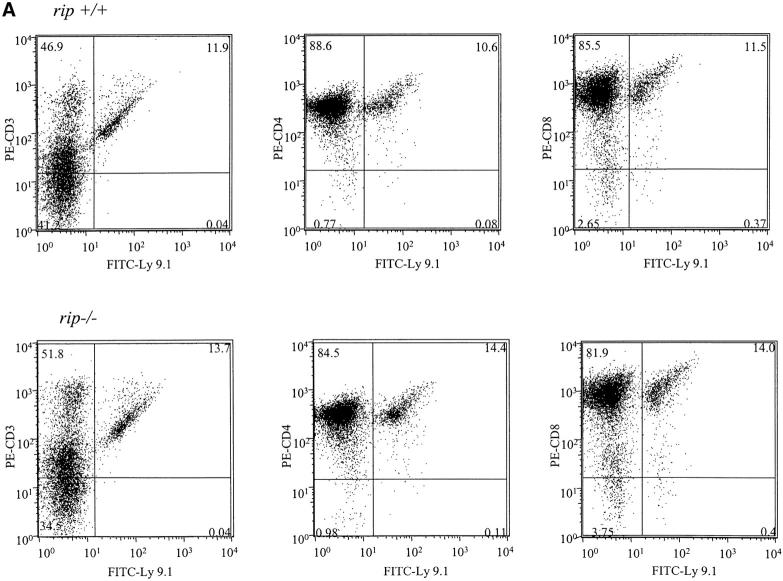
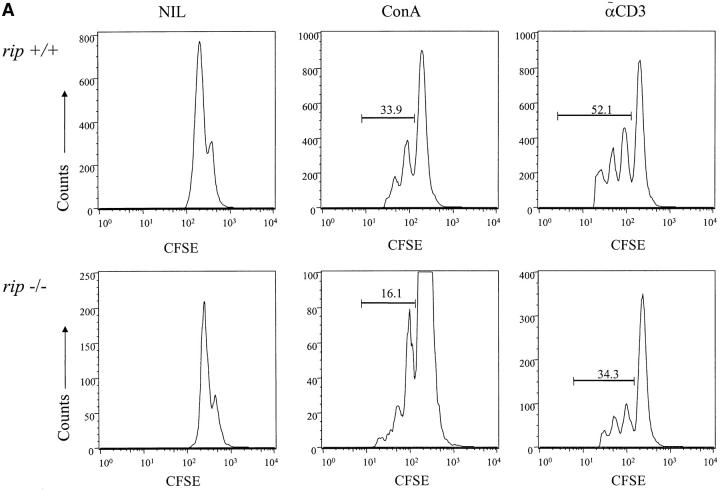
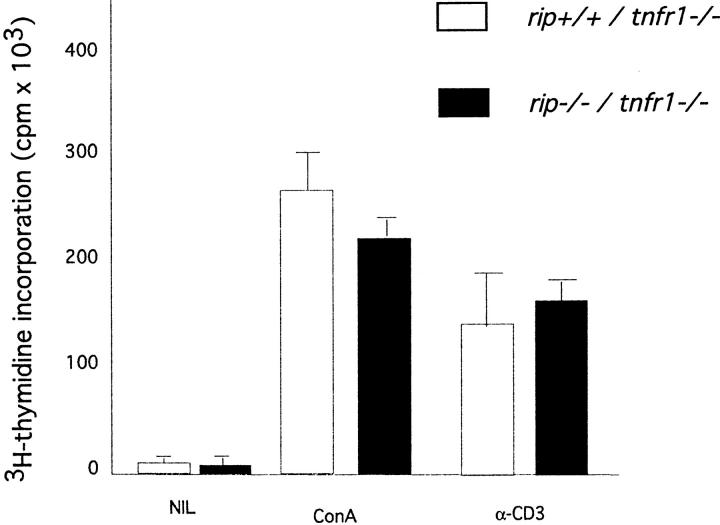
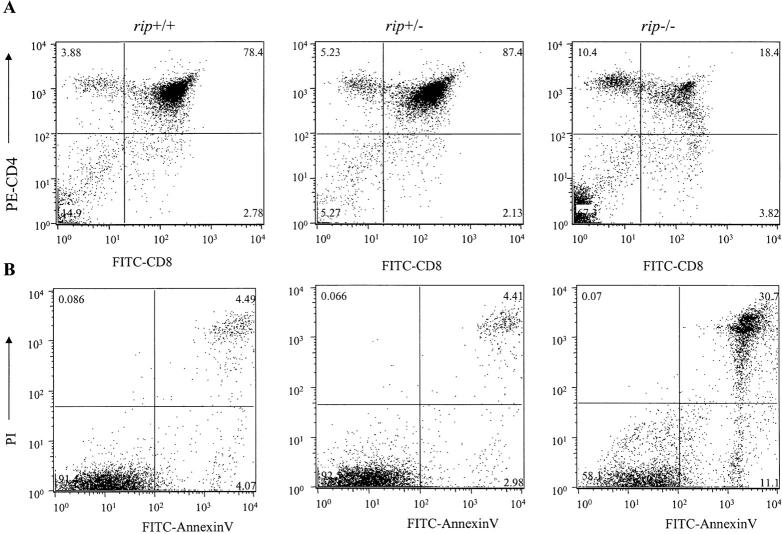
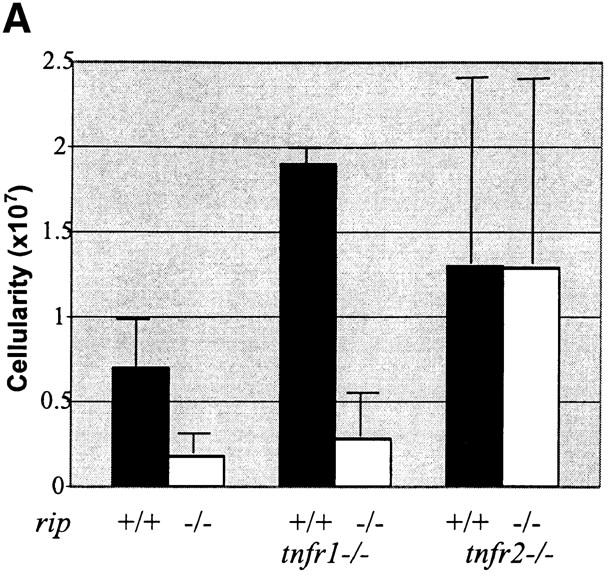
Fas and the tumor necrosis factor receptor (TNFR)1 regulate the programmed cell death of lymphocytes. The death domain kinase, receptor interacting protein (rip), is recruited to the TNFR1 upon receptor activation. In vitro, rip-/- fibroblasts are sensitive to TNF-induced cell death due to an impaired nuclear factor kappaB response. Because rip-/- mice die at birth, we were unable to examine the effects of a targeted rip mutation on lymphocyte survival. To address the contribution of RIP to immune homeostasis, we examined lethally irradiated mice reconstituted with rip-/- hematopoietic precursors. We observed a decrease in rip-/- thymocytes and T cells in both wild-type C57BL/6 and recombination activating gene 1-/- irradiated hosts. In contrast, the B cell and myeloid lineages are unaffected by the absence of rip. Thus, the death domain kinase rip is required for T cell development. Unlike Fas-associated death domain, rip does not regulate T cell proliferation, as rip-/- T cells respond to polyclonal activators. However, rip-deficient mice contain few viable CD4+ and CD8+ thymocytes, and rip-/- thymocytes are sensitive to TNF-induced cell death. Surprisingly, the rip-associated thymocyte apoptosis was not rescued by the absence of TNFR1, but appears to be rescued by an absence of TNFR2. Taken together, this study implicates RIP and TNFR2 in thymocyte survival.
Fas和肿瘤坏死因子受体(TNFR)1调节淋巴细胞的程序性细胞死亡。死亡结构域激酶,即受体相互作用蛋白(rip),在受体激活后被招募至TNFR1。在体外,rip-/-成纤维细胞由于核因子κB反应受损而对TNF诱导的细胞死亡敏感。由于rip-/-小鼠在出生时即死亡,我们无法检测rip靶向突变对淋巴细胞存活的影响。为了探究RIP对免疫稳态的作用,我们检测了用rip-/-造血前体细胞重建的经致死性照射的小鼠。我们观察到,在野生型C57BL/6和重组激活基因1-/-照射宿主中,rip-/-胸腺细胞和T细胞均减少。相比之下,B细胞和髓系细胞谱系不受rip缺失的影响。因此,死亡结构域激酶rip是T细胞发育所必需的。与Fas相关死亡结构域不同,rip不调节T细胞增殖,因为rip-/- T细胞对多克隆激活剂有反应。然而,rip缺陷小鼠中存活的CD4+和CD8+胸腺细胞很少,且rip-/-胸腺细胞对TNF诱导的细胞死亡敏感。令人惊讶的是,TNFR1缺失并不能挽救rip相关的胸腺细胞凋亡,但TNFR2缺失似乎可以挽救。综上所述,本研究表明RIP和TNFR2与胸腺细胞存活有关。