Clark Lorraine, Wei Michelle, Cattoretti Giorgio, Mendelsohn Cathy, Tycko Benjamin
Institute for Cancer Genetics, Columbia University College of Physicians and Surgeons, New York, NY, USA.
BMC Genet. 2002 Jun 27;3:11. doi: 10.1186/1471-2156-3-11.
The Tnfrh1 gene (gene symbol Tnfrsf23) is located near one end of a megabase-scale imprinted region on mouse distal chromosome 7, about 350 kb distant from the nearest known imprinting control element. Within 20 kb of Tnfrh1 is a related gene called Tnfrh2 (Tnfrsf22) These duplicated genes encode putative decoy receptors in the tumor necrosis factor (TNF) receptor family. Although other genes in this chromosomal region show conserved synteny with genes on human Chr11p15.5, there are no obvious human orthologues of Tnfrh1 or Tnfrh2.
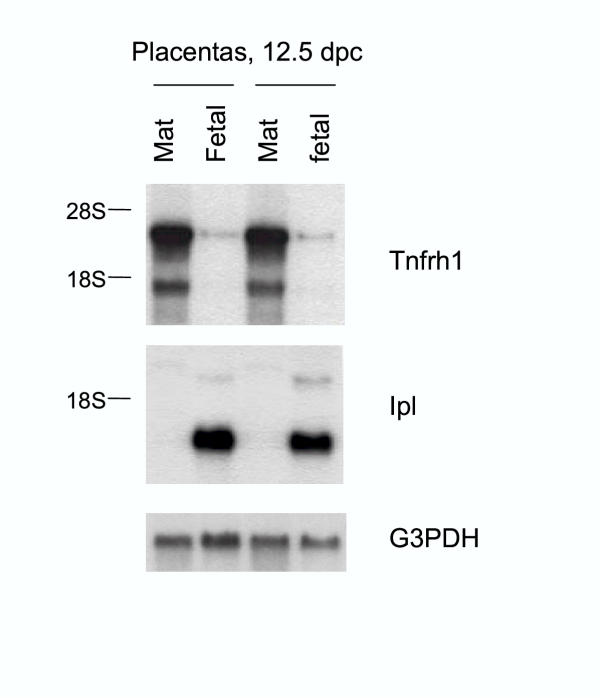
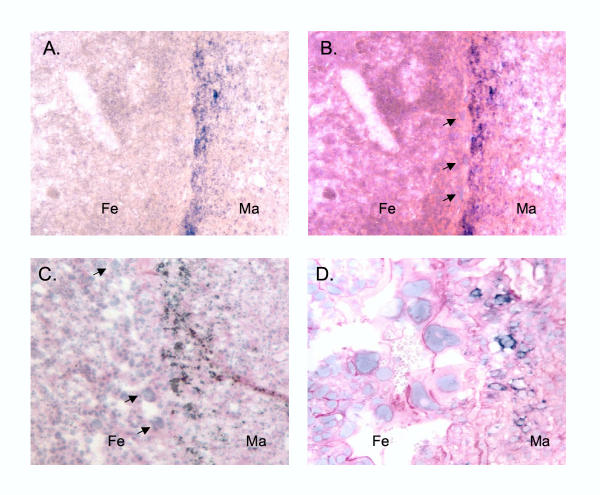
We analyzed Tnfrh1 for evidence of parental imprinting, and characterized its tissue-specific expression. Tnfrh1 mRNA is detectable in multiple adult and fetal tissues, with highest expression in placenta, where in situ hybridization reveals a distinctive population of Tnfrh1-positive cells in maternal decidua, directly beneath the trophoblast giant cells. In offspring of interspecific mouse crosses, Tnfrh1 shows a consistent parent-of-origin-dependent allelic expression bias, with relative repression, but not silencing, of the paternal allele in several organs including fetal liver and adult spleen.
Genes preferentially expressed in the placenta are predicted to evolve rapidly, and Tnfrh1 appears to be an example of this phenomenon. In view of its strong expression in cells at the fetal-maternal boundary, Tnfrh1 warrants further study as a gene that might modulate immune or trophic interactions between the invasive placental trophoblast and the maternal decidua. The preferential expression of Tnfrh1 from the maternal allele indicates weak functional imprinting of this locus in some tissues.
Tnfrh1基因(基因符号Tnfrsf23)位于小鼠7号染色体远端一个兆碱基规模印记区域的一端附近,距离最近已知的印记控制元件约350 kb。在Tnfrh1的20 kb范围内有一个相关基因Tnfrh2(Tnfrsf22)。这些重复基因在肿瘤坏死因子(TNF)受体家族中编码假定的诱饵受体。尽管该染色体区域的其他基因与人11号染色体p15.5上的基因显示出保守的同线性,但Tnfrh1或Tnfrh2没有明显的人类直系同源基因。
我们分析了Tnfrh1的亲本印记证据,并对其组织特异性表达进行了表征。Tnfrh1 mRNA在多个成年和胎儿组织中均可检测到,在胎盘中表达最高,原位杂交显示在滋养层巨细胞正下方的母体蜕膜中有一群独特的Tnfrh1阳性细胞。在种间小鼠杂交后代中,Tnfrh1显示出一致的亲本来源依赖性等位基因表达偏向,在包括胎儿肝脏和成年脾脏在内的几个器官中,父本等位基因相对受抑制,但未沉默。
预计在胎盘中优先表达的基因会快速进化,Tnfrh1似乎就是这种现象的一个例子。鉴于其在胎儿-母体边界细胞中的强表达,Tnfrh1作为一个可能调节侵袭性胎盘滋养层与母体蜕膜之间免疫或营养相互作用的基因,值得进一步研究。母本等位基因中Tnfrh1的优先表达表明该基因座在某些组织中的功能印记较弱。