van Bilsen Jolanda H M, Wagenaar-Hilbers Josée P A, van der Cammen Maarten J F, van Dijk Mariska E A, van Eden Willem, Wauben Marca H M
Department of Infectious Diseases and Immunology, Faculty of Veterinary Medicine, Utrecht University, The Netherlands.
Arthritis Res. 2002;4(4):R2. doi: 10.1186/ar421. Epub 2002 May 7.
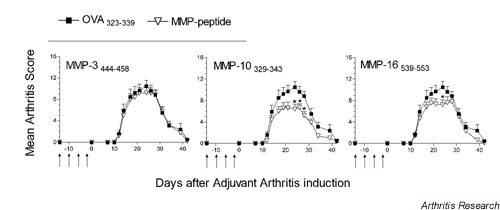
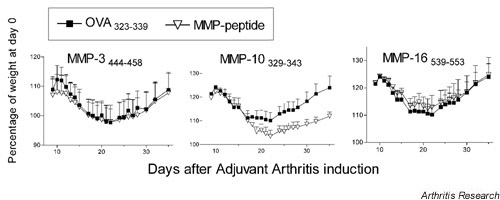
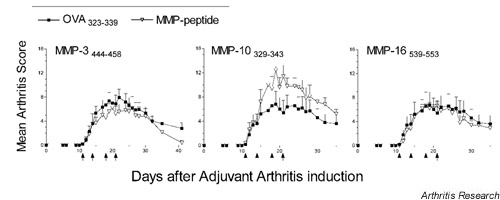
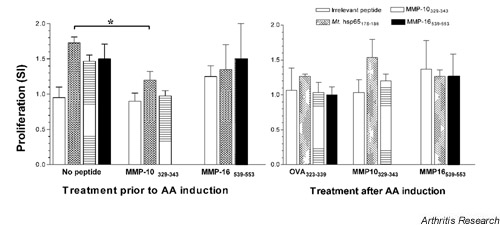
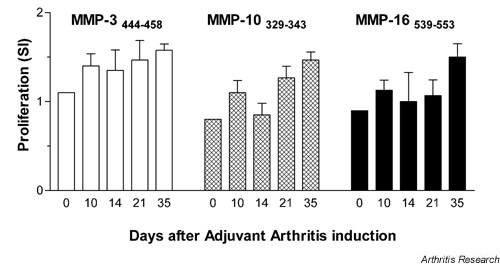
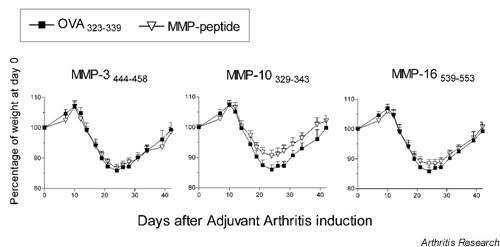
We have recently found that matrix metalloproteinases (MMPs) are targets for T-cell and B-cell reactivity in experimental arthritis. In the present article, we investigate whether modulation of MMP-specific T-cell responses could influence the course of adjuvant arthritis (AA). Lewis rats were treated nasally with MMP peptides prior to or after AA induction. Administration of the MMP-10 or the MMP-16 peptide prior to AA induction reduced the arthritic symptoms. In contrast, administration of the MMP-10 peptide after AA induction aggravated the arthritic symptoms. The present study shows the possible usefulness of MMP peptides for immunotherapy. However, a clear understanding of proper timing of peptide administration is crucial for the development of such therapies.
我们最近发现,基质金属蛋白酶(MMPs)是实验性关节炎中T细胞和B细胞反应的靶点。在本文中,我们研究了MMP特异性T细胞反应的调节是否会影响佐剂性关节炎(AA)的病程。在AA诱导之前或之后,用MMP肽经鼻治疗Lewis大鼠。在AA诱导之前给予MMP-10或MMP-16肽可减轻关节炎症状。相比之下,在AA诱导之后给予MMP-10肽会加重关节炎症状。本研究表明MMP肽在免疫治疗中可能有用。然而,对于此类疗法的开发而言,清楚了解肽给药的合适时机至关重要。