Song Lun, Li Yan, Shen Beifen
Department of Molecular Immunology, Institute of Basic Medical Sciences, Taiping Road, 27, Beijing, 100850, P, R, China.
Cancer Cell Int. 2002 Jul 8;2(1):9. doi: 10.1186/1475-2867-2-9.
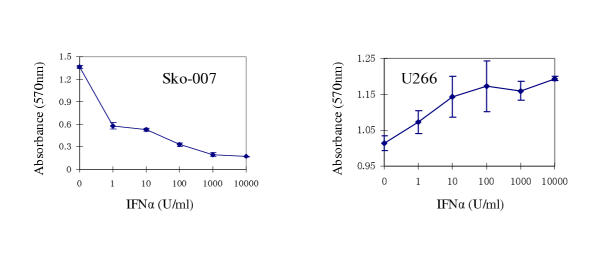
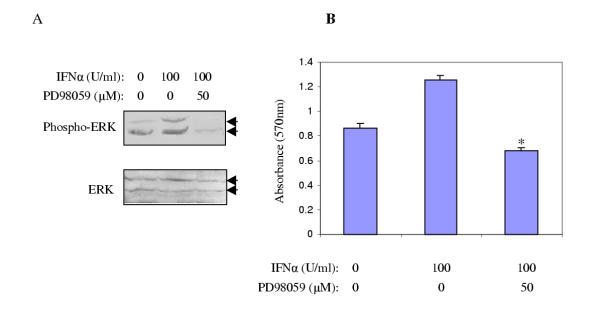
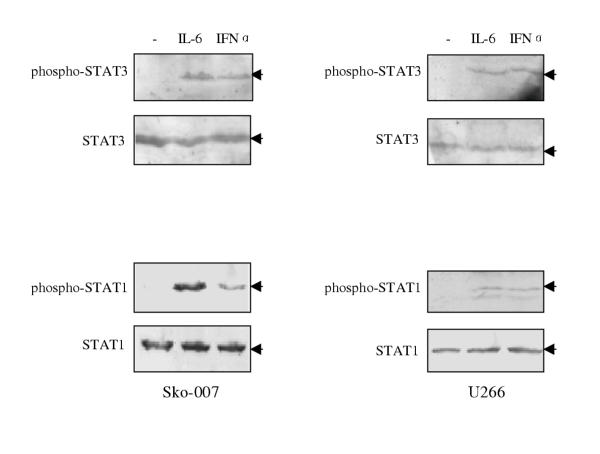
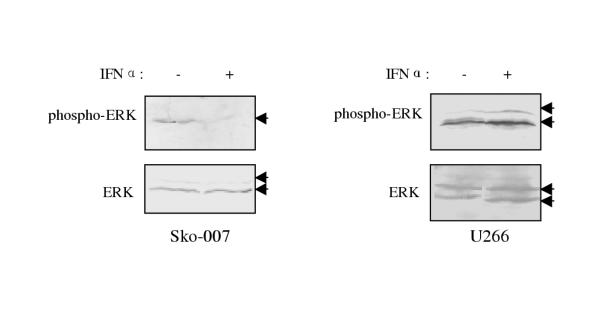
Despite IFNalpha has been used extensively in the treatment of multiple myeloma (MM), there are also several reports suggesting that IFNalpha may aggravate isease in some MM patients. That means the effect of IFNalpha on the growth of myeloma cells in vivo may be different. In this study, we selected two human myeloma cell lines that vary remarkably in response to IFNalpha and focused on elucidating the mechanism of differential IFNalpha responsiveness. RESULTS: Sko-007 is a myeloma cell line whose growth is arrested by IFNalpha; however, IFNalpha promoted the proliferation of the other myeloma cell line U266. We observed that the growth-stimulation effect of IFNalpha on U266 cells did not result from up-regulation of the IL-6 receptors on cell surface; while IFNalpha treatment on Sko-007 cells significantly reduced gp130 expression. Moreover, the transcription factors STAT3 and STAT1, which are involved in the JAK/STAT signal transduction pathway, can be activated in both IFNalpha-stimulated and -inhibited myeloma cell lines; while the activation of the protein kinase ERK, which is involved in the Ras/MAPK signal transduction pathway, can be down-regulated in IFNalpha-arrested Sko-007 cells and up-regulated in IFNalpha-stimulated U266 cells. In addition, both IFNalpha-induced growth-stimulation effect and the up-regulated activation of ERK in U266 cells were efficiently inhibited by PD98059, the specific inhibitor of MAPK/ERK kinase (MEK). CONCLUSION: Myeloma cells responsiveness to IFNalpha is heterogeneous and the activation state of ERK in the Ras/MAPK signalling pathway mainly contributed to this difference.
尽管干扰素α(IFNα)已广泛用于治疗多发性骨髓瘤(MM),但也有一些报道表明,IFNα可能会使某些MM患者的病情加重。这意味着IFNα对体内骨髓瘤细胞生长的影响可能不同。在本研究中,我们选择了两种对IFNα反应差异显著的人骨髓瘤细胞系,并着重阐明IFNα反应性差异的机制。结果:Sko-007是一种骨髓瘤细胞系,其生长被IFNα阻滞;然而,IFNα却促进了另一种骨髓瘤细胞系U266的增殖。我们观察到,IFNα对U266细胞的生长刺激作用并非源于细胞表面IL-6受体的上调;而IFNα处理Sko-007细胞则显著降低了gp130的表达。此外,参与JAK/STAT信号转导途径的转录因子STAT3和STAT1在IFNα刺激和抑制的骨髓瘤细胞系中均能被激活;而参与Ras/MAPK信号转导途径的蛋白激酶ERK的激活在IFNα阻滞的Sko-007细胞中被下调,在IFNα刺激的U266细胞中被上调。另外,U266细胞中IFNα诱导的生长刺激作用以及ERK激活的上调均被MAPK/ERK激酶(MEK)的特异性抑制剂PD98059有效抑制。结论:骨髓瘤细胞对IFNα的反应具有异质性,Ras/MAPK信号通路中ERK的激活状态是造成这种差异的主要原因。