Fedier A, Ruefenacht U B, Schwarz V A, Haller U, Fink D
Department of Obstetrics and Gynaecology, Division of Gynaecology, University Hospital of Zurich, CH-8091, Switzerland.
Br J Cancer. 2002 Oct 21;87(9):1027-33. doi: 10.1038/sj.bjc.6600599.
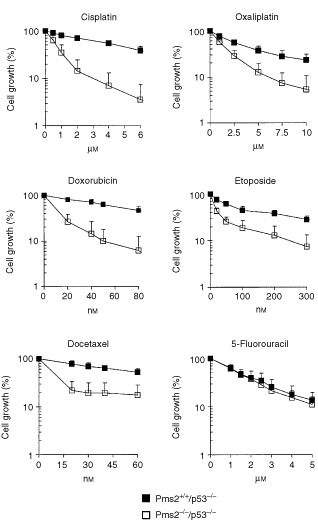
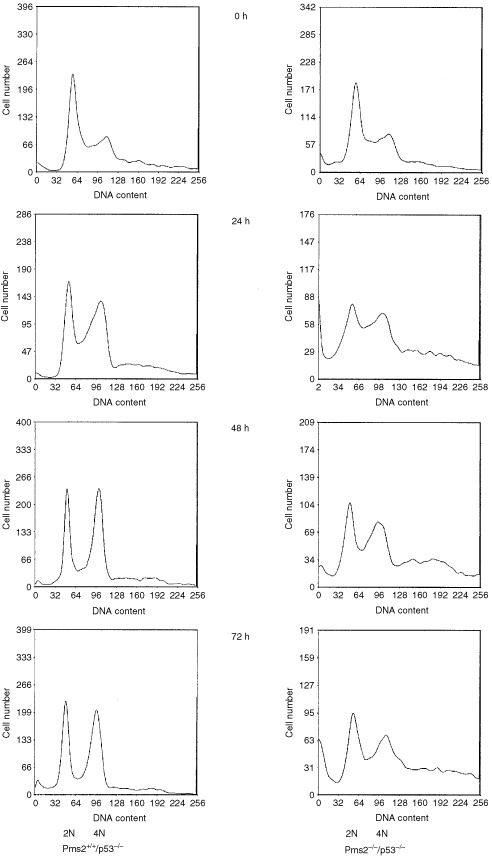
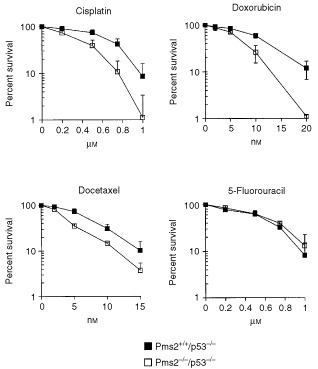
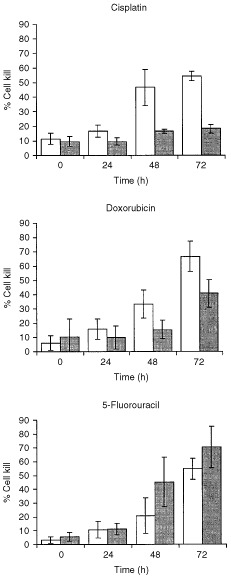
A large fraction of human tumours carries mutations in the p53 gene. p53 plays a central role in controlling cell cycle checkpoint regulation, DNA repair, transcription, and apoptosis upon genotoxic stress. Lack of p53 function impairs these cellular processes, and this may be the basis of resistance to chemotherapeutic regimens. By virtue of the involvement of DNA mismatch repair in modulating cytotoxic pathways in response to DNA damaging agents, we investigated the effects of loss of Pms2 on the sensitivity to a panel of widely used anticancer agents in E1A/Ha-Ras-transformed p53-null mouse fibroblasts either proficient or deficient in Pms2. We report that lack of the Pms2 gene is associated with an increased sensitivity, ranging from 2-6-fold, to some types of anticancer agents including the topoisomerase II poisons doxorubicin, etoposide and mitoxantrone, the platinum compounds cisplatin and oxaliplatin, the taxanes docetaxel and paclitaxel, and the antimetabolite gemcitabine. In contrast, no change in sensitivity was found after treatment with 5-fluorouracil. Cell cycle analysis revealed that both, Pms2-deficient and -proficient cells, retain the ability to arrest at the G2/M upon cisplatin treatment. The data indicate that the concomitant loss of Pms2 function chemosensitises p53-deficient cells to some types of anticancer agents, that Pms2 positively modulates cell survival by mechanisms independent of p53, and that increased cytotoxicity is paralleled by increased apoptosis. Tumour-targeted functional inhibition of Pms2 may be a valuable strategy for increasing the efficacy of anticancer agents in the treatment of p53-mutant cancers.
很大一部分人类肿瘤携带p53基因的突变。p53在控制细胞周期检查点调控、DNA修复、转录以及基因毒性应激时的细胞凋亡中发挥核心作用。p53功能的缺失会损害这些细胞过程,这可能是对化疗方案产生抗性的基础。鉴于DNA错配修复参与调节对DNA损伤剂的细胞毒性途径,我们研究了Pms2缺失对E1A/Ha-Ras转化的p53基因敲除小鼠成纤维细胞(Pms2功能正常或缺陷)对一组广泛使用的抗癌药物敏感性的影响。我们报告称,Pms2基因的缺失与对某些类型抗癌药物的敏感性增加相关,敏感性增加幅度为2至6倍,这些抗癌药物包括拓扑异构酶II抑制剂阿霉素、依托泊苷和米托蒽醌、铂类化合物顺铂和奥沙利铂、紫杉烷类多西他赛和紫杉醇以及抗代谢物吉西他滨。相比之下,用5-氟尿嘧啶处理后未发现敏感性变化。细胞周期分析表明,Pms2缺陷型和正常型细胞在顺铂处理后都保留了在G2/M期停滞的能力。数据表明,Pms2功能的同时缺失使p53缺陷型细胞对某些类型的抗癌药物产生化学敏感性,Pms2通过独立于p53的机制正向调节细胞存活,并且细胞毒性增加与细胞凋亡增加并行。针对肿瘤的Pms2功能抑制可能是提高抗癌药物治疗p53突变癌症疗效的一种有价值的策略。