Sersa G, Krzic M, Sentjurc M, Ivanusa T, Beravs K, Kotnik V, Coer A, Swartz H M, Cemazar M
Laboratory of Radiation Biology, Institute of Oncology Ljubljana, Zaloska 2, SI-1000 Ljubljana, Slovenia.
Br J Cancer. 2002 Oct 21;87(9):1047-54. doi: 10.1038/sj.bjc.6600606.
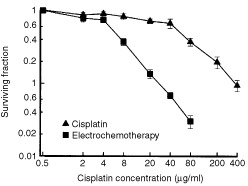
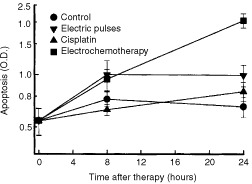
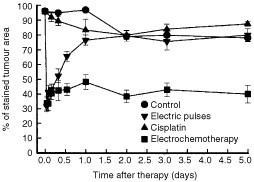
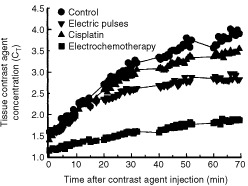
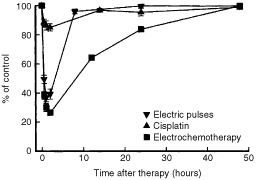
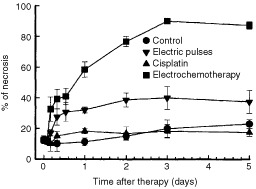
Electrochemotherapy is an antitumour treatment that utilises locally delivered electric pulses to increase cytotoxicity of chemotherapeutic drugs. Besides increased drug delivery, application of electric pulses affects tumour blood flow. The aim of this study was to determine tumour blood flow modifying effects of electrochemotherapy with cisplatin, its effects on tumour oxygenation and to determine their relation to antitumour effectiveness. Electrochemotherapy of SA-1 subcutaneous tumours was performed by application of electric pulses to the tumours, following administration of cisplatin. Tumour blood flow modifying effects of electrochemotherapy were determined by measurement of tumour perfusion using the Patent blue staining technique, determination of tumour blood volume, and microvascular permeability using contrast enhanced magnetic resonance imaging, and tumour oxygenation using electron paramagnetic resonance oximetry. Antitumour effectiveness was determined by tumour growth delay and the extent of tumour necrosis and apoptosis. Tumour treatment by electrochemotherapy induced 9.4 days tumour growth delay. Tumour blood flow was reduced instantaneously and persisted for several days. This reduction in tumour blood flow was reflected in reduced tumour oxygenation. The maximal reduction in partial oxygen pressure (pO2) levels was observed at 2 h after the treatment, with steady recovery to the pretreatment level within 48 h. The reduced tumour blood flow and oxygenation correlated well with the extent of tumour necrosis and tumour cells apoptosis induced by electrochemotherapy with cisplatin. Therefore, the data indicate that antitumour effectiveness of electrochemotherapy is not only due to increased cytotoxicity of cisplatin due to electroporation of tumour cells, but also due to anti-vascular effect of electrochemotherapy, which resulted in reduced tumour blood flow and oxygenation.
电化学疗法是一种抗肿瘤治疗方法,它利用局部施加的电脉冲来增强化疗药物的细胞毒性。除了增加药物递送外,电脉冲的施加还会影响肿瘤血流。本研究的目的是确定顺铂电化学疗法对肿瘤血流的调节作用、其对肿瘤氧合的影响,并确定它们与抗肿瘤效果的关系。在给予顺铂后,通过对SA-1皮下肿瘤施加电脉冲来进行电化学疗法。通过使用专利蓝染色技术测量肿瘤灌注、使用对比增强磁共振成像确定肿瘤血容量和微血管通透性以及使用电子顺磁共振血氧测定法确定肿瘤氧合,来确定电化学疗法对肿瘤血流的调节作用。通过肿瘤生长延迟以及肿瘤坏死和凋亡的程度来确定抗肿瘤效果。电化学疗法治疗肿瘤可使肿瘤生长延迟9.4天。肿瘤血流立即减少并持续数天。这种肿瘤血流的减少反映在肿瘤氧合的降低上。在治疗后2小时观察到局部氧分压(pO2)水平的最大降低,在48小时内稳定恢复到治疗前水平。肿瘤血流和氧合的降低与顺铂电化学疗法诱导的肿瘤坏死程度和肿瘤细胞凋亡密切相关。因此,数据表明电化学疗法的抗肿瘤效果不仅归因于肿瘤细胞电穿孔导致顺铂细胞毒性增加,还归因于电化学疗法的抗血管作用,这导致肿瘤血流和氧合减少。