Jiang Hong, Coleman Jennifer, Miskimins Robin, Miskimins W Keith
Division of Basic Biomedical Sciences, University of South Dakota School of Medicine, Vermillion, South Dakota, 57069, USA.
Cancer Cell Int. 2003 Feb 18;3(1):2. doi: 10.1186/1475-2867-3-2.
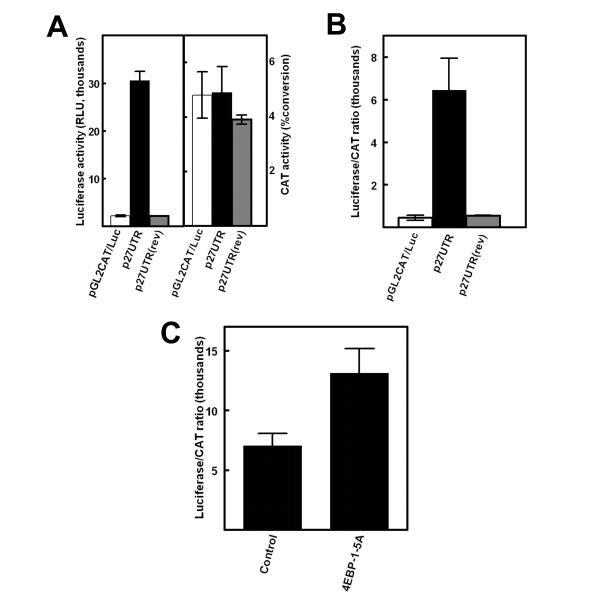
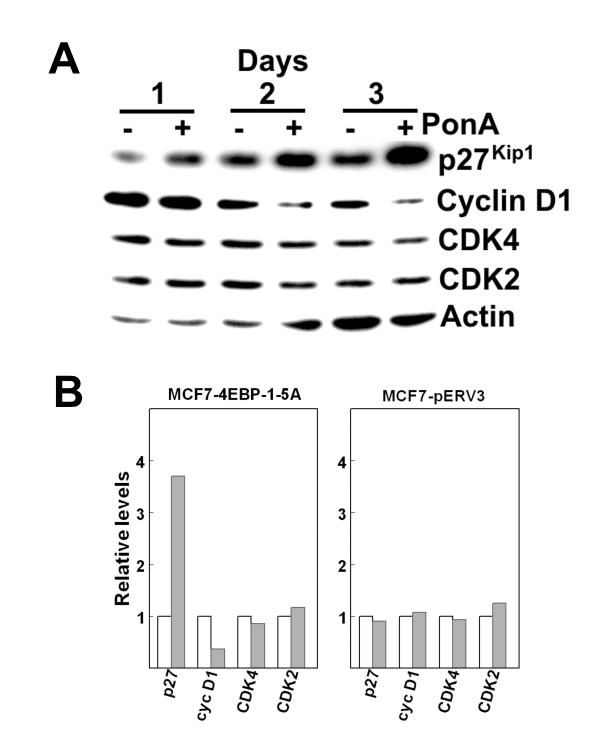
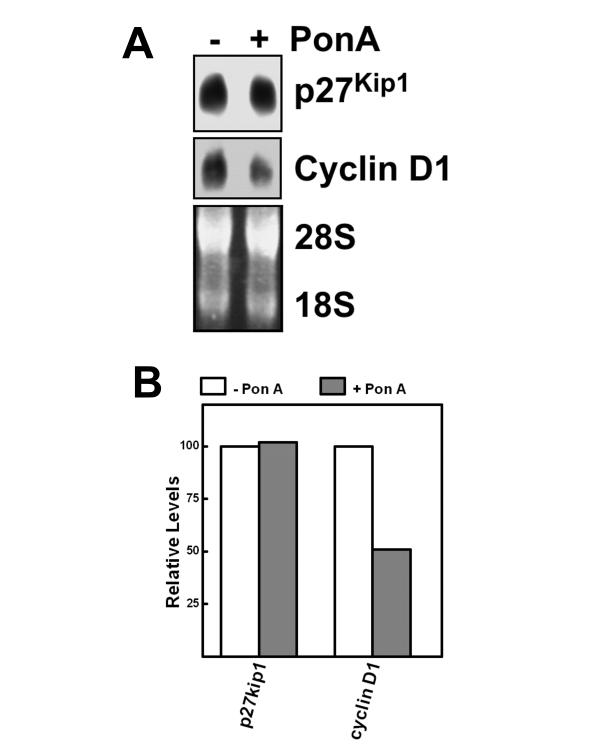
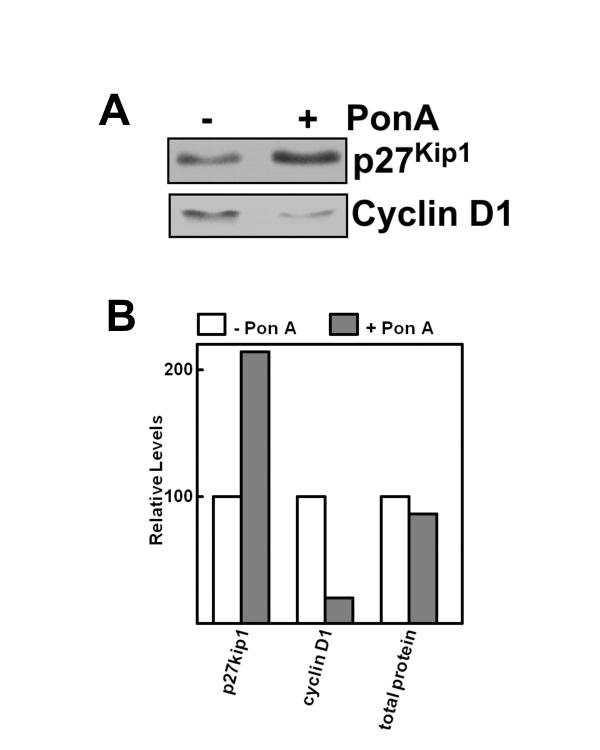
Eukaryotic initiation factor 4E (eIF4E) is essential for cap-dependent initiation of translation. Cell proliferation is associated with increased activity of eIF4E and elevated expression of eIF4E leads to tumorigenic transformation. Many tumors express very high levels of eIF4E and this may be a critical factor in progression of the disease. In contrast, overexpression of 4EBP, an inhibitor of eIF4E, leads to cell cycle arrest and phenotypic reversion of some transformed cells. RESULTS: A constitutively active form of 4EBP-1 was inducibly expressed in the human breast cancer cell line MCF7. Induction of constitutively active 4EBP-1 led to cell cycle arrest. This was not associated with a general inhibition of protein synthesis but rather with changes in specific cell cycle regulatory proteins. Cyclin D1 was downregulated while levels of the CDK inhibitor p27Kip1 were increased. The levels of cyclin E and CDK2 were unaffected but the activity of CDK2 was significantly reduced due to increased association with p27Kip1. The increase in p27Kip1 did not reflect changes in p27Kip1 mRNA or degradation rates. Rather, it was associated with enhanced synthesis of the protein, even though 4EBP-1 is expected to inhibit translation. This could be explained, at least in part, by the ability of the p27Kip1 5'-UTR to mediate cap-independent translation, which was also enhanced by expression of constitutively active 4EBP-1. CONCLUSIONS: Expression of active 4EBP-1 in MCF7 leads to cell cycle arrest which is associated with downregulation of cyclin D1 and upregulation of p27Kip1. Upregulation of p27Kip1reflects increased synthesis which corresponds to enhanced cap-independent translation through the 5'-UTR of the p27Kip1 mRNA.
真核生物起始因子4E(eIF4E)对于帽依赖性翻译起始至关重要。细胞增殖与eIF4E活性增加相关,eIF4E表达升高会导致致瘤性转化。许多肿瘤表达非常高水平的eIF4E,这可能是疾病进展的关键因素。相反,eIF4E抑制剂4EBP的过表达会导致细胞周期停滞和一些转化细胞的表型逆转。结果:在人乳腺癌细胞系MCF7中可诱导表达组成型活性形式的4EBP-1。组成型活性4EBP-1的诱导导致细胞周期停滞。这与蛋白质合成的普遍抑制无关,而是与特定细胞周期调节蛋白的变化有关。细胞周期蛋白D1下调,而细胞周期蛋白依赖性激酶抑制剂p27Kip1的水平升高。细胞周期蛋白E和CDK2的水平未受影响,但由于与p27Kip1的结合增加,CDK2的活性显著降低。p27Kip1的增加并不反映p27Kip1 mRNA或降解速率的变化。相反,它与该蛋白质的合成增强有关,尽管预计4EBP-1会抑制翻译。这至少可以部分地通过p27Kip1 5'-非翻译区介导不依赖帽的翻译的能力来解释,组成型活性4EBP-1的表达也增强了这种能力。结论:MCF7中活性4EBP-1的表达导致细胞周期停滞,这与细胞周期蛋白D1的下调和p27Kip1的上调有关。p27Kip1的上调反映了合成增加,这对应于通过p27Kip1 mRNA的5'-非翻译区增强的不依赖帽的翻译。