Rajan Prithi, Panchision David M, Newell Laura F, McKay Ronald D G
Laboratory of Molecular Biology, National Institute of Neurological Disorders and Stroke, National Institutes of Health, Bethesda, MD 20892, USA.
J Cell Biol. 2003 Jun 9;161(5):911-21. doi: 10.1083/jcb.200211021.
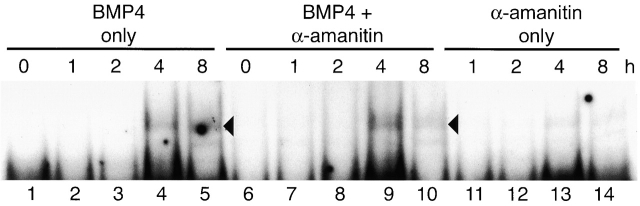
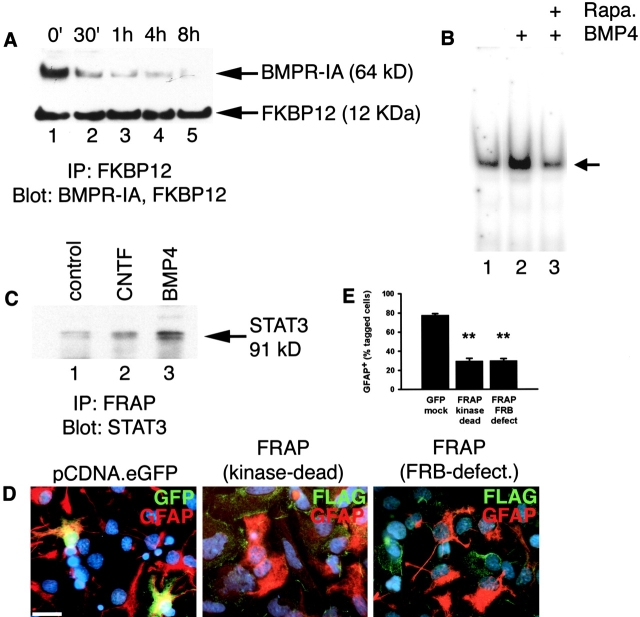
The ability of stem cells to generate distinct fates is critical for the generation of cellular diversity during development. Central nervous system (CNS) stem cells respond to bone morphogenetic protein (BMP) 4 by differentiating into a wide variety of dorsal CNS and neural crest cell types. We show that distinct mechanisms are responsible for the generation of two of these cell types, smooth muscle and glia. Smooth muscle differentiation requires BMP-mediated Smad1/5/8 activation and predominates where local cell density is low. In contrast, glial differentiation predominates at high local densities in response to BMP4 and is specifically blocked by a dominant-negative mutant Stat3. Upon BMP4 treatment, the serine-threonine kinase FKBP12/rapamycin-associated protein (FRAP), mammalian target of rapamycin (mTOR), associates with Stat3 and facilitates STAT activation. Inhibition of FRAP prevents STAT activation and glial differentiation. Thus, glial differentiation by BMP4 occurs by a novel pathway mediated by FRAP and STAT proteins. These results suggest that a single ligand can regulate cell fate by activating distinct cytoplasmic signals.
干细胞产生不同细胞命运的能力对于发育过程中细胞多样性的产生至关重要。中枢神经系统(CNS)干细胞通过分化为多种背侧CNS和神经嵴细胞类型来响应骨形态发生蛋白(BMP)4。我们发现,不同的机制负责其中两种细胞类型(平滑肌和神经胶质细胞)的产生。平滑肌分化需要BMP介导的Smad1/5/8激活,并且在局部细胞密度低的地方占主导。相反,神经胶质细胞分化在局部高密度时对BMP4作出反应并占主导,并且被显性负性突变体Stat3特异性阻断。在BMP4处理后丝氨酸 - 苏氨酸激酶FKBP12/雷帕霉素相关蛋白(FRAP),即雷帕霉素的哺乳动物靶标(mTOR),与Stat3结合并促进STAT激活。抑制FRAP可阻止STAT激活和神经胶质细胞分化。因此,BMP4介导的神经胶质细胞分化通过由FRAP和STAT蛋白介导的新途径发生。这些结果表明,单一配体可以通过激活不同的细胞质信号来调节细胞命运。