Tassone P, Tagliaferri P, Viscomi C, Palmieri C, Caraglia M, D'Alessandro A, Galea E, Goel A, Abbruzzese A, Boland C R, Venuta S
Oncology Unit, Department of Experimental and Clinical Medicine, Via T. Campanella, 115 'Magna Graecia' University, 88100 Catanzaro, Italy.
Br J Cancer. 2003 Jun 16;88(12):1971-8. doi: 10.1038/sj.bjc.6600986.
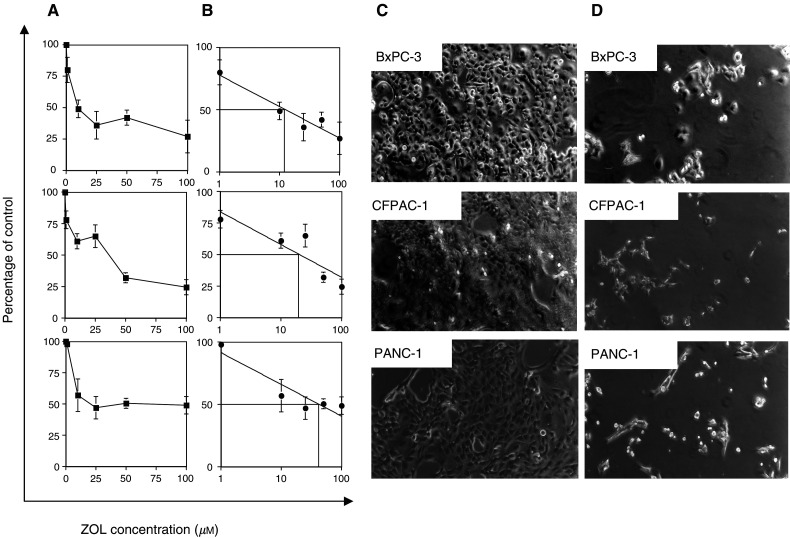
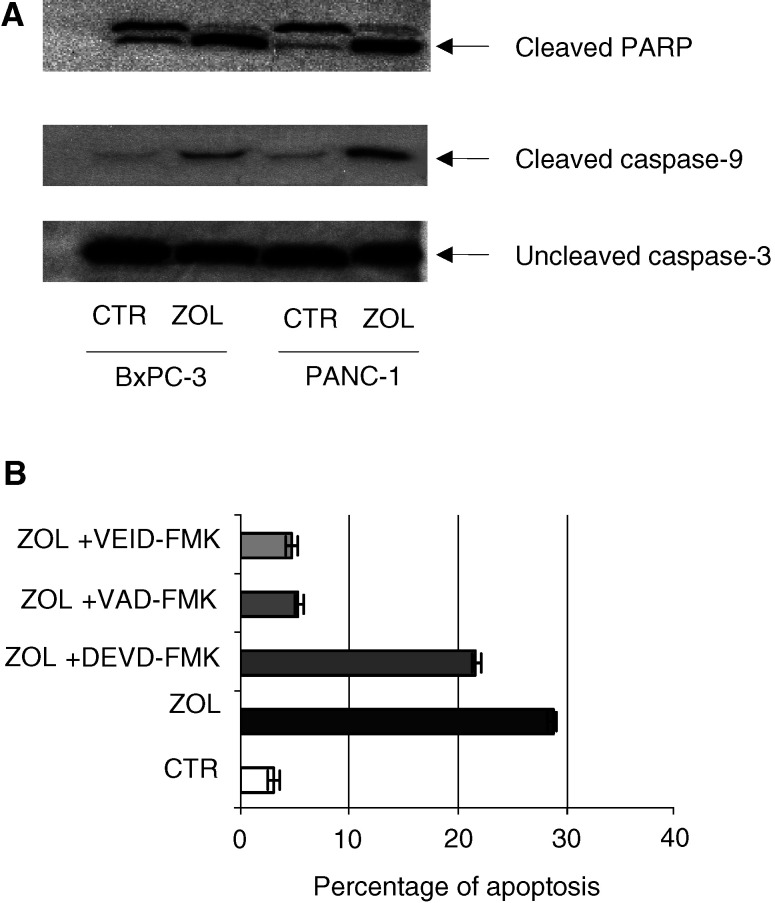
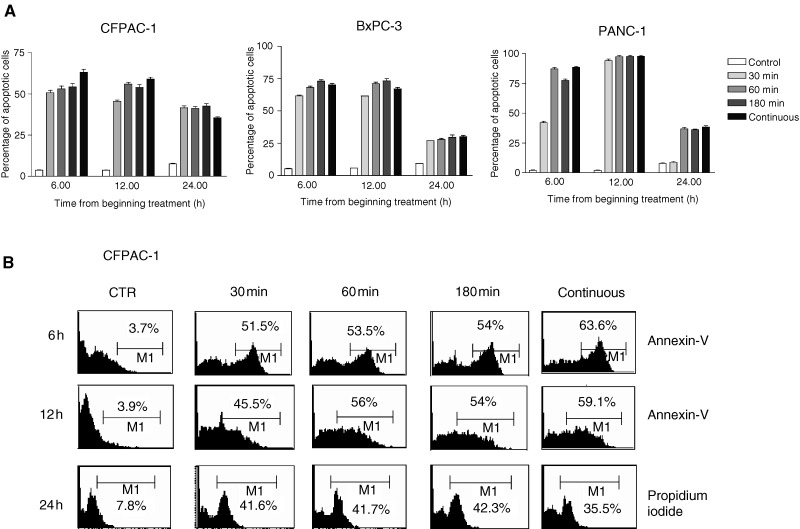
Bisphosphonates (BPs) are an emerging class of drugs mostly used in the palliative care of cancer patients. We investigated the in vitro activity of the most potent antiresorptive BP, zoledronic acid (ZOL), on the growth and survival of three human pancreatic cancer (PC) cell lines (BxPC-3, CFPAC-1 and PANC-1). Pancreatic cancer frequently has a dysregulated p21(ras) pathway and therefore appears to be a suitable target for BPs that interfere with the prenylation of small GTP-binding proteins such as p21(ras). We found that ZOL induces growth inhibition (IC(50):10-50 micro M) and apoptotic death of PC cells. The proapoptotic effect was correlated to cleavage/activation of caspase-9 and poly(ADP)-ribose polymerase, but not of caspase-3. Moreover, we studied the p21(ras) signalling in cells exposed to ZOL and detected a reduction of p21(ras) and Raf-1 content and functional downregulation of the terminal enzyme ERK/MAPkinase and of the pKB/Akt survival pathway. Finally, we observed that ZOL induces significant cytoskeletal rearrangements. In conclusion, we demonstrated that ZOL induces growth inhibition and apoptosis on PC cells and interferes with growth and survival pathways downstream to p21(ras). These findings might be relevant for expanding application of BPs in cancer treatment.
双膦酸盐(BPs)是一类新兴药物,主要用于癌症患者的姑息治疗。我们研究了最有效的抗骨吸收双膦酸盐唑来膦酸(ZOL)对三种人胰腺癌细胞系(BxPC-3、CFPAC-1和PANC-1)生长和存活的体外活性。胰腺癌常常存在p21(ras)信号通路失调,因此似乎是双膦酸盐的合适靶点,这类双膦酸盐可干扰诸如p21(ras)等小GTP结合蛋白的异戊二烯化。我们发现ZOL可诱导胰腺癌细胞生长抑制(IC(50):10 - 50微摩尔)和凋亡死亡。促凋亡作用与半胱天冬酶-9和聚(ADP)-核糖聚合酶的切割/激活相关,但与半胱天冬酶-3无关。此外,我们研究了暴露于ZOL的细胞中的p21(ras)信号传导,检测到p21(ras)和Raf-1含量降低,以及末端酶ERK/丝裂原活化蛋白激酶和pKB/Akt存活通路的功能下调。最后,我们观察到ZOL可诱导显著的细胞骨架重排。总之,我们证明ZOL可诱导胰腺癌细胞生长抑制和凋亡,并干扰p21(ras)下游的生长和存活通路。这些发现可能与扩大双膦酸盐在癌症治疗中的应用相关。