Kabosova Andrea, Kramerov Andrei A, Aoki Annette M, Murphy Gillian, Zieske James D, Ljubimov Alexander V
Ophthalmology Research Laboratories, Cedars-Sinai Medical Center, Burns and Allen Research Institute, Los Angeles, CA 90048, USA.
Exp Eye Res. 2003 Aug;77(2):211-7. doi: 10.1016/s0014-4835(03)00111-8.
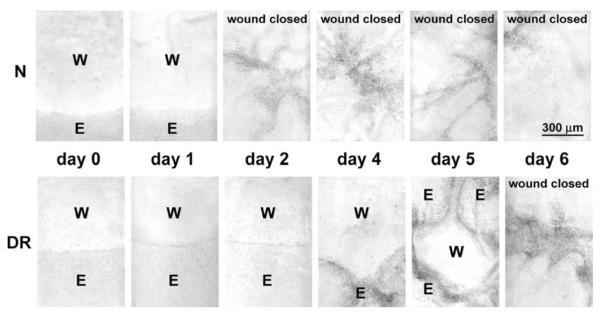
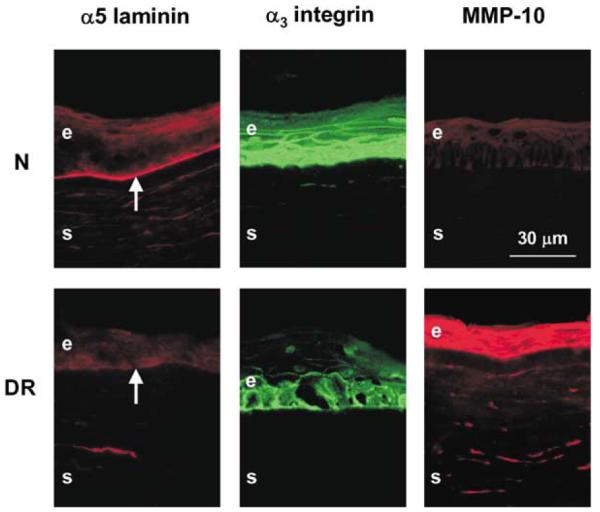
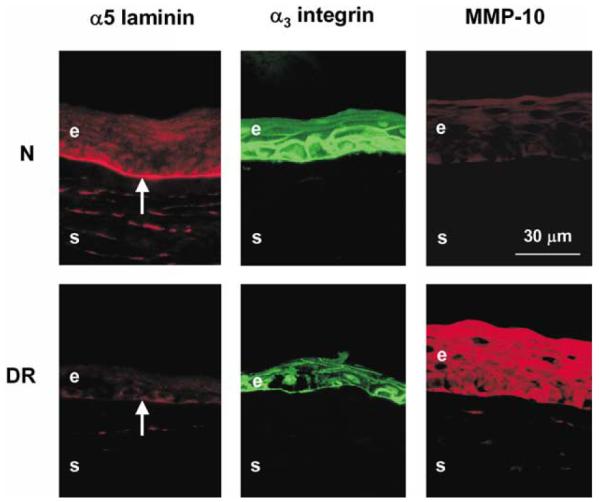
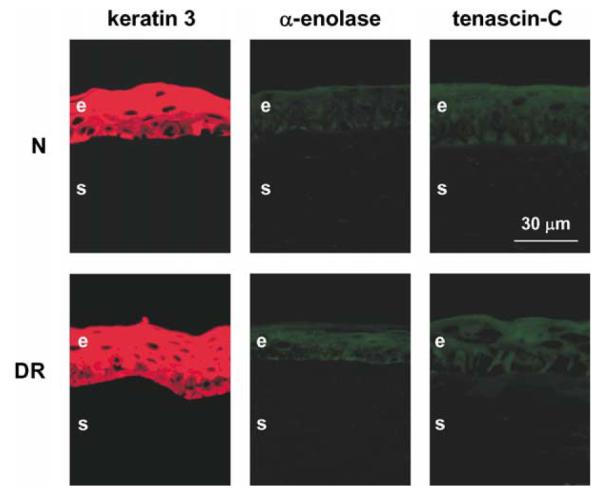
The authors have previously documented decreased epithelial basement membrane (BM) components and alpha3beta1 epithelial integrin, and increased expression of matrix metalloproteinase (MMP)-10 in corneas of patients with diabetic retinopathy (DR) compared to normal corneas. The purpose of this study was to examine if organ-cultured DR corneas exhibited the same alterations in wound healing and diabetic marker distribution as the autopsy DR corneas. Twenty normal and 17 DR corneas were organ-cultured in serum-free medium over agar-collagen gel at the air-liquid interface for up to 45 days. Circular 5 mm central epithelial wounds were made with n-heptanol, the procedure that will preserve fragile diabetic corneal BM. Wound healing was monitored microscopically every 12 hr. Distribution of diabetic corneal epithelial markers including laminin-10 alpha5 chain, nidogen-1/entactin, integrin alpha3beta1, and MMP-10, was examined by immunofluorescence. Normal corneas healed the central epithelial defect within 3 days (mean=2.3 days), whereas DR corneas on average healed about two times slower (mean=4.5 days). In wounded and completely healed organ-cultured corneas, the patterns of studied markers were the same as in the unwounded organ-cultured corneas. This concerned both normal and DR corneas. As in vivo, normal organ-cultured corneas had continuous staining for laminin-10 and nidogen-1/entactin in the epithelial BM, strong and homogeneous staining for both chains of alpha3beta1 integrin in epithelial cells, and little if any staining for MMP-10. Organ-cultured DR corneas also had marker patterns specific for in vivo DR corneas: interrupted to no staining for laminin-10 and nidogen-1/entactin in the epithelial BM, areas of weak or disorganized alpha3beta1 integrin in epithelial cells, and significant MMP-10 staining in the epithelium and keratocytes. Fibrotic extracellular matrix and myofibroblast markers were largely absent. Thus, epithelial wound healing was much slower in organ-cultured DR corneas than in normal corneas, in complete accordance with clinical data in diabetic patients. DR corneas in organ culture preserved the same marker abnormalities as in vivo. The marker distribution was unchanged in wounded and healed organ-cultured corneas, compared to unwounded corneas. The established corneal organ culture provides an adequate system for elucidating mechanisms of epithelial alterations in human DR corneas.
作者之前已证明,与正常角膜相比,糖尿病视网膜病变(DR)患者角膜的上皮基底膜(BM)成分和α3β1上皮整合素减少,基质金属蛋白酶(MMP)-10的表达增加。本研究的目的是检验器官培养的DR角膜在伤口愈合和糖尿病标志物分布方面是否表现出与尸检DR角膜相同的改变。将20只正常角膜和17只DR角膜在气液界面的琼脂-胶原凝胶上于无血清培养基中进行器官培养,长达45天。用正庚醇制作5mm圆形中央上皮伤口,该方法可保留脆弱的糖尿病角膜BM。每12小时通过显微镜监测伤口愈合情况。通过免疫荧光检查糖尿病角膜上皮标志物的分布,包括层粘连蛋白-10α5链、巢蛋白-1/内动蛋白、整合素α3β1和MMP-10。正常角膜在3天内(平均=2.3天)愈合中央上皮缺损,而DR角膜平均愈合速度慢约两倍(平均=4.5天)。在受伤和完全愈合的器官培养角膜中,所研究标志物的模式与未受伤的器官培养角膜相同。正常角膜和DR角膜均如此。与体内情况一样,正常器官培养角膜的上皮BM中层粘连蛋白-10和巢蛋白-1/内动蛋白呈连续染色,上皮细胞中α3β1整合素的两条链呈强而均匀的染色,MMP-10几乎无染色。器官培养的DR角膜也具有体内DR角膜特有的标志物模式:上皮BM中层粘连蛋白-10和巢蛋白-1/内动蛋白呈间断至无染色,上皮细胞中α3β1整合素呈弱或紊乱区域,上皮和角膜细胞中有明显的MMP-10染色。纤维化细胞外基质和成肌纤维细胞标志物基本不存在。因此,器官培养的DR角膜上皮伤口愈合比正常角膜慢得多,这与糖尿病患者的临床数据完全一致。器官培养中的DR角膜保留了与体内相同的标志物异常。与未受伤角膜相比,受伤和愈合的器官培养角膜中的标志物分布没有变化。已建立的角膜器官培养为阐明人类DR角膜上皮改变的机制提供了一个合适的系统。