Kronenwett Ulrike, Castro Juan, Roblick Uwe J, Fujioka Kaoru, Ostring Carin, Faridmoghaddam Farinaz, Laytragoon-Lewin Nongnit, Tribukait Bernhard, Auer Gert
Department of Oncology-Pathology, CCK R8-04, Karolinska Institutet and Hospital, Stockholm, (171 76), Sweden.
BMC Cell Biol. 2003 Jul 22;4:8. doi: 10.1186/1471-2121-4-8.
The progression of normal cells through the cell cycle is meticulously regulated by checkpoints guaranteeing the exact replication of the genome during S-phase and its equal division at mitosis. A prerequisite for this achievement is synchronized DNA-replication and centrosome duplication. In this context the expression of cyclins A and E has been shown to play a principal role.
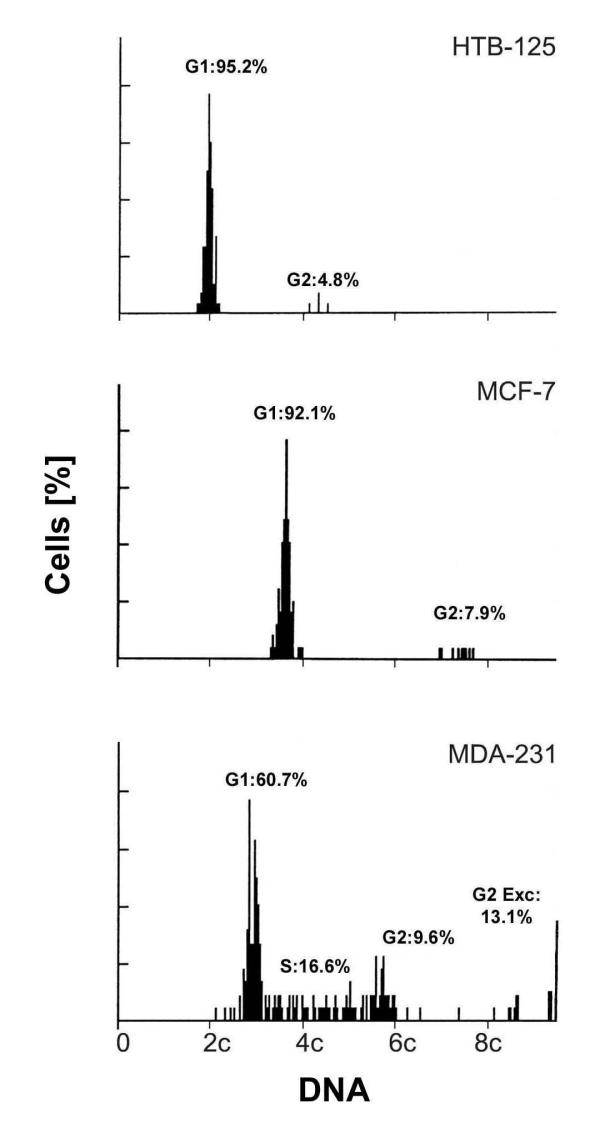
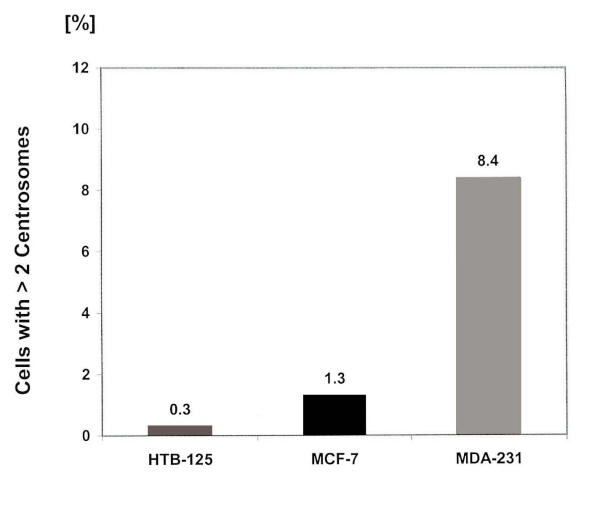
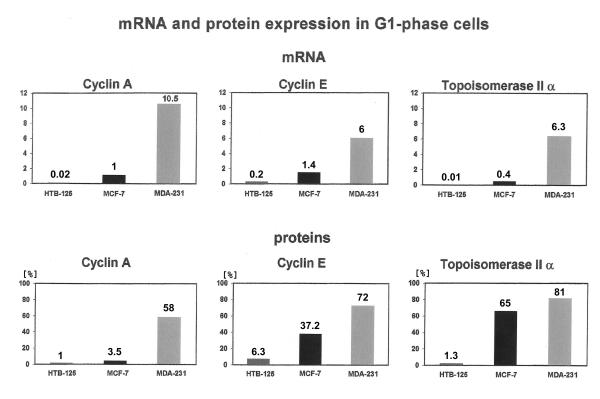
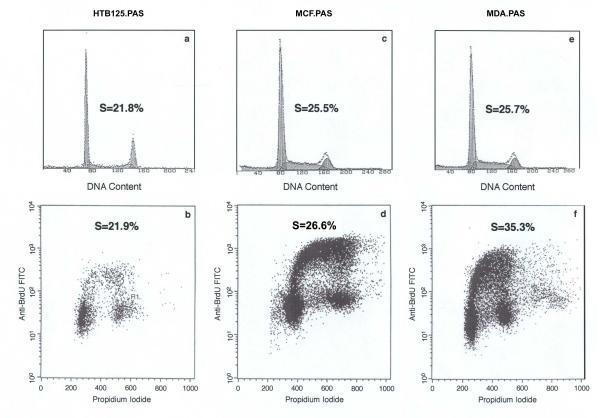
Our results demonstrated a correlation between centrosome amplification, cell cycle fidelity and the level of mRNA and protein expression of cyclins A and E during the part of the cell cycle defined as G1-phase by means of DNA content based histogram analysis. It is shown that the normal diploid breast cell line HTB-125, the genomically relatively stable aneuploid breast cancer cell line MCF-7, and the genomically unstable aneuploid breast cancer cell line MDA-231 differ remarkably concerning both mRNA and protein expression of the two cyclins during G1-phase. In MDA-231 cells the expression of e.g. cyclin A mRNA was found to be ten times higher than in MCF-7 cells and about 500 times higher than in HTB-125 cells. Topoisomerase II alpha showed high mRNA expression in MDA compared to MCF-7 cells, but the difference in protein expression was small. Furthermore, we measured centrosome aberrations in 8.4% of the MDA-231 cells, and in only 1.3% of the more stable aneuploid cell line MCF-7. MDA cells showed 27% more incorporation of BrdU than reflected by S-phase determination with flow cytometric DNA content analysis, whereas these values were found to be of the same size in both HTB-125 and MCF-7 cells.
Our data indicate that the breast cancer cell lines MCF-7 and MDA-231, although both DNA-aneuploid, differ significantly regarding the degree of cell cycle disturbance and centrosome aberrations, which partly could explain the different genomic stability of the two cell lines. The results also question the reliability of cytometric DNA content based S-phase determination in genomically unstable tumor cell populations.
正常细胞通过细胞周期的进程受到关卡的精确调控,这些关卡确保基因组在S期精确复制,并在有丝分裂时均等分裂。实现这一过程的一个先决条件是DNA复制和中心体复制同步。在这种情况下,细胞周期蛋白A和E的表达已被证明起着主要作用。
我们的结果表明,通过基于DNA含量的直方图分析,在定义为G1期的细胞周期部分,中心体扩增、细胞周期保真度与细胞周期蛋白A和E的mRNA及蛋白表达水平之间存在相关性。结果显示,正常二倍体乳腺细胞系HTB - 125、基因组相对稳定的非整倍体乳腺癌细胞系MCF - 7以及基因组不稳定的非整倍体乳腺癌细胞系MDA - 231在G1期这两种细胞周期蛋白的mRNA和蛋白表达方面存在显著差异。在MDA - 231细胞中,例如细胞周期蛋白A的mRNA表达量比MCF - 7细胞高10倍,比HTB - 125细胞高约500倍。与MCF - 7细胞相比,拓扑异构酶IIα在MDA细胞中显示出高mRNA表达,但蛋白表达差异较小。此外,我们检测到8.4%的MDA - 231细胞存在中心体畸变,而在基因组更稳定的非整倍体细胞系MCF - 7中只有1.3%。MDA细胞的BrdU掺入量比通过流式细胞术DNA含量分析测定的S期反映的量多27%,而在HTB - 125和MCF - 7细胞中这些值大小相同。
我们的数据表明,乳腺癌细胞系MCF - 7和MDA - 231虽然都是DNA非整倍体,但在细胞周期紊乱程度和中心体畸变方面存在显著差异,这在一定程度上可以解释这两种细胞系不同的基因组稳定性。结果还质疑了基于细胞计数法DNA含量测定基因组不稳定肿瘤细胞群体中S期的可靠性。