Goodman David S, Orelus Jean-Nicolas, Roberts Jacquelin M, Lammie Patrick J, Streit Thomas G
Centers for Disease Control and Prevention, Division of Parasitic Diseases, Atlanta, Georgia, USA.
Filaria J. 2003 Jul 7;2(1):11. doi: 10.1186/1475-2883-2-11.
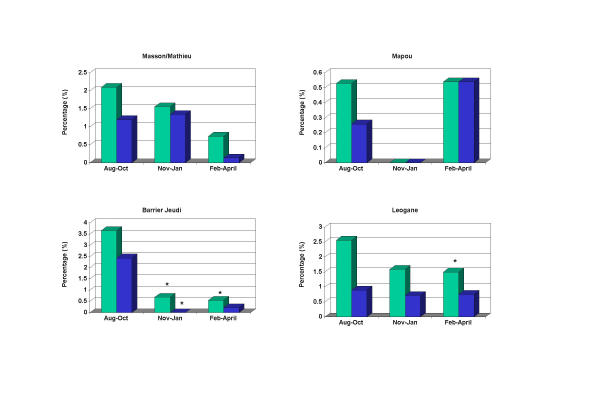
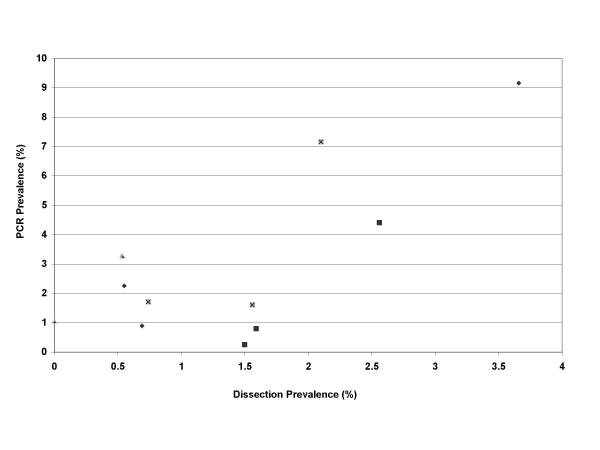
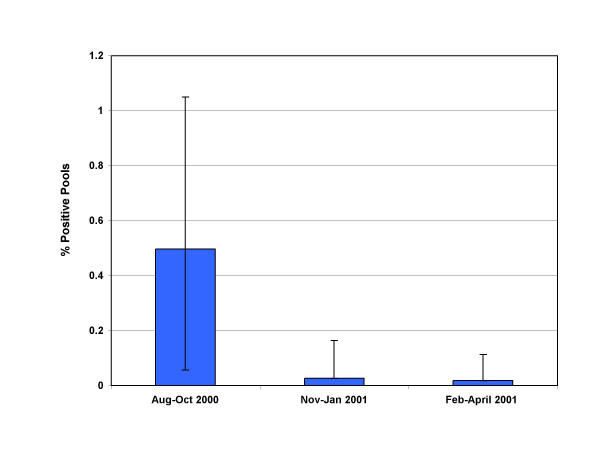
Entomological methods may provide important tools for monitoring the progress of lymphatic filariasis elimination programs. In this study, we compared dissection of the vector, Culex quinquefasciatus, with the polymerase chain reaction (PCR) to assess filarial infection levels in mosquitoes in the context of a lymphatic filariasis elimination program in Leogane, Haiti. METHODS: Mosquitoes were collected using gravid traps located in 4 sentinel communities with Wuchereria bancrofti microfilaria prevalence that ranged from 0.8% to 15.9%. Captured mosquitoes were divided between dissection, to enumerate W. bancrofti larvae (L1, L2, L3) and desiccation for later analysis by PCR. PCR was conducted on DNA extracts from pooled mosquitoes (1-15 pooled females) utilizing a competitive PCR system with primers specific for the Ssp I repeat. PCR products were analyzed with a hybridization ELISA using probes specific for a control sequence and the Ssp I repeat. RESULTS: The prevalence of mosquito infection with W. bancrofti ranged from 0%-3.66% by dissection (L1-L3) and point estimates of infection prevalence, as assayed by PCR, ranged from 0.25% - 9.16%. Following mass treatment, W. bancrofti infection prevalence dropped significantly as determined by PCR and dissection in 2 of the 4 sentinel sites (Leogane and Barrier Jeudi, P = 0.04 and P = 0.005, respectively). Although transmission declined in the other two sites, larval recoveries were low and these changes were not statistically significant. DISCUSSION: Our results suggest that a single round of mass treatment can have an impact on transmission of lymphatic filariasis. The use of entomologic methods as a tool to monitor filariasis programs and the statistical limitations of mosquito trapping are discussed.
昆虫学方法可为监测淋巴丝虫病消除计划的进展提供重要工具。在本研究中,我们在海地莱奥甘的淋巴丝虫病消除计划背景下,将媒介致倦库蚊的解剖与聚合酶链反应(PCR)进行比较,以评估蚊子体内的丝虫感染水平。
使用位于4个哨点社区的孕蚊诱捕器收集蚊子,这些社区的班氏吴策线虫微丝蚴患病率在0.8%至15.9%之间。捕获的蚊子分为两部分,一部分用于解剖以计数班氏吴策线虫幼虫(L1、L2、L3),另一部分进行干燥处理以便后续进行PCR分析。利用针对Ssp I重复序列的特异性引物的竞争性PCR系统,对合并蚊子(1 - 15只合并的雌蚊)的DNA提取物进行PCR。使用针对对照序列和Ssp I重复序列的特异性探针的杂交ELISA分析PCR产物。
通过解剖(L1 - L3)检测到的班氏吴策线虫感染蚊子的患病率为0% - 3.66%,PCR检测的感染患病率点估计值为0.25% - 9.16%。大规模治疗后,在4个哨点中的2个(莱奥甘和周四屏障,分别为P = 0.04和P = 0.005),通过PCR和解剖确定班氏吴策线虫感染患病率显著下降。虽然其他两个地点的传播有所下降,但幼虫回收率较低,这些变化无统计学意义。
我们的结果表明,一轮大规模治疗可对淋巴丝虫病的传播产生影响。讨论了将昆虫学方法用作监测丝虫病计划的工具以及蚊子诱捕的统计局限性。