Locke Devin P, Archidiacono Nicoletta, Misceo Doriana, Cardone Maria Francesca, Deschamps Stephane, Roe Bruce, Rocchi Mariano, Eichler Evan E
Department of Genetics, Center for Computational Genomics, Case Western Reserve University School of Medicine, University Hospitals of Cleveland, Cleveland, OH 44106, USA.
Genome Biol. 2003;4(8):R50. doi: 10.1186/gb-2003-4-8-r50. Epub 2003 Jul 15.
Pericentric inversions are the most common euchromatic chromosomal differences among humans and the great apes. The human and chimpanzee karyotype differs by nine such events, in addition to several constitutive heterochromatic increases and one chromosomal fusion event. Reproductive isolation and subsequent speciation are thought to be the potential result of pericentric inversions, as reproductive boundaries form as a result of hybrid sterility.
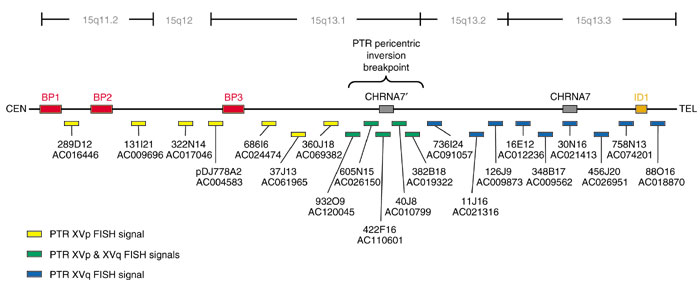
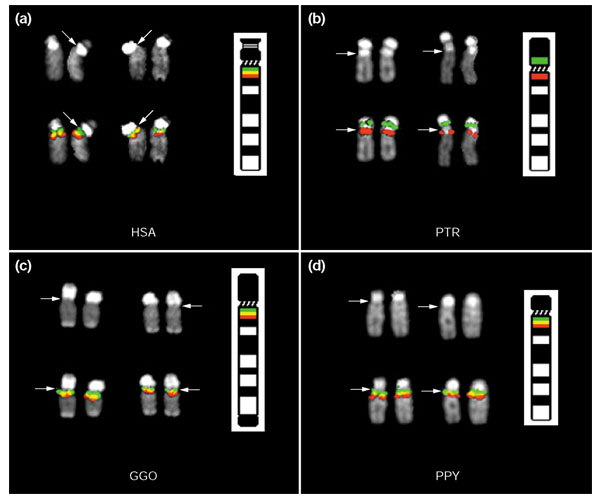
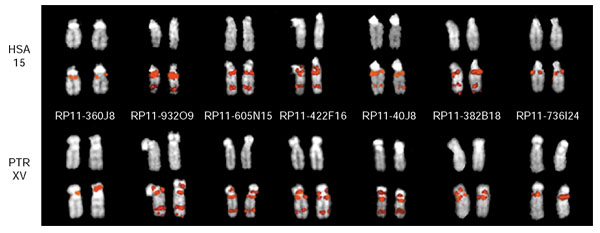
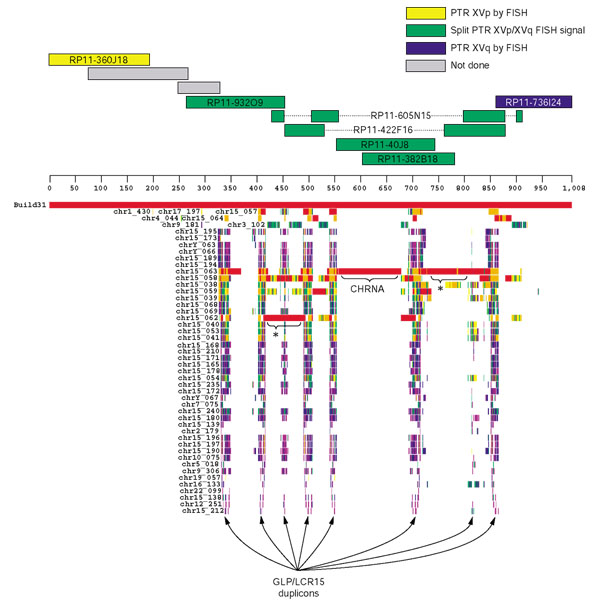
Here we employed a comparative fluorescence in situ hybridization approach, using probes selected from a combination of physical mapping, genomic sequence, and segmental duplication analyses to narrow the breakpoint interval of a pericentric inversion in chimpanzee involving the orthologous human 15q11-q13 region. We have refined the inversion breakpoint of this chimpanzee-specific rearrangement to a 600 kilobase (kb) interval of the human genome consisting of entirely duplicated material. Detailed analysis of the underlying sequence indicated that this region comprises multiple segmental duplications, including a previously characterized duplication of the alpha7 neuronal nicotinic acetylcholine receptor subunit gene (CHRNA7) in 15q13.3 and several Golgin-linked-to-PML, or LCR15, duplications.
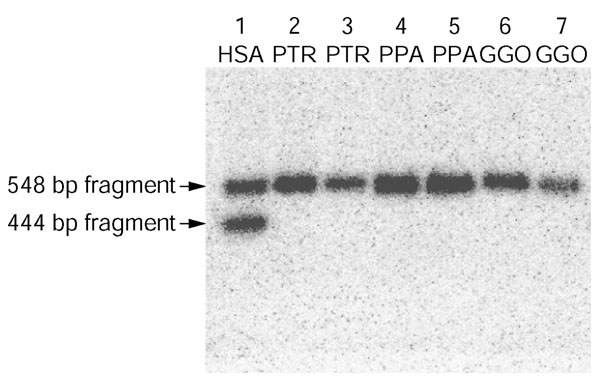
We conclude that, on the basis of experimental data excluding the CHRNA7 duplicon as the site of inversion, and sequence analysis of regional duplications, the most likely rearrangement site is within a GLP/LCR15 duplicon. This study further exemplifies the genomic plasticity due to the presence of segmental duplications and highlights their importance for a complete understanding of genome evolution.
臂间倒位是人类和大猩猩之间最常见的常染色质染色体差异。除了一些组成型异染色质增加和一次染色体融合事件外,人类和黑猩猩的核型因九次此类事件而不同。生殖隔离及随后的物种形成被认为是臂间倒位的潜在结果,因为杂种不育会形成生殖边界。
在此,我们采用了一种比较荧光原位杂交方法,使用从物理图谱、基因组序列和片段重复分析相结合中选择的探针,来缩小黑猩猩中涉及人类直系同源15q11 - q13区域的臂间倒位的断点区间。我们已将这种黑猩猩特异性重排的倒位断点细化到人类基因组的一个600千碱基(kb)区间,该区间完全由重复物质组成。对基础序列的详细分析表明,该区域包含多个片段重复,包括先前在15q13.3中鉴定的α7神经元烟碱型乙酰胆碱受体亚基基因(CHRNA7)的重复以及几个与高尔基体相关的PML或LCR15重复。
我们得出结论,基于排除CHRNA7重复子作为倒位位点的实验数据以及区域重复的序列分析,最可能的重排位点在一个GLP/LCR15重复子内。这项研究进一步例证了由于片段重复的存在而导致的基因组可塑性,并突出了它们对于全面理解基因组进化的重要性。