Choi T L, Kim Y K
Department of Internal Medicine, St. Benedict Hospital, Pusan, Korea.
Korean J Intern Med. 1992 Jul;7(2):130-6. doi: 10.3904/kjim.1992.7.2.130.
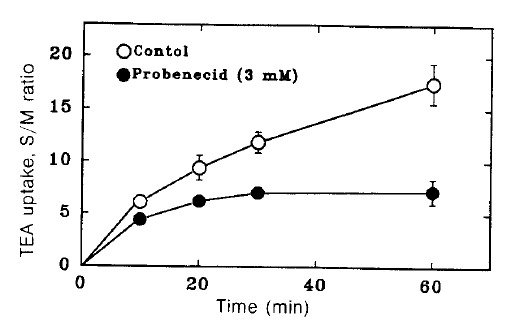
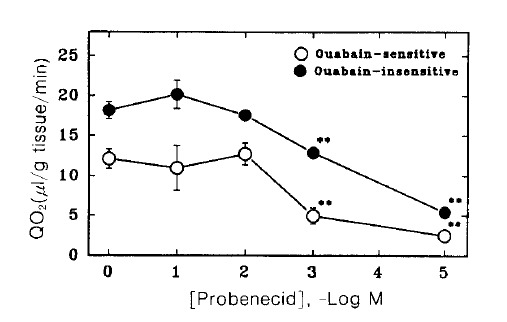
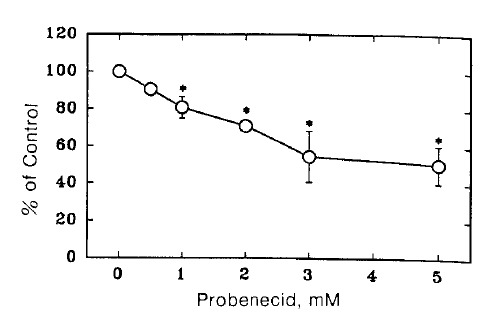
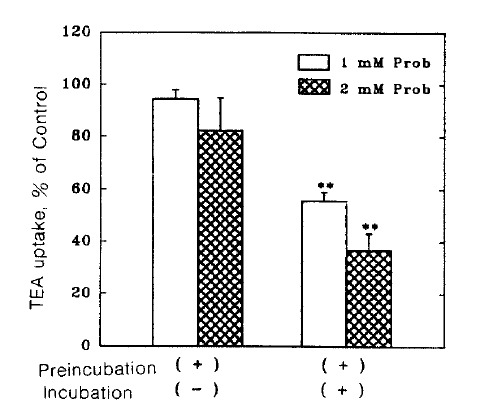
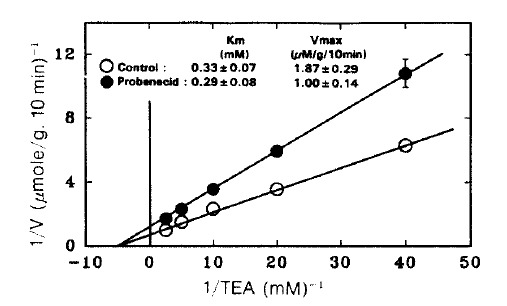
The effect of probenecid on the transport of tetraethylammonium (TEA) was investigated in rabbit reanal cortical slices in an attempt to ascertain the interaction of organic anion with the organic cation transport system in proximal tubule. Probenecid reversibly inhibited TEA uptake by cortical slices in a dose-dependent manner over the concentration range of 1 and 5 mM. The efflux of TEA was not affected by the presence of 3 mM probenecid. Kinetic analysis indicated that probenecid decreased Vmax without a significant change in Km. Probenecid inhibited significantly tissue oxygen consumption at concentrations of 3 and 5 mM. However, probenecid did not significantly reduce TEA uptake in brush border and basolateral membrane vesicles prepared from renal cortex even at higher concentration of 10 mM. These results indicate that probenecid reduces TEA uptake in cortical slices by inhibiting the tissue metabolism rather than by the interaction with the organic cation transporter.
为了确定有机阴离子与近端小管中有机阳离子转运系统的相互作用,研究了丙磺舒对家兔肾皮质切片中四乙铵(TEA)转运的影响。在1至5 mM的浓度范围内,丙磺舒以剂量依赖的方式可逆地抑制皮质切片对TEA的摄取。3 mM丙磺舒的存在并不影响TEA的流出。动力学分析表明,丙磺舒降低了Vmax,但Km没有显著变化。在3 mM和5 mM的浓度下,丙磺舒显著抑制组织耗氧量。然而,即使在10 mM的较高浓度下,丙磺舒也不会显著降低从肾皮质制备的刷状缘和基底外侧膜囊泡对TEA的摄取。这些结果表明,丙磺舒通过抑制组织代谢而非与有机阳离子转运体的相互作用来降低皮质切片对TEA的摄取。