
胆管结扎后大鼠肝脏中胆管样肝细胞的出现以及随后四氯化碳诱导的3区坏死。
Appearance of ductular hepatocytes in rat liver after bile duct ligation and subsequent zone 3 necrosis by carbon tetrachloride.
作者信息
Sirica A E, Williams T W
机构信息
Department of Pathology, Medical College of Virginia, Virginia Commonwealth University, Richmond 23298.
出版信息
Am J Pathol. 1992 Jan;140(1):129-36.
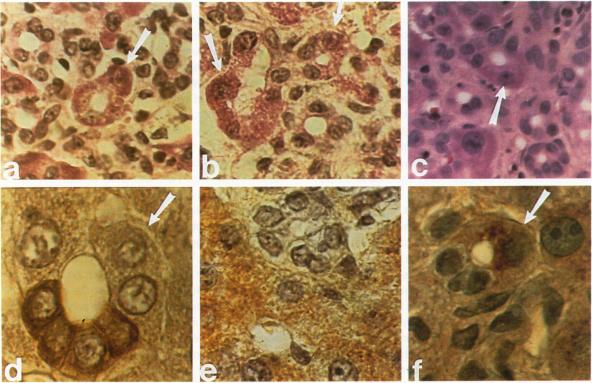
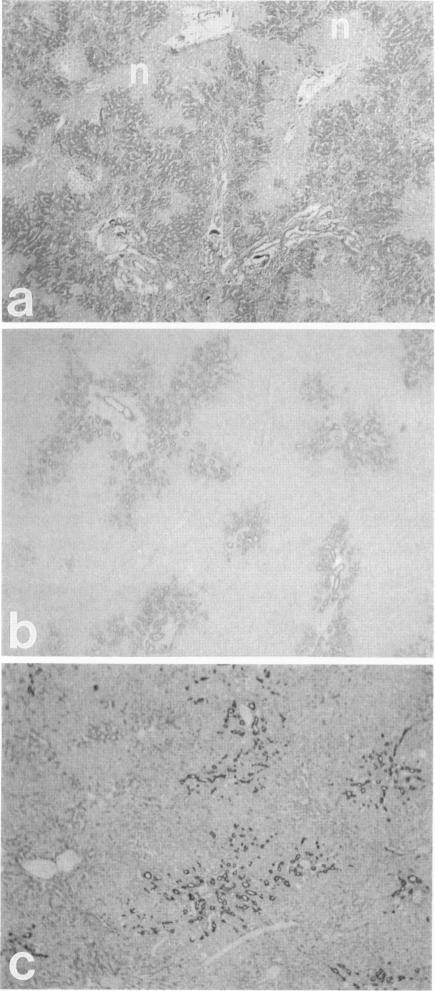
Intrahepatic biliary cell plasticity was investigated in a rat model that combined prior bile ductular cell hyperplasia after bile duct ligation with subsequent CCl4-induced hepatonecrosis. Morphometric analysis of histologic liver sections from rats at 4 to 6 weeks after bile duct ligation and 3 to 5 days after CCl4 demonstrated the total section area to be occupied by near-equal amounts of hyperplastic bile ductular tissue area and hepatonecrotic area. Of particular significance was the unique presence, albeit infrequent, of newly appearing hepatic cell cholangioles composed of both biliary epithelial cells and one or more 'ductular hepatocytes' exclusively within the hyperplastic bile ductular tissue area of liver sections from the bile-duct-ligated/CCl4-treated rats, but not observed in control liver sections. This finding is compatible with the possibility of a 'transdifferentiation' of some hyperplastic biliary epithelial cells into 'ductular hepatocytes' in response to an extreme hepatic injury.
在一个大鼠模型中研究了肝内胆管细胞可塑性,该模型将胆管结扎后先前的胆小管细胞增生与随后的四氯化碳诱导的肝坏死相结合。对胆管结扎后4至6周和四氯化碳处理后3至5天的大鼠肝脏组织切片进行形态计量分析,结果显示增生的胆小管组织区域和肝坏死区域几乎等量占据了整个切片面积。特别重要的是,在胆管结扎/四氯化碳处理大鼠肝脏切片的增生胆小管组织区域内,独特地存在着由胆管上皮细胞和一个或多个“胆小管肝细胞”组成的新出现的肝细胞胆管小体,尽管这种情况并不常见,而在对照肝脏切片中未观察到。这一发现与一些增生的胆管上皮细胞在极端肝损伤时“转分化”为“胆小管肝细胞”的可能性相符。
 Zotero 插件