Polee M B, Hop W C J, Kok T C, Eskens F A L M, van der Burg M E L, Splinter T A W, Siersema P D, Tilanus H W, Stoter G, van der Gaast A
Department of Medical Oncology, Erasmus Medical Center, Rotterdam, The Netherlands.
Br J Cancer. 2003 Dec 1;89(11):2045-50. doi: 10.1038/sj.bjc.6601364.
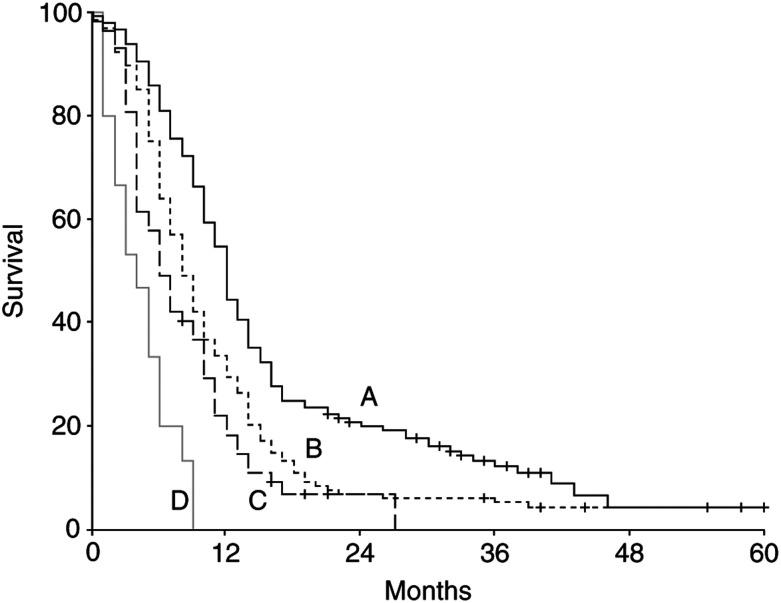
The objective of this study was to identify prognostic factors for survival in patients with advanced oesophageal cancer, who are treated with cisplatin-based combination chemotherapy. We analysed the baseline characteristics of 350 patients who were treated in six consecutive prospective trials with one of the following regimens: cisplatin/etoposide, cisplatin/etoposide/5-fluorouracil, cisplatin/paclitaxel (weekly) and cisplatin/paclitaxel (biweekly). Predictive factors in univariate analyses were further evaluated using multivariate analysis (Cox regression). The median survival of all patients was 9 months. The 1, 2 and 5-year survival rates were 33, 12 and 4%, respectively. The main prognostic factors were found to be WHO performance status (0 or 1 vs 2), lactate dehydrogenase (normal vs elevated), extent of disease (limited disease defined as locoregional irresectable disease or lymph node metastases confined to either the supraclavicular or celiac region vs extensively disseminated disease) in addition to the type of treatment (weekly or biweekly cisplatin/paclitaxel regimen vs 4-weekly cisplatin/etoposide with or without 5-fluorouracil). Although weight loss, liver metastases and alkaline phosphatase were significant prognostic factors in univariate analyses, these factors lost their significance in multivariate analyses. The median survival for patients without any risk factors was 12 months, compared to only 4 months in patients with WHO 2 plus elevated LDH and extensive disease. The performance status, extent of disease, LDH and the addition of paclitaxel to cisplatin are independent prognostic factors in patients with advanced oesophageal cancer, who are treated with cisplatin-based combination chemotherapy.
本研究的目的是确定接受以顺铂为基础的联合化疗的晚期食管癌患者的生存预后因素。我们分析了350例患者的基线特征,这些患者在六项连续的前瞻性试验中接受了以下方案之一的治疗:顺铂/依托泊苷、顺铂/依托泊苷/5-氟尿嘧啶、顺铂/紫杉醇(每周一次)和顺铂/紫杉醇(每两周一次)。单因素分析中的预测因素使用多因素分析(Cox回归)进一步评估。所有患者的中位生存期为9个月。1年、2年和5年生存率分别为33%、12%和4%。主要预后因素包括世界卫生组织(WHO)表现状态(0或1对比2)、乳酸脱氢酶(正常对比升高)、疾病范围(局限性疾病定义为局部不可切除疾病或局限于锁骨上或腹腔区域的淋巴结转移对比广泛播散性疾病),此外还有治疗类型(每周或每两周一次的顺铂/紫杉醇方案对比每四周一次的顺铂/依托泊苷,加或不加5-氟尿嘧啶)。尽管体重减轻、肝转移和碱性磷酸酶在单因素分析中是显著的预后因素,但这些因素在多因素分析中失去了意义。无任何危险因素的患者中位生存期为12个月,而WHO表现状态为2且乳酸脱氢酶升高及疾病广泛的患者中位生存期仅为4个月。表现状态、疾病范围、乳酸脱氢酶以及顺铂加用紫杉醇是接受以顺铂为基础的联合化疗的晚期食管癌患者的独立预后因素。