• 文献检索
  • 文档翻译
  • 深度研究
  • 学术资讯
  • Suppr Zotero 插件Zotero 插件
  • 邀请有礼
  • 套餐&价格
  • 历史记录
应用&插件
Suppr Zotero 插件Zotero 插件浏览器插件Mac 客户端Windows 客户端微信小程序
定价
高级版会员购买积分包购买API积分包
服务
文献检索文档翻译深度研究API 文档MCP 服务
关于我们
关于 Suppr公司介绍联系我们用户协议隐私条款
关注我们

Suppr 超能文献

核心技术专利:CN118964589B侵权必究
粤ICP备2023148730 号-1Suppr @ 2026

文献检索

告别复杂PubMed语法,用中文像聊天一样搜索,搜遍4000万医学文献。AI智能推荐,让科研检索更轻松。

立即免费搜索

文件翻译

保留排版,准确专业,支持PDF/Word/PPT等文件格式,支持 12+语言互译。

免费翻译文档

深度研究

AI帮你快速写综述,25分钟生成高质量综述,智能提取关键信息,辅助科研写作。

立即免费体验

N-甲基-N'-硝基-N-亚硝基胍诱导结肠癌细胞出现衰老样生长停滞,这与腺瘤性息肉病大肠杆菌蛋白缺失、微管组织及端粒DNA有关。

N-methyl-N'-nitro-N-nitrosoguanidine-induced senescence-like growth arrest in colon cancer cells is associated with loss of adenomatous polyposis coli protein, microtubule organization, and telomeric DNA.

作者信息

Jaiswal Aruna S, Multani Asha S, Pathak Sen, Narayan Satya

机构信息

UF Shands Cancer Center and Anatomy and Cell Biology, College of Medicine, Academic Research Building, Room R4-216, PO Box 100232, University of Florida, Gainesville, FL 32610, USA.

出版信息

Mol Cancer. 2004 Jan 16;3:3. doi: 10.1186/1476-4598-3-3.

DOI:10.1186/1476-4598-3-3
PMID:14728717
原文链接:https://pmc.ncbi.nlm.nih.gov/articles/PMC320492/
Abstract

BACKGROUND

Cellular senescence is a state in which mammalian cells enter into an irreversible growth arrest and altered biological functions. The senescence response in mammalian cells can be elicited by DNA-damaging agents. In the present study we report that the DNA-damaging agent N-methyl-N'-nitro-N-nitrosoguanidine (MNNG) is able to induce senescence in the HCT-116 colon cancer cell line.

RESULTS

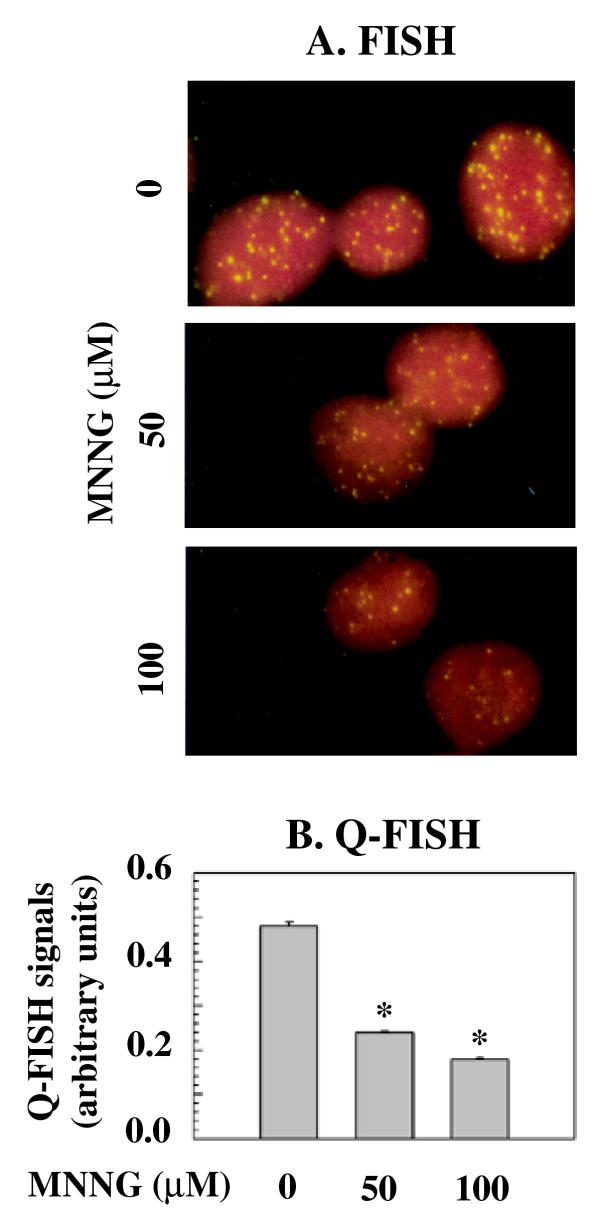
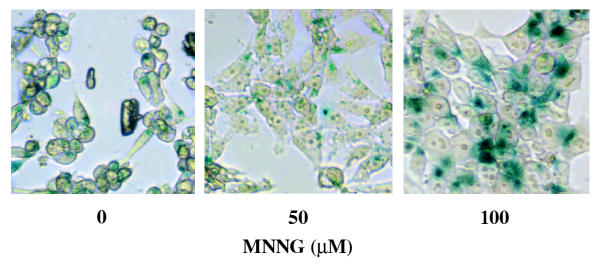
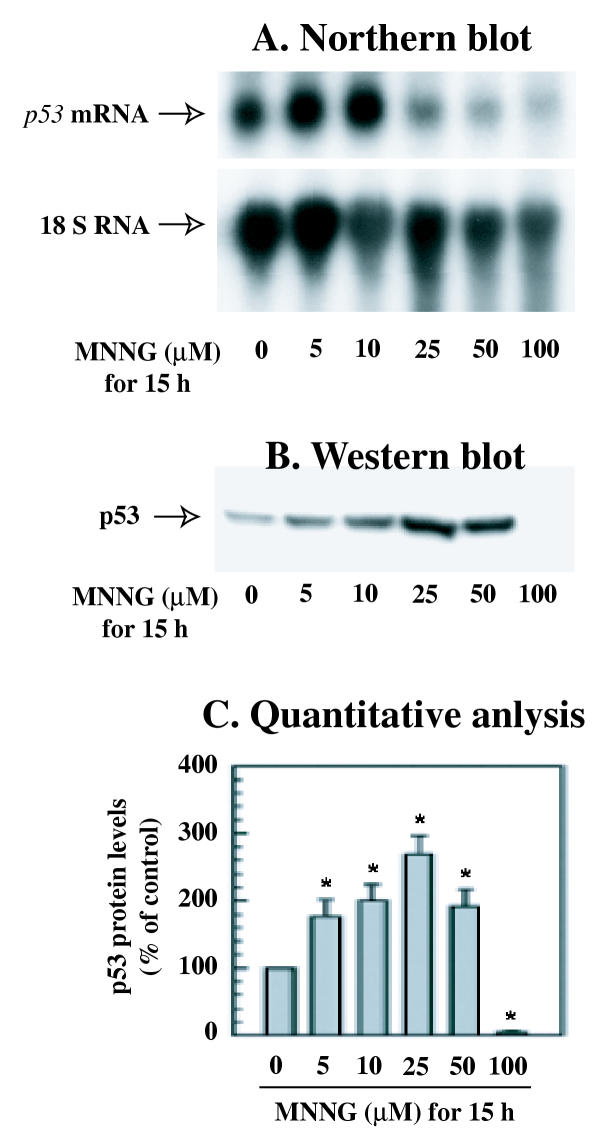
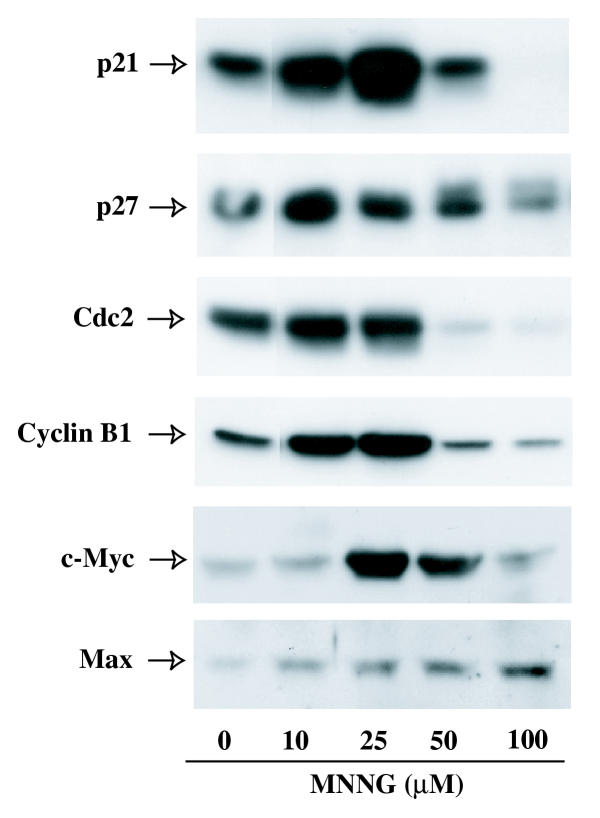
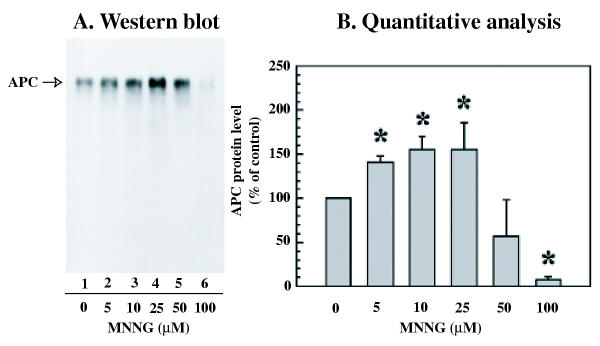
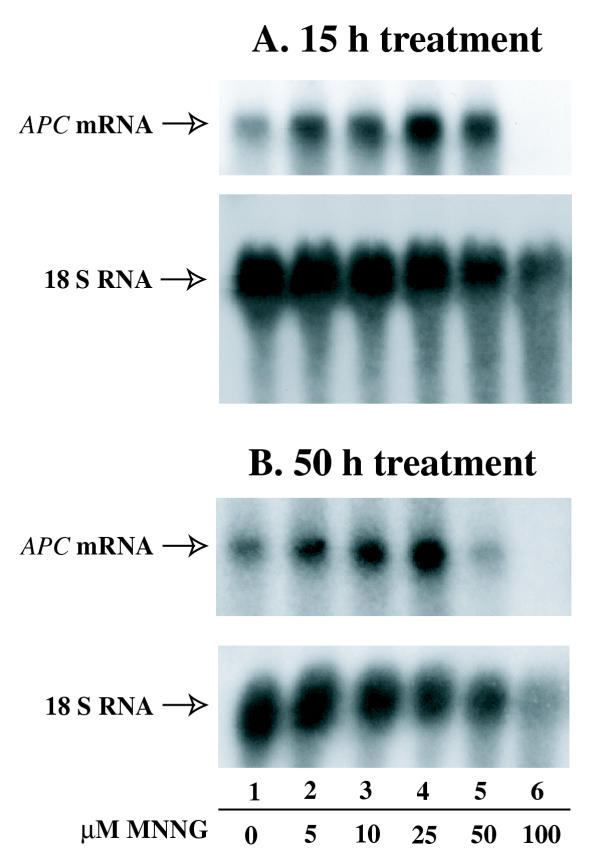
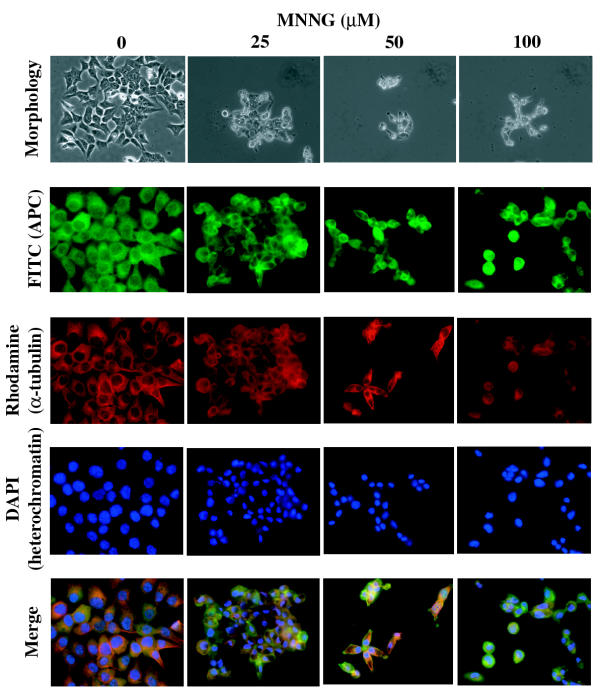
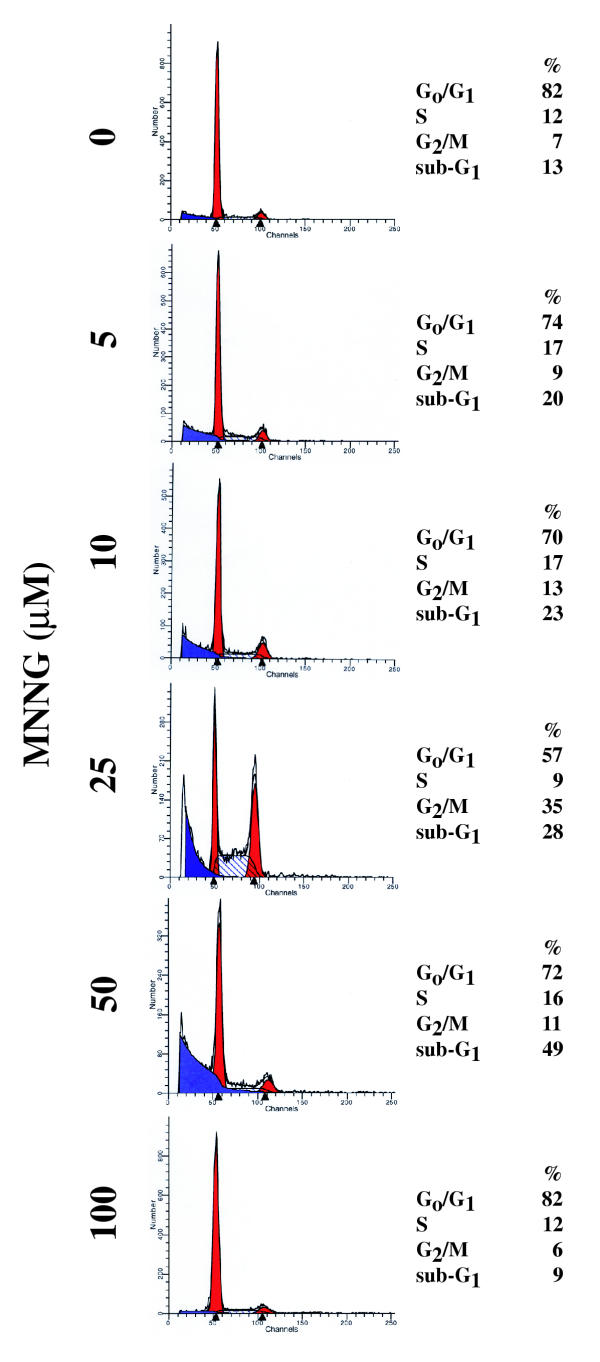
Cells treated with lower concentrations of MNNG (0-25 microM) for 50 h showed a dose-dependent increase in G2/M phase arrest and apoptosis; however, cells treated with higher concentrations of MNNG (50-100 microM) showed a senescence-like G0/G1 phase arrest which was confirmed by increased expression of beta-galactosidase, a senescence induced marker. The G2/M phase arrest and apoptosis were found to be associated with increased levels of p53 protein, but the senescence-like G0/G1 phase arrest was dissociated with p53 protein levels, since the p53 protein levels decreased in senescence-like arrested cells. We further, determined whether the decreased level of p53 was a transcriptional or a translational phenomenon. The results revealed that the decreased level of p53 protein in senescence-like arrested cells was a transcriptional phenomenon since p53 mRNA levels simultaneously decreased after treatment with higher concentrations of MNNG. We also examined the effect of MNNG treatment on other cell cycle-related proteins such as p21, p27, cyclin B1, Cdc2, c-Myc and max. The expression levels of these proteins were increased in cells treated with lower concentrations of MNNG, which supported the G2/M phase arrest. However, cells treated with higher concentrations of MNNG showed decreased levels of these proteins, and hence, may not play a role in cell cycle arrest. We then examined a possible association of the expression of APC protein and telomeric DNA signals with cellular senescence in MNNG-treated cells. We found that protein and mRNA levels of APC were drastically reduced in cells treated with higher concentrations of MNNG. The loss of APC expression might lead to chromosomal instability as well as microtubular disorganization through its dissociation with tubulin. In fact, the protein level of alpha-tubulin was also drastically decreased in senescence-like arrested cells treated with higher concentrations of MNNG. The levels of telomeric DNA also decreased in cells treated with higher concentrations of MNNG.

CONCLUSIONS

These results suggest that in response to DNA alkylation damage the senescence-like arrest of HCT-116 cells was associated with decreased levels of APC protein, microtubular organization, and telomeric DNA.

摘要

背景

细胞衰老指的是哺乳动物细胞进入不可逆生长停滞并伴有生物学功能改变的一种状态。DNA损伤剂可引发哺乳动物细胞的衰老反应。在本研究中,我们报告DNA损伤剂N-甲基-N'-硝基-N-亚硝基胍(MNNG)能够在HCT-116结肠癌细胞系中诱导衰老。

结果

用较低浓度(0 - 25微摩尔)的MNNG处理细胞50小时,细胞在G2/M期停滞和凋亡方面呈现剂量依赖性增加;然而,用较高浓度(50 - 100微摩尔)的MNNG处理的细胞表现出类似衰老的G0/G1期停滞,这通过衰老诱导标志物β-半乳糖苷酶表达增加得到证实。发现G2/M期停滞和凋亡与p53蛋白水平升高有关,但类似衰老的G0/G1期停滞与p53蛋白水平无关,因为在类似衰老停滞的细胞中p53蛋白水平降低。我们进一步确定p53水平降低是转录现象还是翻译现象。结果表明,在类似衰老停滞的细胞中p53蛋白水平降低是转录现象,因为用较高浓度的MNNG处理后p53 mRNA水平同时降低。我们还检测了MNNG处理对其他细胞周期相关蛋白如p21、p27、细胞周期蛋白B1、Cdc2、c-Myc和max的影响。在用较低浓度MNNG处理的细胞中,这些蛋白的表达水平升高,这支持了G2/M期停滞。然而,用较高浓度MNNG处理的细胞这些蛋白水平降低,因此可能在细胞周期停滞中不起作用。然后我们检测了MNNG处理细胞中APC蛋白表达和端粒DNA信号与细胞衰老之间可能的关联。我们发现用较高浓度MNNG处理的细胞中APC的蛋白和mRNA水平大幅降低。APC表达缺失可能通过其与微管蛋白解离导致染色体不稳定以及微管紊乱。事实上,在用较高浓度MNNG处理的类似衰老停滞的细胞中α-微管蛋白的蛋白水平也大幅降低。用较高浓度MNNG处理的细胞中端粒DNA水平也降低。

结论

这些结果表明,响应DNA烷基化损伤,HCT-116细胞的类似衰老停滞与APC蛋白水平降低、微管组织和端粒DNA有关。
https://cdn.ncbi.nlm.nih.gov/pmc/blobs/d347/320492/238a5626185a/1476-4598-3-3-8.jpg
https://cdn.ncbi.nlm.nih.gov/pmc/blobs/d347/320492/fc2a26fd349e/1476-4598-3-3-1.jpg
https://cdn.ncbi.nlm.nih.gov/pmc/blobs/d347/320492/4dc2fc0702fd/1476-4598-3-3-2.jpg
https://cdn.ncbi.nlm.nih.gov/pmc/blobs/d347/320492/9205dd13cba6/1476-4598-3-3-3.jpg
https://cdn.ncbi.nlm.nih.gov/pmc/blobs/d347/320492/76c9a364a265/1476-4598-3-3-4.jpg
https://cdn.ncbi.nlm.nih.gov/pmc/blobs/d347/320492/b8db02519d2f/1476-4598-3-3-5.jpg
https://cdn.ncbi.nlm.nih.gov/pmc/blobs/d347/320492/ff243c9489ab/1476-4598-3-3-6.jpg
https://cdn.ncbi.nlm.nih.gov/pmc/blobs/d347/320492/e6bbfec45013/1476-4598-3-3-7.jpg
https://cdn.ncbi.nlm.nih.gov/pmc/blobs/d347/320492/238a5626185a/1476-4598-3-3-8.jpg
https://cdn.ncbi.nlm.nih.gov/pmc/blobs/d347/320492/fc2a26fd349e/1476-4598-3-3-1.jpg
https://cdn.ncbi.nlm.nih.gov/pmc/blobs/d347/320492/4dc2fc0702fd/1476-4598-3-3-2.jpg
https://cdn.ncbi.nlm.nih.gov/pmc/blobs/d347/320492/9205dd13cba6/1476-4598-3-3-3.jpg
https://cdn.ncbi.nlm.nih.gov/pmc/blobs/d347/320492/76c9a364a265/1476-4598-3-3-4.jpg
https://cdn.ncbi.nlm.nih.gov/pmc/blobs/d347/320492/b8db02519d2f/1476-4598-3-3-5.jpg
https://cdn.ncbi.nlm.nih.gov/pmc/blobs/d347/320492/ff243c9489ab/1476-4598-3-3-6.jpg
https://cdn.ncbi.nlm.nih.gov/pmc/blobs/d347/320492/e6bbfec45013/1476-4598-3-3-7.jpg
https://cdn.ncbi.nlm.nih.gov/pmc/blobs/d347/320492/238a5626185a/1476-4598-3-3-8.jpg

相似文献

1
N-methyl-N'-nitro-N-nitrosoguanidine-induced senescence-like growth arrest in colon cancer cells is associated with loss of adenomatous polyposis coli protein, microtubule organization, and telomeric DNA.N-甲基-N'-硝基-N-亚硝基胍诱导结肠癌细胞出现衰老样生长停滞,这与腺瘤性息肉病大肠杆菌蛋白缺失、微管组织及端粒DNA有关。
Mol Cancer. 2004 Jan 16;3:3. doi: 10.1186/1476-4598-3-3.
2
Induction of apoptosis and G2/M arrest by N-methyl-N'-nitro-N-nitrosoguanidine in human prostate carcinoma cells.
Mutat Res. 2004 Oct 10;563(2):139-49. doi: 10.1016/j.mrgentox.2004.06.007.
3
Apoptosis or senescence-like growth arrest: influence of cell-cycle position, p53, p21 and bax in H2O2 response of normal human fibroblasts.凋亡或衰老样生长停滞:细胞周期位置、p53、p21和bax对正常人成纤维细胞H2O2反应的影响
Biochem J. 2000 Apr 15;347(Pt 2):543-51. doi: 10.1042/0264-6021:3470543.
4
Cell cycle was disturbed in the MNNG-induced initiation stage during in vitro two-stage transformation of Balb/3T3 cells.
Toxicology. 2001 Jun 21;163(2-3):175-84. doi: 10.1016/s0300-483x(01)00400-0.
5
Zinc stabilizes adenomatous polyposis coli (APC) protein levels and induces cell cycle arrest in colon cancer cells.锌可稳定腺瘤性结肠息肉病蛋白(APC)的水平,并诱导结肠癌细胞的细胞周期停滞。
J Cell Biochem. 2004 Oct 1;93(2):345-57. doi: 10.1002/jcb.20156.
6
Low concentrations of paclitaxel induce cell type-dependent p53, p21 and G1/G2 arrest instead of mitotic arrest: molecular determinants of paclitaxel-induced cytotoxicity.低浓度紫杉醇诱导细胞类型依赖性的p53、p21和G1/G2期阻滞而非有丝分裂阻滞:紫杉醇诱导细胞毒性的分子决定因素
Oncogene. 2001 Jun 28;20(29):3806-13. doi: 10.1038/sj.onc.1204487.
7
Molecular mechanisms underlying interferon-alpha-induced G0/G1 arrest: CKI-mediated regulation of G1 Cdk-complexes and activation of pocket proteins.α干扰素诱导G0/G1期阻滞的分子机制:细胞周期蛋白依赖性激酶抑制剂介导的G1期细胞周期蛋白依赖性激酶复合物调控及口袋蛋白激活。
Oncogene. 1999 May 6;18(18):2798-810. doi: 10.1038/sj.onc.1202609.
8
G1 versus G2 cell cycle arrest after adriamycin-induced damage in mouse Swiss3T3 cells.阿霉素诱导损伤后小鼠瑞士3T3细胞中G1期与G2期细胞周期停滞
FEBS Lett. 1999 Nov 19;461(3):299-305. doi: 10.1016/s0014-5793(99)01481-7.
9
Evidence for a connection between the mismatch repair system and the G2 cell cycle checkpoint.错配修复系统与G2细胞周期检查点之间存在关联的证据。
Cancer Res. 1995 Sep 1;55(17):3721-5.
10
Protein synthesis and transcriptional inhibitors control N-methyl-N'-nitro-N-nitrosoguanidine-induced levels of APC mRNA in a p53-dependent manner.蛋白质合成和转录抑制剂以p53依赖的方式控制N-甲基-N'-硝基-N-亚硝基胍诱导的APC mRNA水平。
Int J Oncol. 1998 Oct;13(4):733-40. doi: 10.3892/ijo.13.4.733.

引用本文的文献

1
Wnt/β-catenin signaling pathway: proteins' roles in osteoporosis and cancer diseases and the regulatory effects of natural compounds on osteoporosis.Wnt/β-连环蛋白信号通路:蛋白质在骨质疏松症和癌症疾病中的作用以及天然化合物对骨质疏松症的调节作用。
Mol Med. 2024 Oct 28;30(1):193. doi: 10.1186/s10020-024-00957-x.
2
The hypoxia-activated prodrug evofosfamide in combination with multiple regimens of radiotherapy.缺氧激活前药依沃福司胺与多种放疗方案联合使用。
Oncotarget. 2017 Apr 4;8(14):23702-23712. doi: 10.18632/oncotarget.15784.
3
NSC666715 and Its Analogs Inhibit Strand-Displacement Activity of DNA Polymerase β and Potentiate Temozolomide-Induced DNA Damage, Senescence and Apoptosis in Colorectal Cancer Cells.

本文引用的文献

1
Role of APC and DNA mismatch repair genes in the development of colorectal cancers.APC和DNA错配修复基因在结直肠癌发生发展中的作用。
Mol Cancer. 2003 Dec 12;2:41. doi: 10.1186/1476-4598-2-41.
2
A DNA damage checkpoint response in telomere-initiated senescence.端粒引发的衰老中的DNA损伤检查点反应。
Nature. 2003 Nov 13;426(6963):194-8. doi: 10.1038/nature02118. Epub 2003 Nov 5.
3
THE LIMITED IN VITRO LIFETIME OF HUMAN DIPLOID CELL STRAINS.人二倍体细胞株的体外寿命有限。
NSC666715及其类似物抑制DNA聚合酶β的链置换活性,并增强替莫唑胺诱导的大肠癌细胞DNA损伤、衰老和凋亡。
PLoS One. 2015 May 1;10(5):e0123808. doi: 10.1371/journal.pone.0123808. eCollection 2015.
4
A drug-induced accelerated senescence (DIAS) is a possibility to study aging in time lapse.药物诱导的加速衰老(DIAS)是一种在时间推移中研究衰老的可能性。
Age (Dordr). 2014 Jun;36(3):9658. doi: 10.1007/s11357-014-9658-8. Epub 2014 May 16.
5
Antiproliferative effects of fluoxetine on colon cancer cells and in a colonic carcinogen mouse model.氟西汀对结肠癌细胞的抗增殖作用及其在结直肠致癌物小鼠模型中的作用。
PLoS One. 2012;7(11):e50043. doi: 10.1371/journal.pone.0050043. Epub 2012 Nov 27.
6
Chalcone-imidazolone conjugates induce apoptosis through DNA damage pathway by affecting telomeres.查尔酮-咪唑啉酮缀合物通过影响端粒,通过 DNA 损伤途径诱导细胞凋亡。
Cancer Cell Int. 2011 Apr 25;11:11. doi: 10.1186/1475-2867-11-11.
7
Selective down-regulation of nuclear poly(ADP-ribose) glycohydrolase.核聚(ADP - 核糖)糖苷水解酶的选择性下调
PLoS One. 2009;4(3):e4896. doi: 10.1371/journal.pone.0004896. Epub 2009 Mar 25.
8
Activated Kras, but not Hras or Nras, may initiate tumors of endodermal origin via stem cell expansion.激活的Kras而非Hras或Nras,可能通过干细胞扩增引发内胚层起源的肿瘤。
Mol Cell Biol. 2008 Apr;28(8):2659-74. doi: 10.1128/MCB.01661-07. Epub 2008 Feb 11.
9
Methylator-induced, mismatch repair-dependent G2 arrest is activated through Chk1 and Chk2.甲基化诱导的、错配修复依赖性的G2期阻滞通过Chk1和Chk2激活。
Mol Biol Cell. 2005 Mar;16(3):1513-26. doi: 10.1091/mbc.e04-02-0089. Epub 2005 Jan 12.
Exp Cell Res. 1965 Mar;37:614-36. doi: 10.1016/0014-4827(65)90211-9.
4
The serial cultivation of human diploid cell strains.人二倍体细胞株的连续培养。
Exp Cell Res. 1961 Dec;25:585-621. doi: 10.1016/0014-4827(61)90192-6.
5
Werner syndrome protein limits MYC-induced cellular senescence.沃纳综合征蛋白限制MYC诱导的细胞衰老。
Genes Dev. 2003 Jul 1;17(13):1569-74. doi: 10.1101/gad.1100303.
6
hMad4, c-Myc endogenous inhibitor, induces a replicative senescence-like state when overexpressed in human fibroblasts.hMad4是c-Myc内源性抑制剂,在人成纤维细胞中过表达时会诱导类似复制性衰老的状态。
J Cell Biochem. 2003 Jun 1;89(3):576-88. doi: 10.1002/jcb.10517.
7
The role of the cyclin-dependent kinase inhibitor p21 in apoptosis.细胞周期蛋白依赖性激酶抑制剂p21在细胞凋亡中的作用。
Mol Cancer Ther. 2002 Jun;1(8):639-49.
8
Long-patch base excision repair of apurinic/apyrimidinic site DNA is decreased in mouse embryonic fibroblast cell lines treated with plumbagin: involvement of cyclin-dependent kinase inhibitor p21Waf-1/Cip-1.在用白花丹醌处理的小鼠胚胎成纤维细胞系中,无嘌呤/无嘧啶位点DNA的长片段碱基切除修复减少:细胞周期蛋白依赖性激酶抑制剂p21Waf-1/Cip-1的作用。
Oncogene. 2002 Aug 29;21(38):5912-22. doi: 10.1038/sj.onc.1205789.
9
Live or let die: the cell's response to p53.生存还是死亡:细胞对p53的反应。
Nat Rev Cancer. 2002 Aug;2(8):594-604. doi: 10.1038/nrc864.
10
The subcellular destinations of APC proteins.腺瘤性息肉病(APC)蛋白的亚细胞定位
Nat Rev Mol Cell Biol. 2002 May;3(5):328-38. doi: 10.1038/nrm806.