Goode Ellen L, Badzioch Michael D, Kim Helen, Gagnon France, Rozek Laura S, Edwards Karen L, Jarvik Gail P
Cancer Prevention Research Program, Fred Hutchinson Cancer Research Center, Seattle, Washington, USA.
BMC Genet. 2003 Dec 31;4 Suppl 1(Suppl 1):S102. doi: 10.1186/1471-2156-4-S1-S102.
Cigarette smoking behavior may have a genetic basis. We assessed evidence for quantitative trait loci (QTLs) affecting the maximum number of cigarettes smoked per day, a trait meant to quantify this behavior, using data collected over 40 years as part of the Framingham Heart Study's original and offspring cohorts.
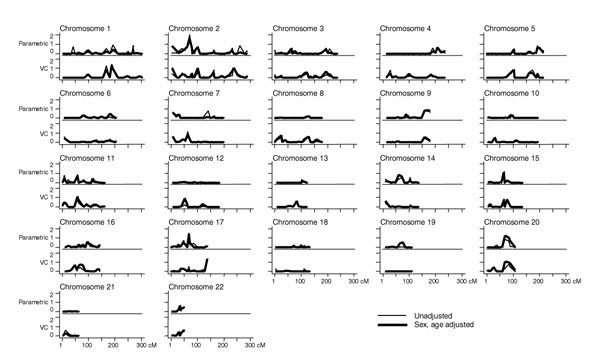
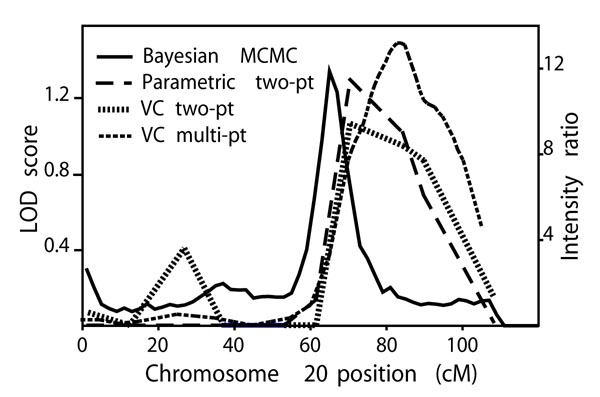
Heritability was estimated to be approximately 21% using variance components (VC) methods (SOLAR), while oligogenic linkage and segregation analysis based on Bayesian Markov chain Monte Carlo (MCMC) methods (LOKI) estimated a mean of two large QTLs contributing approximately 28% and 20%, respectively, to the trait's variance. Genome-wide parametric (FASTLINK) and VC linkage analyses (SOLAR) revealed several LOD scores greater than 1.0, with peak LOD scores using both methods on chromosomes 2, 17, and 20; multi-point MCMC methods followed up on these chromosomes. The most robust linkage results were for a QTL between 65 and 84 cM on chromosome 20 with signals from multiple sex- and age-adjusted analyses including two-point LOD scores of 1.30 (parametric) and 1.07 (heritability = 0.17, VC) at 70.51 cM, a multi-point LOD score of 1.50 (heritability = 0.20, VC) at 84 cM, and an intensity ratio of 12.0 (MCMC) at 65 cM.
Familial aggregation of the maximum number of cigarettes smoked per day was consistent with a genetic component to this behavior, and oligogenic segregation analyses using MCMC suggested two important QTLs. Linkage signals on chromosome 20 between 65 and 84 cM were seen using multiple analytical methods. No linkage result, however, met genome-wide statistical significance criteria, and the true relationship between these regions and smoking behavior remains unclear.
吸烟行为可能具有遗传基础。我们利用作为弗雷明汉心脏研究原始队列和后代队列一部分在40多年间收集的数据,评估了影响每日吸烟最大量(该性状用于量化此行为)的数量性状基因座(QTL)的证据。
使用方差成分(VC)方法(SOLAR)估计遗传度约为21%,而基于贝叶斯马尔可夫链蒙特卡罗(MCMC)方法(LOKI)的寡基因连锁和分离分析估计平均有两个大的QTL,分别对该性状的方差贡献约28%和20%。全基因组参数(FASTLINK)和VC连锁分析(SOLAR)显示了几个大于1.0的LOD分数,两种方法在2号、17号和20号染色体上的LOD分数峰值最高;多点MCMC方法对这些染色体进行了后续分析。最稳健的连锁结果是20号染色体上65至84厘摩之间的一个QTL,来自多种性别和年龄调整分析的信号包括在70.51厘摩处的两点LOD分数1.30(参数法)和1.07(遗传度 = 0.17,VC法)、在84厘摩处的多点LOD分数1.50(遗传度 = 0.20,VC法)以及在65厘摩处的强度比12.0(MCMC法)。
每日吸烟最大量的家族聚集与该行为的遗传成分一致,使用MCMC的寡基因分离分析提示了两个重要的QTL。使用多种分析方法在20号染色体65至84厘摩之间发现了连锁信号。然而,没有连锁结果达到全基因组统计显著性标准,这些区域与吸烟行为之间的真实关系仍不清楚。