Tandle Anita, Blazer Dan G, Libutti Steven K
Surgery Branch, Center for Cancer Research, National Cancer Institute, Bethesda, MD 20892 USA.
J Transl Med. 2004 Jun 25;2(1):22. doi: 10.1186/1479-5876-2-22.
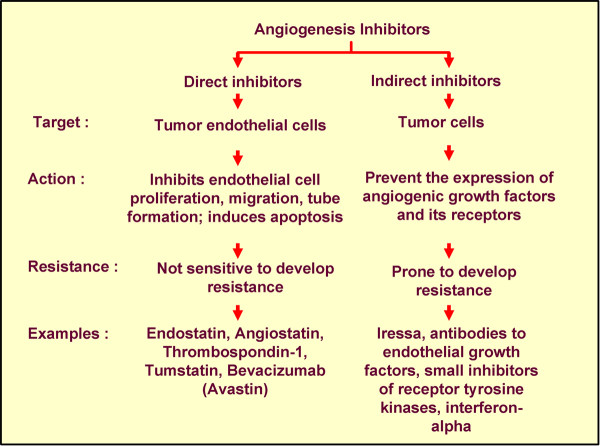
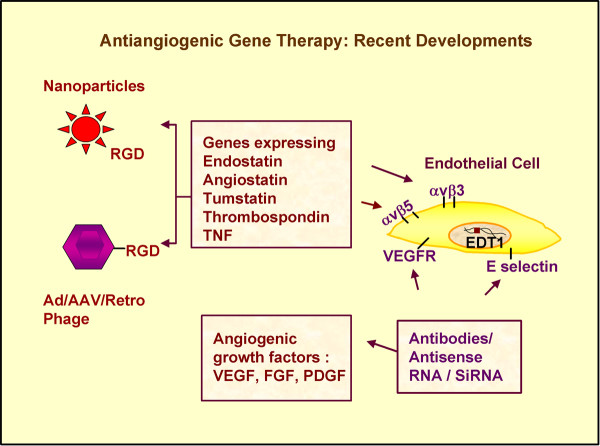
With the role of angiogenesis in tumor growth and progression firmly established, considerable effort has been directed to antiangiogenic therapy as a new modality to treat human cancers. Antiangiogenic agents have recently received much widespread attention but strategies for their optimal use are still being developed. Gene therapy represents an attractive alternative to recombinant protein administration for several reasons. This review evaluates the potential advantages of gene transfer for antiangiogenic cancer therapy and describes preclinical gene transfer work with endogenous angiogenesis inhibitors demonstrating the feasibility of effectively suppressing and even eradicating tumors in animal models. Additionally, we describe the advantages and disadvantages of currently available gene transfer vectors and update novel developments in this field. In conclusion, gene therapy holds great promise in advancing antiangiogenesis as an effective cancer therapy and will undoubtedly be evaluated in human clinical trials in the near future.
随着血管生成在肿瘤生长和进展中的作用得到明确确立,人们已付出巨大努力将抗血管生成疗法作为治疗人类癌症的一种新方法。抗血管生成药物最近受到了广泛关注,但仍在开发其最佳使用策略。由于多种原因,基因治疗是重组蛋白给药的一种有吸引力的替代方法。本综述评估了基因转移在抗血管生成癌症治疗中的潜在优势,并描述了使用内源性血管生成抑制剂的临床前基因转移工作,证明了在动物模型中有效抑制甚至根除肿瘤的可行性。此外,我们描述了当前可用基因转移载体的优缺点,并介绍了该领域的新进展。总之,基因治疗在推进抗血管生成作为一种有效的癌症治疗方法方面具有巨大潜力,并且无疑将在不久的将来在人类临床试验中进行评估。