
调节性T细胞可阻止对低免疫原性黑色素瘤的伴随肿瘤免疫。
Concomitant tumor immunity to a poorly immunogenic melanoma is prevented by regulatory T cells.
作者信息
Turk Mary Jo, Guevara-Patiño José A, Rizzuto Gabrielle A, Engelhorn Manuel E, Sakaguchi Shimon, Houghton Alan N
机构信息
The Swim Across America Laboratory of Tumor Immunology, Memorial Sloan-Kettering Cancer Center, 1275 York Ave., New York, NY 10021, USA.
出版信息
J Exp Med. 2004 Sep 20;200(6):771-82. doi: 10.1084/jem.20041130.
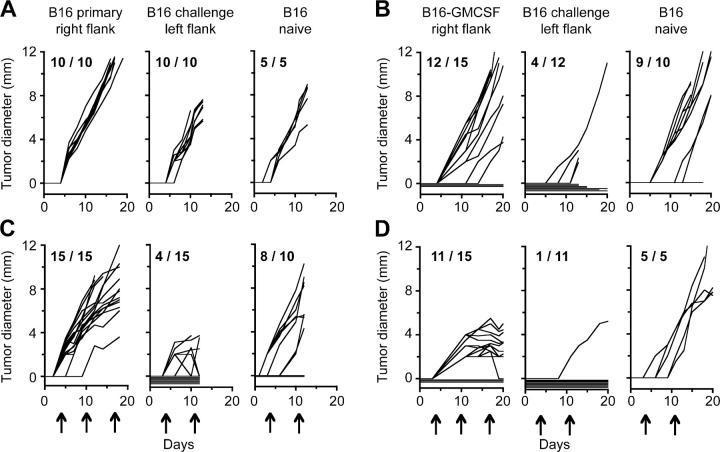
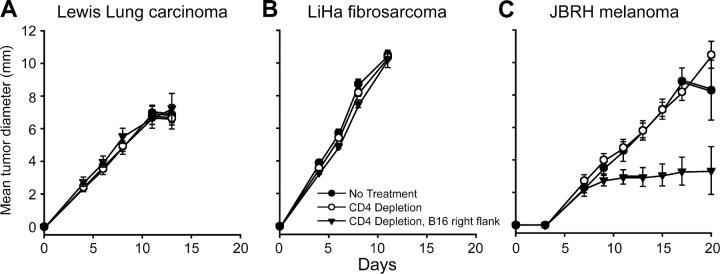
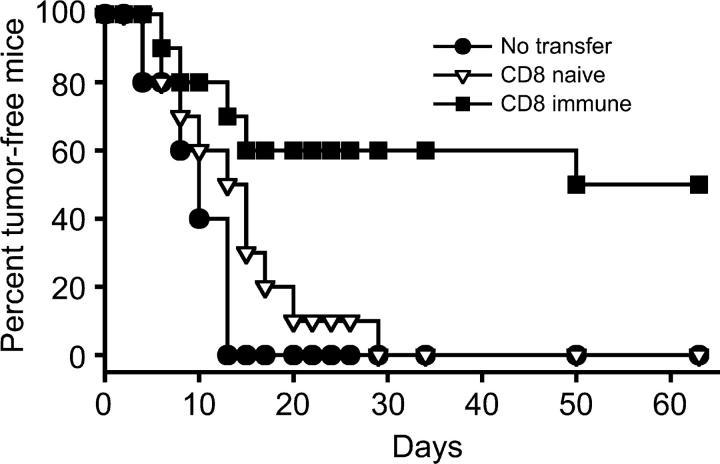
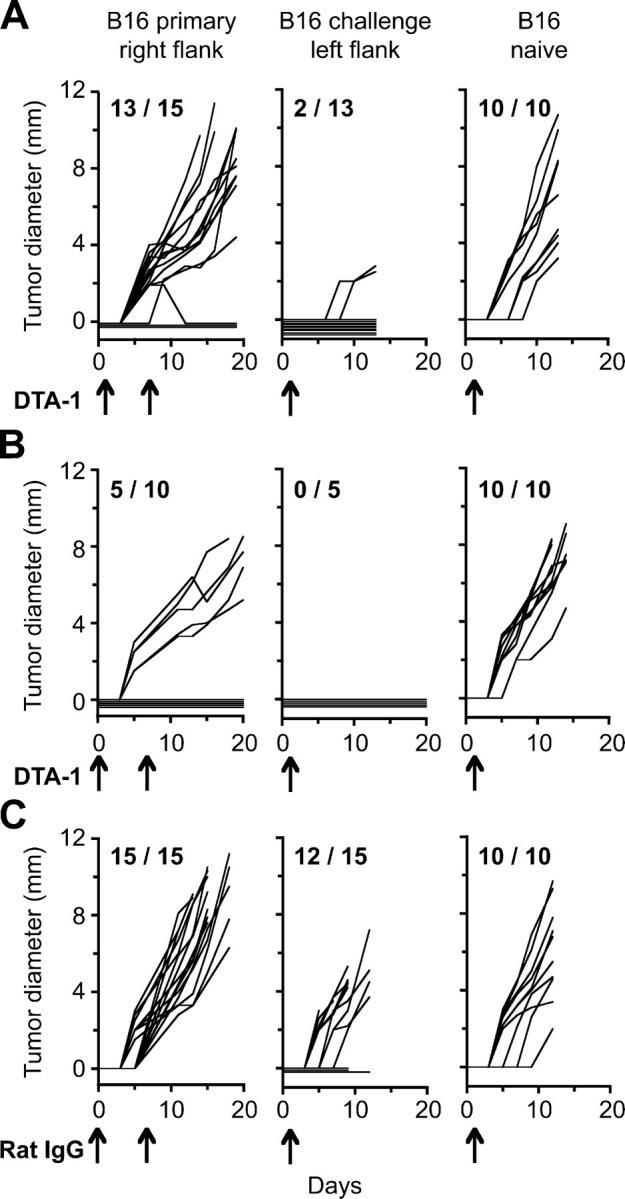
Concomitant tumor immunity describes immune responses in a host with a progressive tumor that rejects the same tumor at a remote site. In this work, concomitant tumor immunity was investigated in mice bearing poorly immunogenic B16 melanoma. Progression of B16 tumors did not spontaneously elicit concomitant immunity. However, depletion of CD4(+) T cells in tumor-bearing mice resulted in CD8(+) T cell-mediated rejection of challenge tumors given on day 6. Concomitant immunity was also elicited by treatment with cyclophosphamide or DTA-1 monoclonal antibody against the glucocorticoid-induced tumor necrosis factor receptor. Immunity elicited by B16 melanoma cross-reacted with a distinct syngeneic melanoma, but not with nonmelanoma tumors. Furthermore, CD8(+) T cells from mice with concomitant immunity specifically responded to major histocompatibility complex class I-restricted epitopes of two melanocyte differentiation antigens. RAG1(-/-) mice adoptively transferred with CD8(+) and CD4(+) T cells lacking the CD4(+)CD25(+) compartment mounted robust concomitant immunity, which was suppressed by readdition of CD4(+)CD25(+) cells. Naturally occurring CD4(+)CD25(+) T cells efficiently suppressed concomitant immunity mediated by previously activated CD8(+) T cells, demonstrating that precursor regulatory T cells in naive hosts give rise to effective suppressors. These results show that regulatory T cells are the major regulators of concomitant tumor immunity against this weakly immunogenic tumor.
伴随肿瘤免疫描述的是宿主对进展性肿瘤产生的免疫反应,该宿主能在远处部位排斥同一肿瘤。在这项研究中,我们在携带免疫原性较差的B16黑色素瘤的小鼠中研究了伴随肿瘤免疫。B16肿瘤的进展不会自发引发伴随免疫。然而,荷瘤小鼠体内CD4(+) T细胞的耗竭导致在第6天给予的攻击肿瘤被CD8(+) T细胞介导排斥。用环磷酰胺或抗糖皮质激素诱导的肿瘤坏死因子受体的DTA-1单克隆抗体治疗也能引发伴随免疫。B16黑色素瘤引发的免疫与一种不同的同基因黑色素瘤发生交叉反应,但与非黑色素瘤肿瘤无交叉反应。此外,具有伴随免疫的小鼠的CD8(+) T细胞对两种黑素细胞分化抗原的主要组织相容性复合体I类限制性表位有特异性反应。用缺乏CD4(+)CD25(+)亚群的CD8(+)和CD4(+) T细胞过继转移的RAG1(-/-)小鼠产生了强大的伴随免疫,而重新添加CD4(+)CD25(+)细胞可抑制这种免疫。天然存在的CD4(+)CD25(+) T细胞能有效抑制由先前活化的CD8(+) T细胞介导的伴随免疫,表明未活化宿主中的前体调节性T细胞可产生有效的抑制细胞。这些结果表明,调节性T细胞是针对这种弱免疫原性肿瘤的伴随肿瘤免疫的主要调节因子。






 Zotero 插件