Yamaoka Kunihiro, Saharinen Pipsa, Pesu Marko, Holt Vance E T, Silvennoinen Olli, O'Shea John J
Molecular Immunology and Inflammation Branch, National Institute of Arthritis and Musculoskeletal and Skin Diseases, National Institutes of Health, Bethesda, MD 20892, USA.
Genome Biol. 2004;5(12):253. doi: 10.1186/gb-2004-5-12-253. Epub 2004 Nov 30.
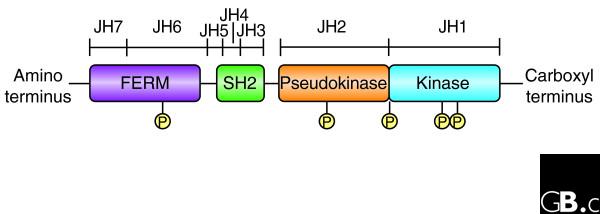
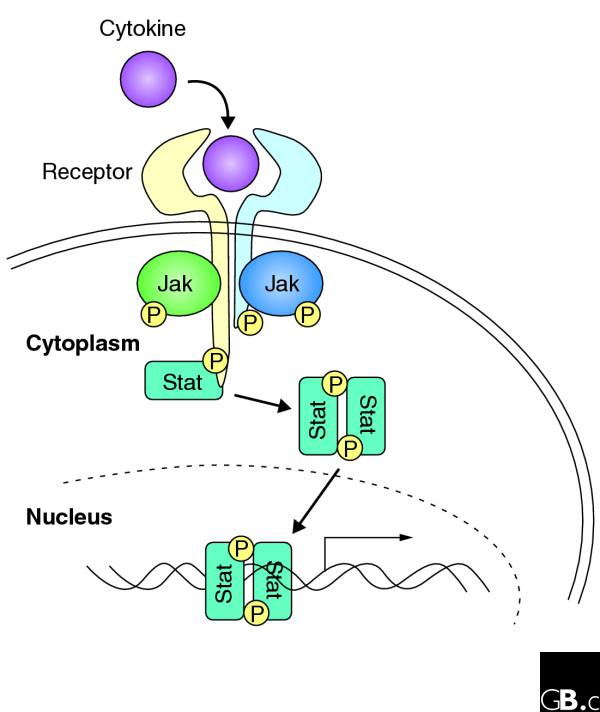
The Janus kinase (Jak) family is one of ten recognized families of non-receptor tyrosine kinases. Mammals have four members of this family, Jak1, Jak2, Jak3 and Tyrosine kinase 2 (Tyk2). Birds, fish and insects also have Jaks. Each protein has a kinase domain and a catalytically inactive pseudo-kinase domain, and they each bind cytokine receptors through amino-terminal FERM (Band-4.1, ezrin, radixin, moesin) domains. Upon binding of cytokines to their receptors, Jaks are activated and phosphorylate the receptors, creating docking sites for signaling molecules, especially members of the signal transducer and activator of transcription (Stat) family. Mutations of the Drosophila Jak (Hopscotch) have revealed developmental defects, and constitutive activation of Jaks in flies and humans is associated with leukemia-like syndromes. Through the generation of Jak-deficient cell lines and gene-targeted mice, the essential, nonredundant functions of Jaks in cytokine signaling have been established. Importantly, deficiency of Jak3 is the basis of human autosomal recessive severe combined immunodeficiency (SCID); accordingly, a selective Jak3 inhibitor has been developed, forming a new class of immunosuppressive drugs.
Janus激酶(Jak)家族是已确认的十个非受体酪氨酸激酶家族之一。哺乳动物有该家族的四个成员,即Jak1、Jak2、Jak3和酪氨酸激酶2(Tyk2)。鸟类、鱼类和昆虫也有Jak。每种蛋白质都有一个激酶结构域和一个催化无活性的假激酶结构域,它们各自通过氨基末端的FERM(带4.1、埃兹蛋白、根蛋白、膜突蛋白)结构域结合细胞因子受体。细胞因子与其受体结合后,Jak被激活并使受体磷酸化,为信号分子,尤其是信号转导子和转录激活子(Stat)家族成员创造停靠位点。果蝇Jak(跳房子)的突变已揭示出发育缺陷,果蝇和人类中Jak的组成型激活与类白血病综合征有关。通过生成Jak缺陷细胞系和基因靶向小鼠,已确定Jak在细胞因子信号传导中的基本、非冗余功能。重要的是,Jak3缺陷是人类常染色体隐性重症联合免疫缺陷(SCID)的基础;因此,已开发出一种选择性Jak3抑制剂,形成了一类新的免疫抑制药物。