Li Bin, Xia Qingyou, Lu Cheng, Zhou Zeyang, Xiang Zhonghuai
The Key Sericultural Laboratory of Agricultural Ministry, College of Sericulture and Biotechnology, Southwest Agricultural University, Chongqing 400716, China.
Genomics Proteomics Bioinformatics. 2004 Feb;2(1):24-31. doi: 10.1016/s1672-0229(04)02004-2.
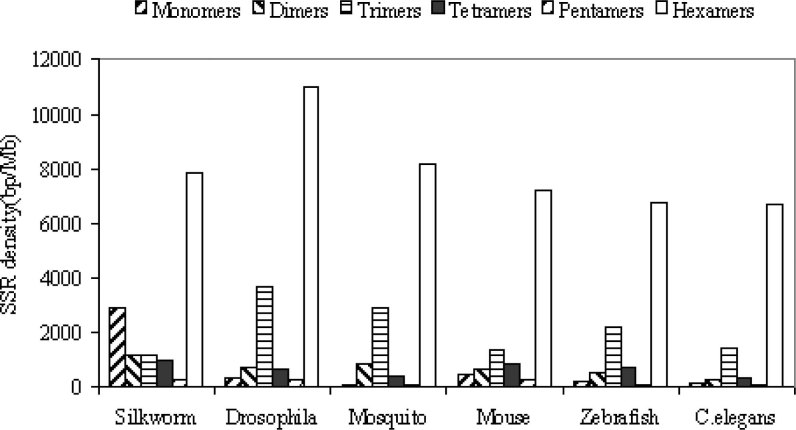
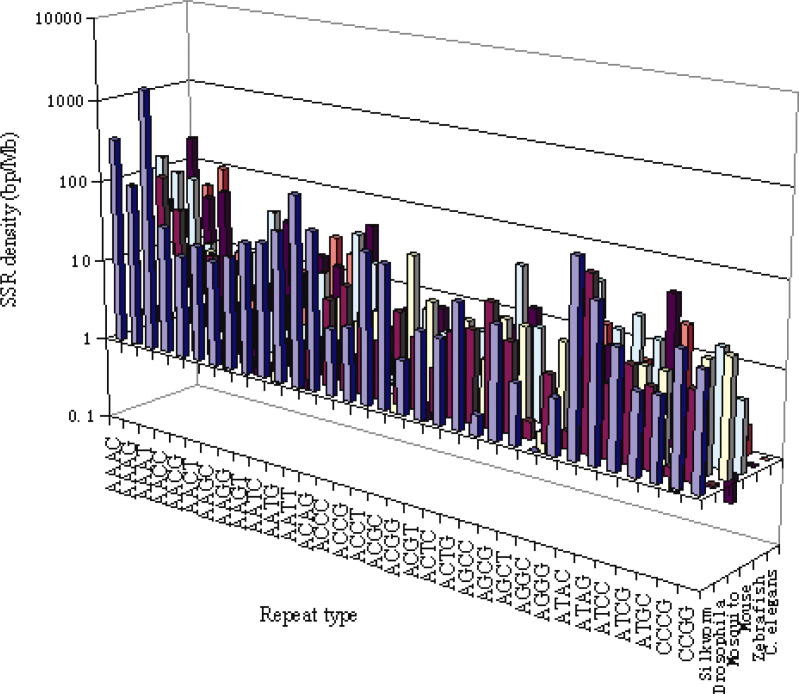
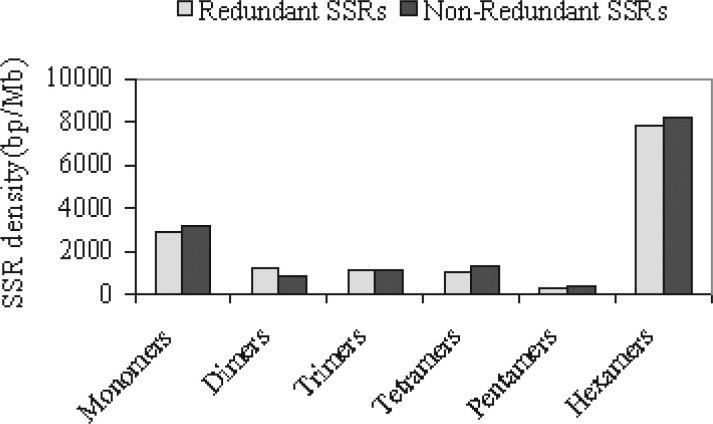
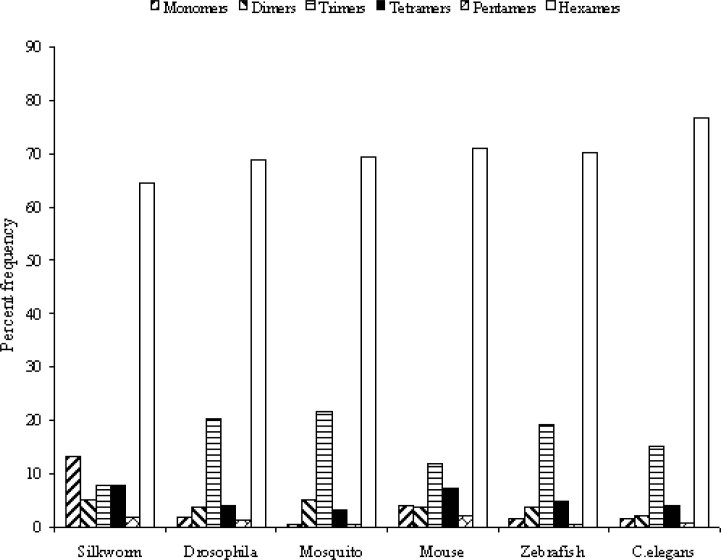
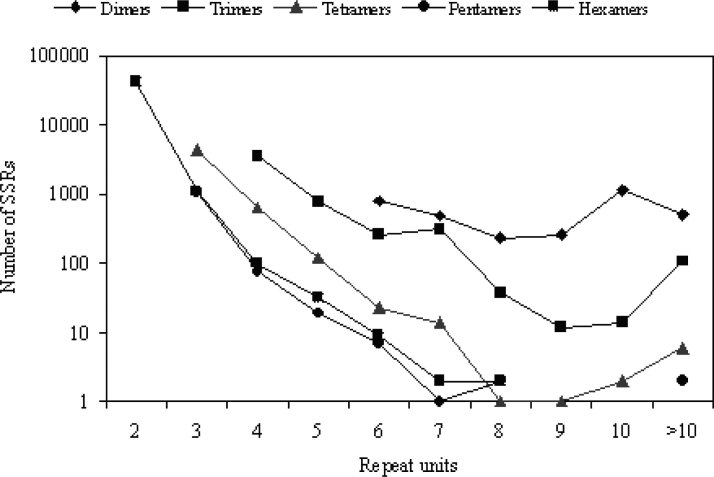
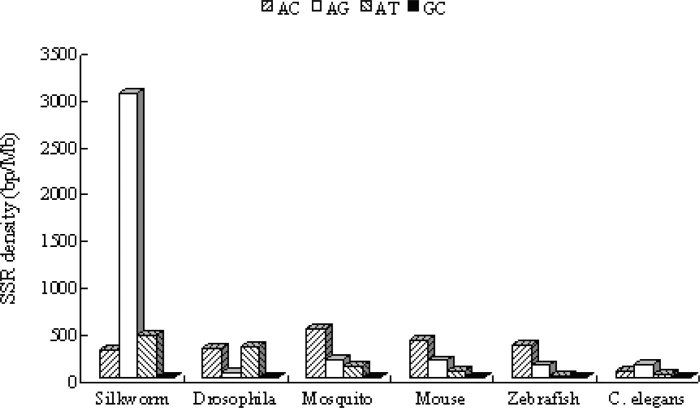
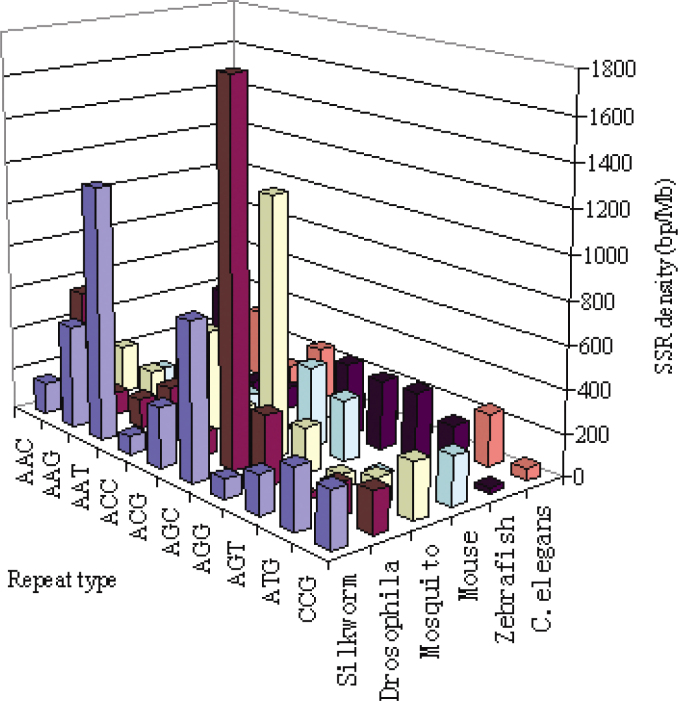
Microsatellites or simple sequence repeats (SSRs) have been found in most organisms during the last decade. Since large-scale sequences are being generated, especially those that can be used to search for microsatellites, the development of these markers is getting more convenient. Keeping SSRs in viewing the importance of the application, available CDS (coding sequences) or ESTs (expressed sequence tags) of some eukaryotic species were used to study the frequency and density of various types of microsatellites. On the basis of surveying CDS or EST sequences amounting to 66.6 Mb in silkworm, 37.2 Mb in fly, 20.8 Mb in mosquito, 60.0 Mb in mouse, 34.9 Mb in zebrafish and 33.5 Mb in Caenorhabditis elegans, the frequency of SSRs was 1/1.00 Kb in silkworm, 1/0.77 Kb in fly, 1/1.03 Kb in mosquito, 1/1.21 Kb in mouse, 1/1.25 Kb in zebrafish and 1/1.38 Kb in C. elegans. The overall average SSR frequency of these species is 1/1.07 Kb. Hexanucleotide repeats (64.5%-76.6%) are the most abundant class of SSR in the investigated species, followed by trimeric, dimeric, tetrameric, monomeric and pentameric repeats. Furthermore, the A-rich repeats are predominant in each type of SSRs, whereas G-rich repeats are rare in the coding regions.
在过去十年中,微卫星或简单序列重复(SSRs)已在大多数生物体中被发现。由于正在生成大规模序列,尤其是那些可用于搜索微卫星的序列,这些标记的开发变得更加便捷。鉴于SSRs在应用方面的重要性,我们利用一些真核生物物种现有的编码序列(CDS)或表达序列标签(ESTs)来研究各种类型微卫星的频率和密度。基于对家蚕66.6 Mb、果蝇37.2 Mb、蚊子20.8 Mb、小鼠60.0 Mb、斑马鱼34.9 Mb和秀丽隐杆线虫33.5 Mb的CDS或EST序列进行调查,家蚕中SSRs的频率为1/1.00 Kb,果蝇中为1/0.77 Kb,蚊子中为1/1.03 Kb,小鼠中为1/1.21 Kb,斑马鱼中为1/1.25 Kb,秀丽隐杆线虫中为1/1.38 Kb。这些物种的总体平均SSR频率为1/1.07 Kb。六核苷酸重复序列(64.5%-76.6%)是被调查物种中最丰富的SSR类别,其次是三聚体、二聚体、四聚体、单体和五聚体重复序列。此外,富含A的重复序列在每种类型的SSRs中占主导地位,而富含G的重复序列在编码区中很少见。