
使用表达C-Raf的重组鼠伤寒沙门氏菌菌株预防小鼠中C-Raf诱导的肺腺瘤。
Use of a recombinant Salmonella enterica serovar Typhimurium strain expressing C-Raf for protection against C-Raf induced lung adenoma in mice.
作者信息
Gentschev Ivaylo, Fensterle Joachim, Schmidt Andreas, Potapenko Tamara, Troppmair Jakob, Goebel Werner, Rapp Ulf R
机构信息
Institut für Medizinische Strahlenkunde und Zellforschung (MSZ), University of Wuerzburg, D-97078 Wuerzburg, Germany.
出版信息
BMC Cancer. 2005 Feb 9;5:15. doi: 10.1186/1471-2407-5-15.
BACKGROUND
Serine-threonine kinases of the Raf family (A-Raf, B-Raf, C-Raf) are central players in cellular signal transduction, and thus often causally involved in the development of cancer when mutated or over-expressed. Therefore these proteins are potential targets for immunotherapy and a possible basis for vaccine development against tumors. In this study we analyzed the functionality of a new live C-Raf vaccine based on an attenuated Salmonella enterica serovar Typhimurium aroA strain in two Raf dependent lung tumor mouse models.
METHODS
The antigen C-Raf has been fused to the C-terminal secretion signal of Escherichia coli alpha-hemolysin and expressed in secreted form by an attenuated aroA Salmonella enterica serovar Typhimurium strain via the alpha-hemolysin secretion pathway. The effect of the immunization with this recombinant C-Raf strain on wild-type C57BL/6 or lung tumor bearing transgenic BxB mice was analyzed using western blot and FACS analysis as well as specific tumor growth assays.
RESULTS
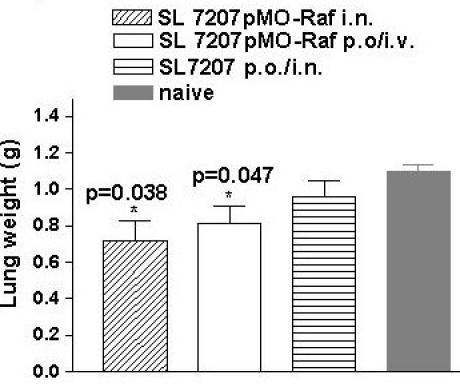
C-Raf antigen was successfully expressed in secreted form by an attenuated Salmonella enterica serovar Typhimurium aroA strain using the E. coli hemolysin secretion system. Immunization of wild-type C57BL/6 or tumor bearing mice provoked specific C-Raf antibody and T-cell responses. Most importantly, the vaccine strain significantly reduced tumor growth in two transgenic mouse models of Raf oncogene-induced lung adenomas.
CONCLUSIONS
The combination of the C-Raf antigen, hemolysin secretion system and Salmonella enterica serovar Typhimurium could form the basis for a new generation of live bacterial vaccines for the treatment of Raf dependent human malignancies.
背景
Raf家族的丝氨酸 - 苏氨酸激酶(A - Raf、B - Raf、C - Raf)是细胞信号转导的核心参与者,因此在发生突变或过度表达时常常与癌症的发生有因果关系。所以这些蛋白质是免疫治疗的潜在靶点,也是开发肿瘤疫苗的可能基础。在本研究中,我们在两种Raf依赖性肺癌小鼠模型中分析了一种基于减毒鼠伤寒沙门氏菌aroA菌株的新型活C - Raf疫苗的功能。
方法
将抗原C - Raf与大肠杆菌α - 溶血素的C末端分泌信号融合,并通过α - 溶血素分泌途径由减毒的aroA鼠伤寒沙门氏菌菌株以分泌形式表达。使用蛋白质免疫印迹和流式细胞术分析以及特定的肿瘤生长测定法,分析用这种重组C - Raf菌株免疫对野生型C57BL / 6或携带肺癌的转基因BxB小鼠的影响。
结果
利用大肠杆菌溶血素分泌系统,减毒的鼠伤寒沙门氏菌aroA菌株成功地以分泌形式表达了C - Raf抗原。对野生型C57BL / 6或荷瘤小鼠进行免疫引发了特异性C - Raf抗体和T细胞反应。最重要的是,该疫苗菌株在两种Raf癌基因诱导的肺腺瘤转基因小鼠模型中显著降低了肿瘤生长。
结论
C - Raf抗原、溶血素分泌系统和鼠伤寒沙门氏菌的组合可为新一代治疗Raf依赖性人类恶性肿瘤的活细菌疫苗奠定基础。


 Zotero 插件