Kang Du Cheol, Lee Young-Mock, Lee JoonSoo, Kim Heung Dong, Coe ChangJun
Department of Pediatrics, Institute of Handicapped Children, Yongdong Severance Hospital, Yonsei University College of Medicine, 146-92 Dogok- dong, Kangnam-gu, Seoul 135-720, Korea.
Yonsei Med J. 2005 Feb 28;46(1):27-33. doi: 10.3349/ymj.2005.46.1.27.
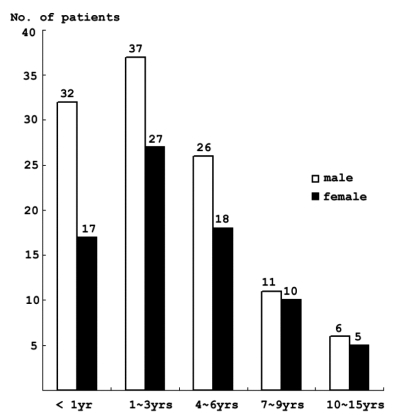
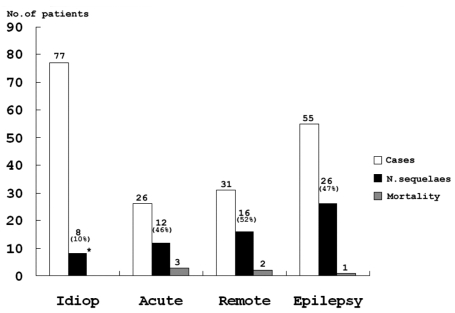
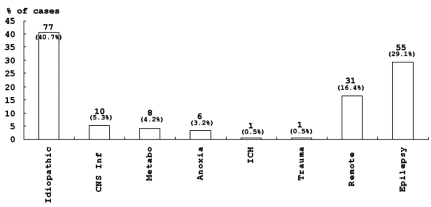
We retrospectively reviewed the medical records of 189 children who were admitted to the Pediatric Neurology Department at Yonsei University College of Medicine with status epilepticus (SE) between April, 1994 and April, 2003. The children were followed up for a mean duration of 17 months. We analyzed the clinical findings and the relationships between neurologic sequelae, recurrence, age of onset, presumptive causes, types of seizure, seizure duration and the presence of fever. Mean age at SE onset was 37 months. Incidences by seizure type classification were generalized convulsive SE in 73.5%, and non-convulsive SE in 26.5%. The incidences of presumptive causes of SE were idiopathic 40.7%, epilepsy 29.1%, remote 16.4% and acute symptomatic in 13.3%. Among all the patients, febrile episodes occurred in 35.4%, especially in patients under 3 year old, and 38.4% of these were associated with febrile illness regardless of presumptive cause. Neurologic sequelae occurred in 33% and the mortality rate was 3%. Neurologic sequelae were lower in patients that presented with an idiopathic etiology and higher in generalized convulsive SE patients. The recurrence of SE was higher in patients with a remote symptomatic epileptic etiology, and generalized convulsive SE showed higher rates of recurrence. Based on this retrospective study, the neurologic outcomes and recurrence of SE were found to be strongly associated with etiology and seizure type. Age, seizure duration and the presence of febrile illness were found to have no effect on outcome.
我们回顾性分析了1994年4月至2003年4月期间延世大学医学院儿科神经科收治的189例癫痫持续状态(SE)患儿的病历。对这些患儿进行了平均17个月的随访。我们分析了临床发现以及神经后遗症、复发、发病年龄、推测病因、癫痫发作类型、发作持续时间和发热情况之间的关系。SE发作时的平均年龄为37个月。按癫痫发作类型分类,全身性惊厥性SE的发生率为73.5%,非惊厥性SE的发生率为26.5%。SE的推测病因发生率分别为:特发性40.7%,癫痫29.1%,既往史16.4%,急性症状性13.3%。所有患者中,35.4%出现发热发作,尤其是3岁以下的患者,其中38.4%与发热性疾病相关,与推测病因无关。神经后遗症发生率为33%,死亡率为3%。特发性病因患者的神经后遗症发生率较低,全身性惊厥性SE患者的发生率较高。既往有症状性癫痫病因的患者SE复发率较高,全身性惊厥性SE的复发率也较高。基于这项回顾性研究,发现SE的神经学结局和复发与病因和癫痫发作类型密切相关。年龄、发作持续时间和发热性疾病的存在对结局无影响。