Kim Beom Seok, Park Hyeong Cheon, Kang Shin Wook, Choi Kyu Hun, Ha Sung Kyu, Han Dae Suk, Lee Ho Yung
Division of Nephrology, Department of Internal Medicine, Institute of Kidney Disease, Yonsei University College of Medicine, 134 Shinchon-dong, Seodaemun-gu, Seoul 120-752, Korea.
Yonsei Med J. 2005 Feb 28;46(1):141-8. doi: 10.3349/ymj.2005.46.1.141.
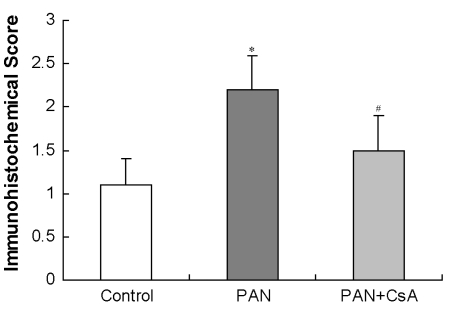
Puromycin aminonucleoside (PAN)-induced nephrosis is a well-described model of human idiopathic nephrotic syndrome, but the mechanism of PAN's effect is not completely understood. To investigate whether proteinuria in the PAN model is associated with an alteration of zonula occludens-1 (ZO-1) expression within the glomeruli, and whether cyclosporin A (CsA) has an effect on proteinuria and ZO-1 expression in this model, eighteen Sprague Dawley (SD) rats were assigned into three groups. Twelve rats received a single intraperitoneal injection of PAN (15 mg/100 g). The other six rats received an equal volume of saline (normal control group; control). CsA solution was administered intraperitoneally once a day for 20 days after the PAN injection (n=6, PAN+CsA). The remaining six rats received PAN, but they didn't receive CsA (n=6, PAN). Compared to control rats (35.1+/-5.4 mg/day), the 24-hour urinary protein excretion on day 18 was significantly higher in the PAN rats (1021.9+/-128.9 mg/day, p<0.01), and the CsA treatment partly reversed the increase in proteinuria in the PAN rats (556.4+/-102.3 mg/day, p<0.05). Glomerular ZO-1 protein expressions were significantly increased in the PAN rats as compared to the control group on day 20 (176%, p<0.01). CsA treatment for 20 days in the PAN rats inhibited the increase in ZO-1 protein expression by 71.1% (p<0.05). CsA treatment significantly diminished the glomerular ZO-1 expression in the PAN rats as assessed by immunohistochemistry. CsA treatment significantly reduced proteinuria and the diminished glomerular ZO-1 expression in a PAN nephrosis rat model. These findings suggest the potential role of the slit diaphragm associated proteins in the development of the nephrotic syndrome, and CsA decreased the proteinuria probably by a direct action on the expression of these proteins in podocytes. Further investigations are needed to clarify the role of slit diaphragm associated proteins in the development of PAN nephrosis.
嘌呤霉素氨基核苷(PAN)诱导的肾病是一种已被充分描述的人类特发性肾病综合征模型,但PAN作用的机制尚未完全阐明。为了研究PAN模型中的蛋白尿是否与肾小球内紧密连接蛋白1(ZO-1)表达的改变有关,以及环孢素A(CsA)在该模型中对蛋白尿和ZO-1表达是否有影响,将18只Sprague Dawley(SD)大鼠分为三组。12只大鼠接受单次腹腔注射PAN(15mg/100g)。另外6只大鼠接受等量的生理盐水(正常对照组;对照组)。在注射PAN后,每天腹腔注射CsA溶液,持续20天(n = 6,PAN + CsA)。其余6只大鼠接受PAN,但未接受CsA(n = 6,PAN)。与对照大鼠(35.1±5.4mg/天)相比,PAN大鼠在第18天的24小时尿蛋白排泄量显著更高(1021.9±128.9mg/天,p < 0.01),并且CsA治疗部分逆转了PAN大鼠蛋白尿的增加(556.4±102.3mg/天,p < 0.05)。与对照组相比,PAN大鼠在第20天时肾小球ZO-1蛋白表达显著增加(176%,p < 0.01)。在PAN大鼠中,CsA治疗20天抑制了ZO-1蛋白表达增加的71.1%(p < 0.05)。通过免疫组织化学评估,CsA治疗显著降低了PAN大鼠肾小球中的ZO-1表达。在PAN肾病大鼠模型中,CsA治疗显著降低了蛋白尿并减少了肾小球ZO-1表达。这些发现提示了裂孔隔膜相关蛋白在肾病综合征发生发展中的潜在作用,并且CsA可能通过直接作用于足细胞中这些蛋白的表达而降低蛋白尿。需要进一步研究以阐明裂孔隔膜相关蛋白在PAN肾病发生发展中的作用。