Stackhouse Scott K, Binder-Macleod Stuart A, Lee Samuel C K
Program in Biomechanics and Movement Science, University of Delaware, Newark, Delaware, USA.
Muscle Nerve. 2005 May;31(5):594-601. doi: 10.1002/mus.20302.
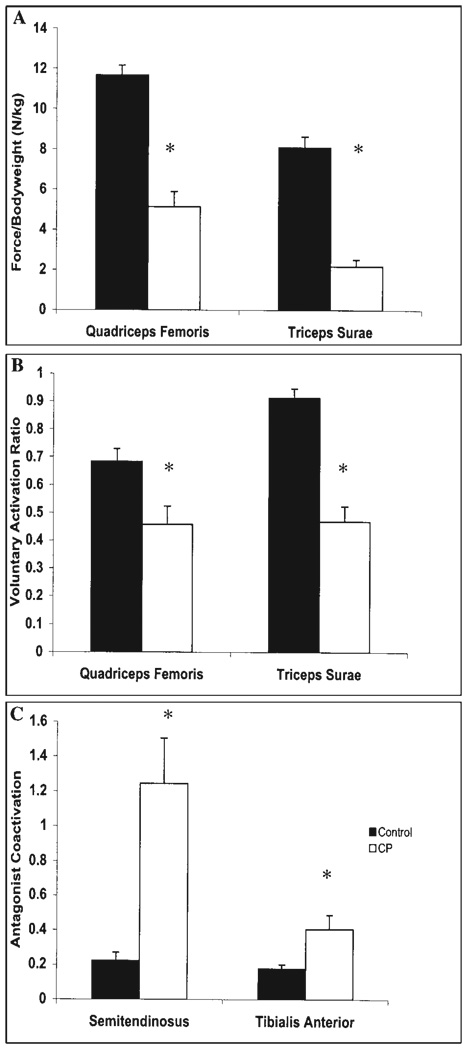
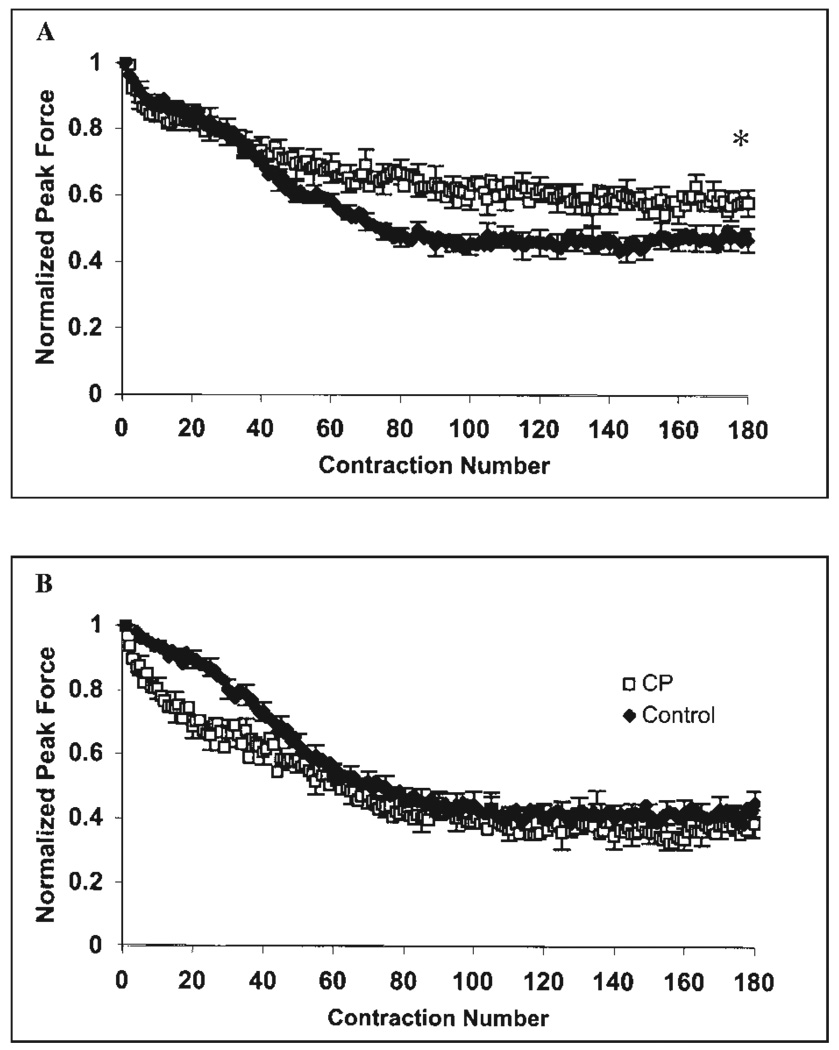
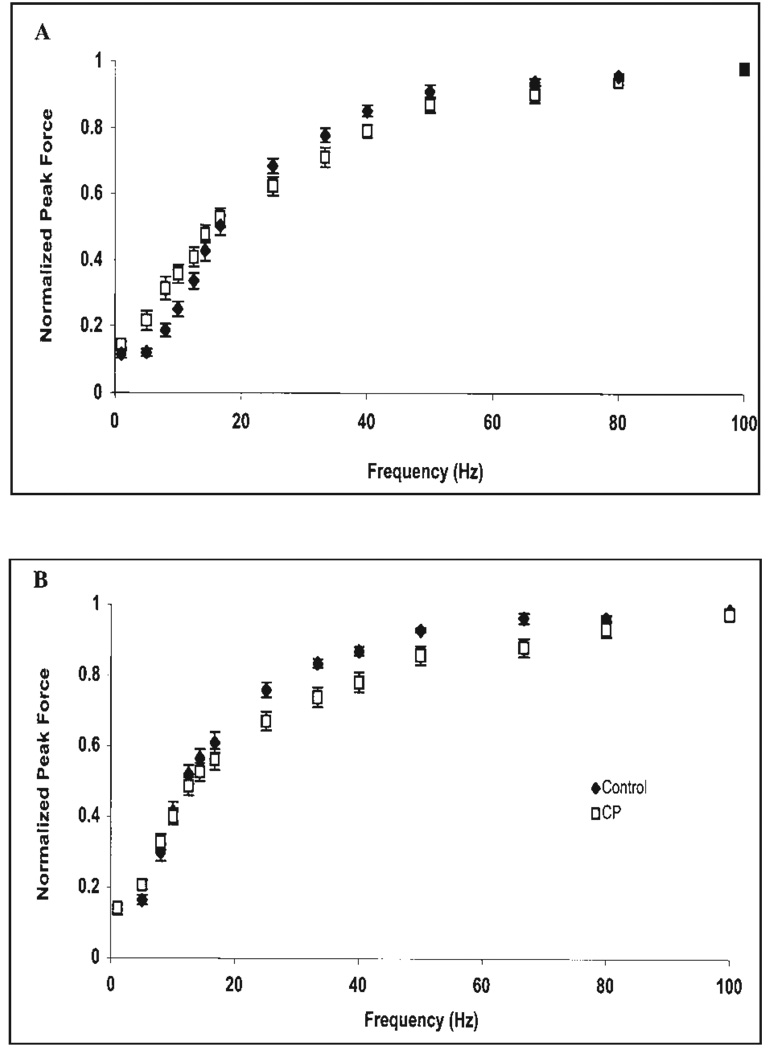
Cerebral palsy (CP) may lead to profound weakness in affected portions of the extremities and trunk. Knowing the mechanisms underlying muscle weakness will help to better design interventions for increasing force production in children with CP. This study quantified voluntary muscle activation, contractile properties, and fatigability of the quadriceps femoris and triceps surae in children with and without CP. Twelve children with CP (7-13 years) and 10 unaffected children (controls, 8-12 years) were assessed for (1) voluntary muscle activation during maximum voluntary isometric contractions (MVICs); (2) antagonist coactivation during agonist MVICs; (3) contractile properties, and (4) fatigability using electrically elicited tests. Children with CP were significantly weaker, had lower agonist voluntary muscle activation, and greater antagonist coactivation. In children with CP, the quadriceps normalized force-frequency relationship (FFR) was shifted upward at low frequencies and was less fatigable than controls. No differences were seen between groups in the normalized FFR and fatigability of the triceps surae. In addition, no differences were seen in the sum of the time to peak tension and half-relaxation times between groups for either muscle. Because children with CP demonstrated large deficits in voluntary muscle activation, using voluntary contractions for strength training may not produce forces sufficient to induce muscle hypertrophy. Techniques such as enhanced feedback and neuromuscular electrical stimulation may be helpful for strengthening muscles that cannot be sufficiently recruited with voluntary effort.
脑瘫(CP)可能导致四肢和躯干受影响部位出现严重无力。了解肌肉无力的潜在机制将有助于更好地设计干预措施,以提高脑瘫患儿的力量产生。本研究对有和没有脑瘫的儿童股四头肌和腓肠肌的自主肌肉激活、收缩特性和疲劳性进行了量化。对12名脑瘫儿童(7 - 13岁)和10名未受影响的儿童(对照组,8 - 12岁)进行了以下评估:(1)最大自主等长收缩(MVICs)期间的自主肌肉激活;(2)激动剂MVICs期间的拮抗剂共激活;(3)收缩特性,以及(4)使用电诱发试验评估的疲劳性。脑瘫儿童明显更虚弱,激动剂自主肌肉激活较低,拮抗剂共激活程度更高。在脑瘫儿童中,股四头肌的标准化力-频率关系(FFR)在低频时向上偏移,且比对照组更不易疲劳。两组之间腓肠肌的标准化FFR和疲劳性没有差异。此外,两组之间任何一块肌肉的峰值张力时间和半松弛时间之和也没有差异。由于脑瘫儿童在自主肌肉激活方面存在较大缺陷,使用自主收缩进行力量训练可能无法产生足以诱导肌肉肥大的力量。增强反馈和神经肌肉电刺激等技术可能有助于增强那些无法通过自主努力充分募集的肌肉。