Hartl Dominik, Griese Matthias
Pediatric Pneumology, Childrens' hospital of the Ludwig-Maximilians-University, Munich, Germany.
Respir Res. 2005 Apr 8;6(1):32. doi: 10.1186/1465-9921-6-32.
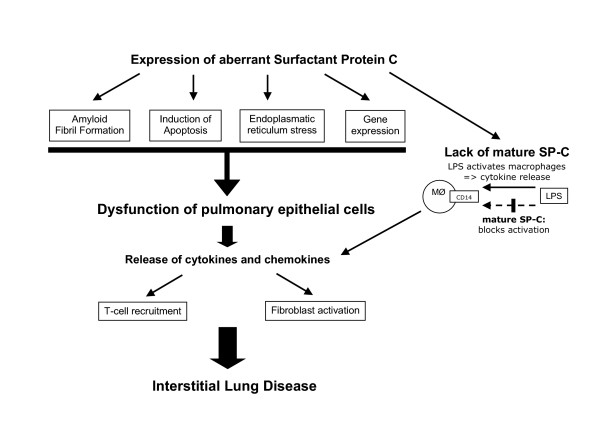
Interstitial lung disease in children represents a group of rare chronic respiratory disorders. There is growing evidence that mutations in the surfactant protein C gene play a role in the pathogenesis of certain forms of pediatric interstitial lung disease. Recently, mutations in the ABCA3 transporter were found as an underlying cause of fatal respiratory failure in neonates without surfactant protein B deficiency. Especially in familiar cases or in children of consanguineous parents, genetic diagnosis provides an useful tool to identify the underlying etiology of interstitial lung disease. The aim of this review is to summarize and to describe in detail the clinical features of hereditary interstitial lung disease in children. The knowledge of gene variants and associated phenotypes is crucial to identify relevant patients in clinical practice.
儿童间质性肺疾病是一组罕见的慢性呼吸系统疾病。越来越多的证据表明,表面活性蛋白C基因的突变在某些形式的小儿间质性肺疾病的发病机制中起作用。最近,发现ABCA3转运蛋白的突变是无表面活性蛋白B缺乏的新生儿致命呼吸衰竭的根本原因。特别是在家族性病例或近亲父母的子女中,基因诊断为确定间质性肺疾病的潜在病因提供了一种有用的工具。这篇综述的目的是总结并详细描述儿童遗传性间质性肺疾病的临床特征。了解基因变异和相关表型对于在临床实践中识别相关患者至关重要。