Bühling Frank, Wille Aline, Röcken Christoph, Wiesner Olaf, Baier Anja, Meinecke Ingmar, Welte Tobias, Pap Thomas
Institute of Immunology, Otto-von-Guericke-University, Magdeburg, Germany.
Respir Res. 2005 Apr 17;6(1):37. doi: 10.1186/1465-9921-6-37.
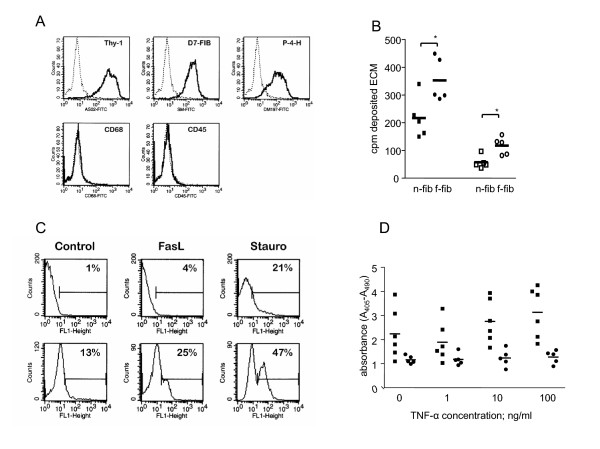
An altered susceptibility of lung fibroblasts to Fas-induced apoptosis has been implicated in the pathogenesis of pulmonary fibrosis; however, the underlying mechanism is not completely understood. Here, we studied the susceptibility of lung fibroblasts, obtained from patients with (f-fibs) and without pulmonary fibrosis (n-fibs), to FasL- (CD95L/APO-1) induced apoptosis in relation to the expression and the amounts of membrane-bound and soluble Fas. We also analysed the effects of tumor necrosis factor-beta on FasL-induced cell death.
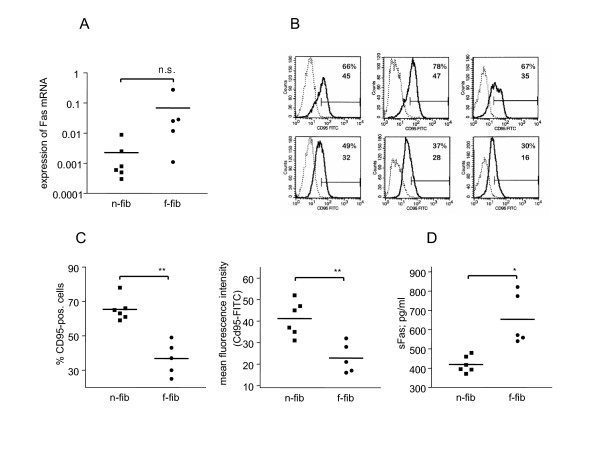
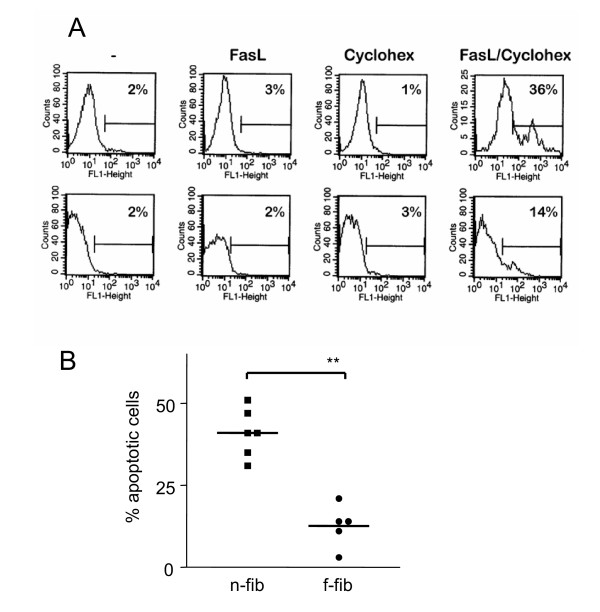
Apoptosis was induced with recombinant human FasL, with and without prior stimulation of the fibroblasts with tumor necrosis factor-alpha and measured by a histone fragmentation assay and flow cytometry. The expression of Fas mRNA was determined by quantitative PCR. The expression of cell surface Fas was determined by flow cytometry, and that of soluble Fas (sFas) was determined by enzyme-linked immunosorbent assay.
When compared to n-fibs, f-fibs were resistant to FasL-induced apoptosis, despite significantly higher levels of Fas mRNA. F-fibs showed lower expression of surface-bound Fas but higher levels of sFas. While TNF-alpha increased the susceptibility to FasL-induced apoptosis in n-fibs, it had no pro-apoptotic effect in f-fibs.
The data suggest that lower expression of surface Fas, but higher levels of apoptosis-inhibiting sFas, contribute to the resistance of fibroblasts in lung fibrosis against apoptosis, to increased cellularity and also to increased formation and deposition of extracellular matrix.
肺成纤维细胞对Fas诱导的凋亡敏感性改变与肺纤维化的发病机制有关;然而,其潜在机制尚未完全阐明。在此,我们研究了从肺纤维化患者(f-fibs)和无肺纤维化患者(n-fibs)获取的肺成纤维细胞对FasL(CD95L/APO-1)诱导凋亡的敏感性,及其与膜结合型和可溶性Fas的表达及含量的关系。我们还分析了肿瘤坏死因子-β对FasL诱导细胞死亡的影响。
用重组人FasL诱导凋亡,在有或无肿瘤坏死因子-α预先刺激成纤维细胞的情况下,通过组蛋白片段化分析和流式细胞术进行检测。通过定量PCR测定Fas mRNA的表达。通过流式细胞术测定细胞表面Fas的表达,通过酶联免疫吸附测定法测定可溶性Fas(sFas)的表达。
与n-fibs相比,f-fibs对FasL诱导的凋亡具有抗性,尽管Fas mRNA水平显著更高。f-fibs表面结合型Fas表达较低,但sFas水平较高。虽然肿瘤坏死因子-α增加了n-fibs对FasL诱导凋亡的敏感性,但对f-fibs没有促凋亡作用。
数据表明,表面Fas表达较低,但凋亡抑制性sFas水平较高,导致肺纤维化中的成纤维细胞对凋亡产生抗性,细胞数量增加,以及细胞外基质形成和沉积增加。