Deichmann Martin, Thome Marianne, Benner Axel, Kirschner Martin, Hassanzadeh Judith, Kurzen Hjalmar
Department of Dermatology, Heidelberg University Clinics, Vossbstrasse 2, 69115 Heidelberg, Germany.
BMC Cancer. 2005 Jun 3;5:58. doi: 10.1186/1471-2407-5-58.
Downstream of Ras, the serine/threonine kinase B-raf has been reported to be mutated, among other carcinomas, in a substantial subset of primary melanomas with a preponderance of mutations within the kinase domain including the activating V599E and V599K transitions.
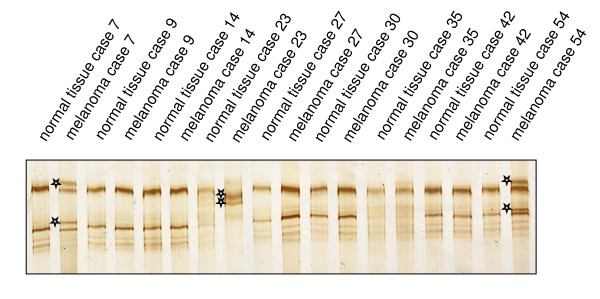
We here investigated a representative series of 60 resection specimens of cutaneous and subcutaneous melanoma metastases for the presence of mutations within the activation segment (exon 15) of the B-raf kinase domain by polymerase chain reaction (PCR) and single-strand conformation polymorphism (SSCP) gel electrophoresis.
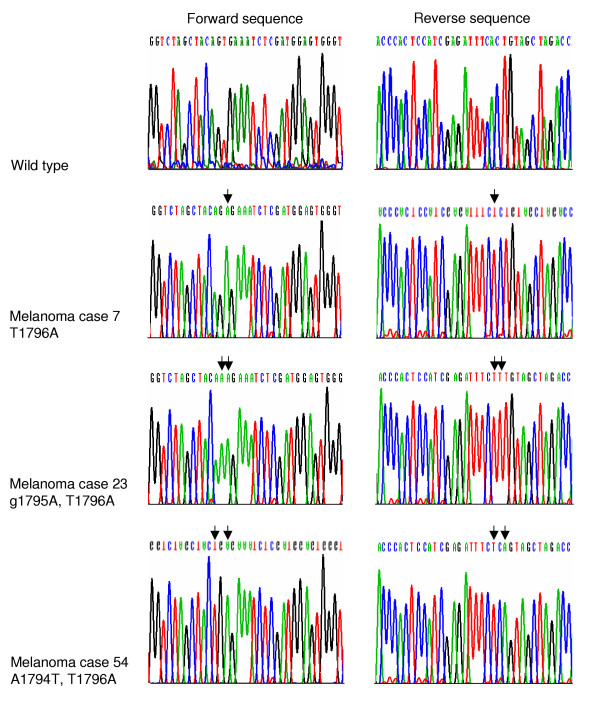
Sequencing of cloned PCR-SSCP amplicons resulted in 24 (40%) samples harbouring somatic mutations which is not exceeding the mutation frequency in recently investigated primary melanomas. The activating mutation T1796A was present in 24/60 (40%) resection specimens, followed in frequency by the oncogenic g1795A mutation in 8/60 (13%) cases. As to the B-raf protein sequence, the acidic amino acid transitions V599E and V599K were predicted in 19/60 (32%) and 6/60 (10%) cases, respectively, but were not associated with enhanced risk for subsequent metastasis in patients' follow up. In comparison to the primary melanomas that we recently investigated, the spectrum of predicted B-raf protein mutations narrowed significantly in the cutaneous/subcutaneous metastases. Unexpectedly, V599 and V599E mutations were absent in cutaneous/subcutaneous metastases derived from acrolentiginous melanomas as preceding primary tumours.
During transition from primary melanomas towards cutaneous/subcutaneous metastases, the spectrum of predicted B-raf mutations narrows significantly. Focusing on the V599E and V599K, these oncogenic mutations are likely to affect melanocyte-specific pathways controlling proliferation and differentiation.
在Ras下游,丝氨酸/苏氨酸激酶B-raf已被报道在多种癌症中发生突变,在相当一部分原发性黑色素瘤中也存在突变,且激酶结构域内的突变占优势,包括激活型V599E和V599K转换。
我们通过聚合酶链反应(PCR)和单链构象多态性(SSCP)凝胶电泳,研究了一系列具有代表性的60例皮肤和皮下黑色素瘤转移灶切除标本,检测B-raf激酶结构域激活片段(外显子15)内的突变情况。
对克隆的PCR-SSCP扩增子进行测序,结果显示24例(40%)样本存在体细胞突变,这一突变频率未超过近期研究的原发性黑色素瘤的突变频率。激活型突变T1796A存在于24/60(40%)的切除标本中,其次是致癌性g1795A突变,在8/60(13%)的病例中出现。就B-raf蛋白序列而言,酸性氨基酸转换V599E和V599K分别在19/60(32%)和6/60(10%)的病例中被预测,但在患者随访中与后续转移风险增加无关。与我们近期研究的原发性黑色素瘤相比,皮肤/皮下转移灶中预测的B-raf蛋白突变谱显著变窄。出乎意料的是,作为原发肿瘤的肢端雀斑样黑色素瘤来源的皮肤/皮下转移灶中不存在V599和V599E突变。
在从原发性黑色素瘤向皮肤/皮下转移灶转变的过程中,预测的B-raf突变谱显著变窄。聚焦于V599E和V599K,这些致癌性突变可能影响控制增殖和分化的黑素细胞特异性途径。