Ito Hideaki, Kanzawa Takao, Miyoshi Toru, Hirohata Satoshi, Kyo Satoru, Iwamaru Arifumi, Aoki Hiroshi, Kondo Yasuko, Kondo Seiji
Department of Neurosurgery, University of Texas M.D. Anderson Cancer Center, Houston, TX 77030, USA.
Hum Gene Ther. 2005 Jun;16(6):685-98. doi: 10.1089/hum.2005.16.685.
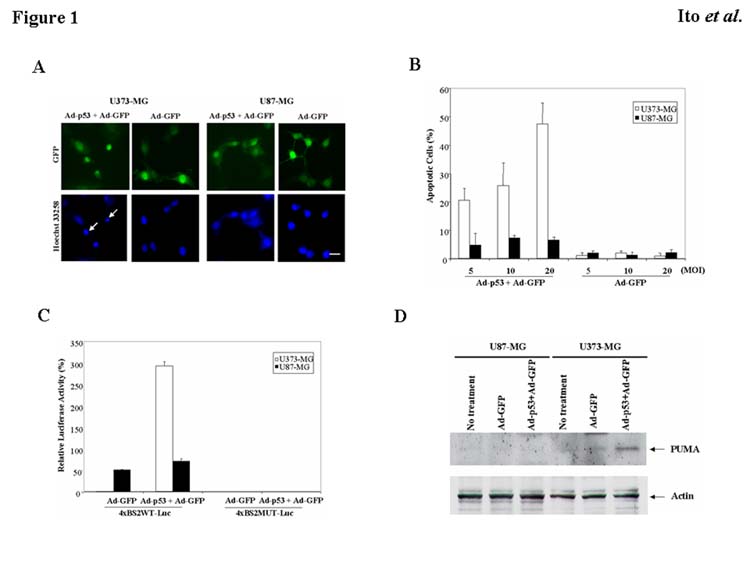
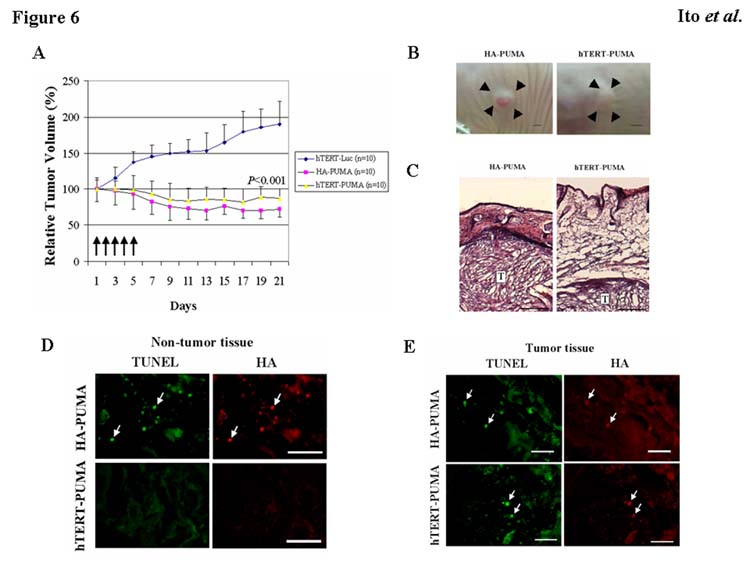
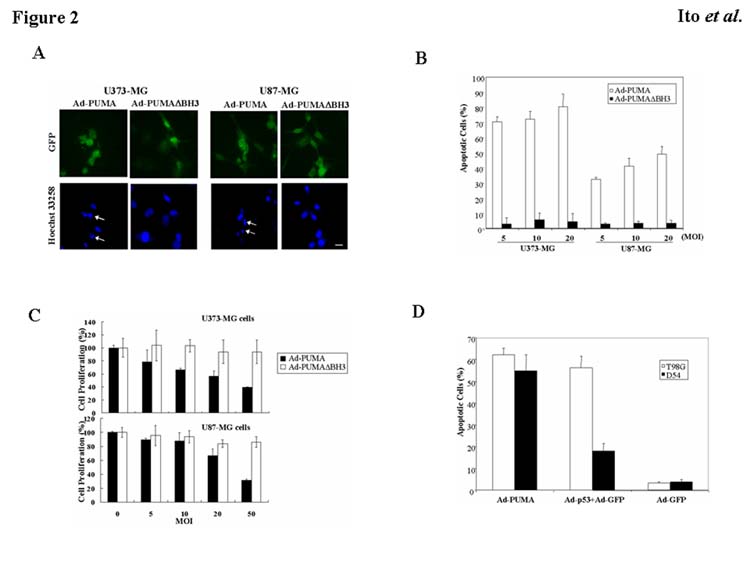
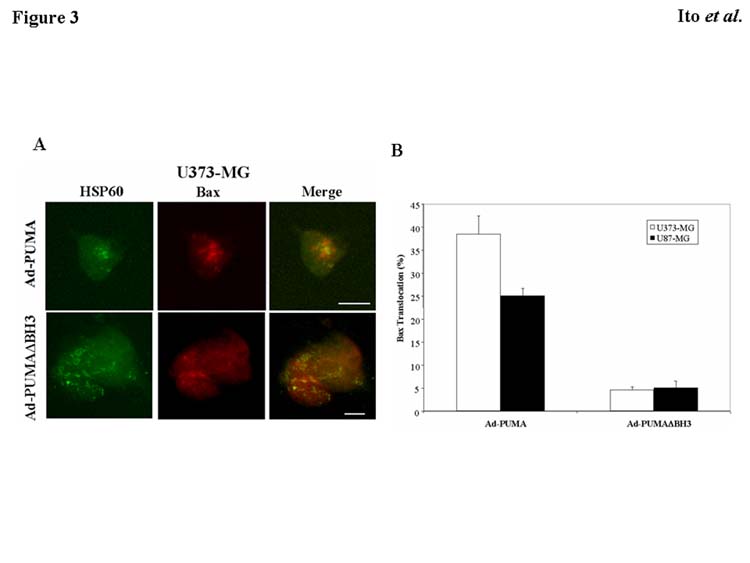
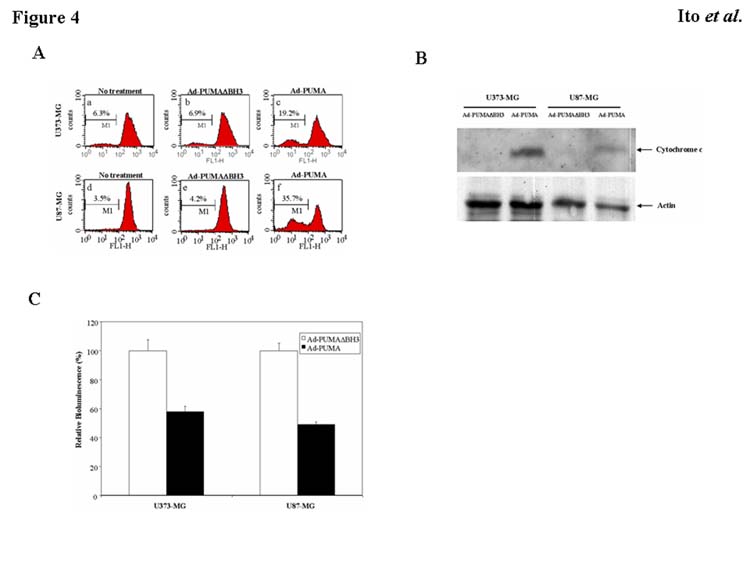
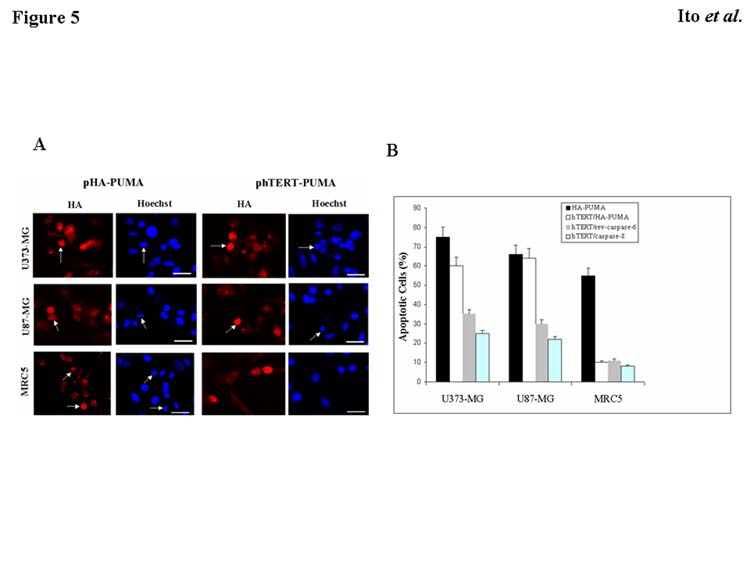
Replacement of the p53 tumor suppressor gene is a rational approach to the management of malignant gliomas because p53 is frequently mutated or inactivated in these cancers. Major weaknesses of this approach are that malignant gliomas are mixtures of cells with wild-type and mutant p53, and that tumor cells exhibiting wildtype p53 are resistant to p53 gene transfer. An effective alternative is needed to overcome these difficulties. p53-upregulated modulator of apoptosis (PUMA) was identified as a p53-inducible proapoptotic molecule. Our purpose was to elucidate a role for PUMA in p53 gene therapy and to investigate whether PUMA is an efficient substitute for p53 in cancer therapy. We demonstrated that PUMA was upregulated in mutant p53 malignant glioma cells (U373-MG and T98G) undergoing apoptosis but was not upregulated in apoptosis-resistant wild-type p53 malignant glioma cells (U87-MG and D54) after adenoviral transfer of p53. Overexpression of PUMA resulted in massive apoptosis associated with mitochondrial damage and caspase-3 activation in all tumor cells tested. Use of the human telomerase reverse transcriptase (hTERT) promoter system induced apoptosis only in malignant glioma cells with telomerase activity, while sparing normal cells lacking telomerase. The ability of PUMA to induce apoptosis was greater than that of caspase-6 or caspase-8 transfer, using the same system. Moreover, exogenous expression of PUMA under the hTERT promoter system significantly suppressed the growth of subcutaneous U87-MG tumors in nude mice and did not induce apoptosis in surrounding nontumor tissues. These results indicate that PUMA, which is regulated under a tumor-specific expression system such as the hTERT promoter, may be better than p53 as a therapeutic tool for malignant gliomas.
替换p53肿瘤抑制基因是治疗恶性胶质瘤的一种合理方法,因为p53在这些癌症中经常发生突变或失活。这种方法的主要缺点是恶性胶质瘤是具有野生型和突变型p53的细胞混合物,并且表现出野生型p53的肿瘤细胞对p53基因转移具有抗性。需要一种有效的替代方法来克服这些困难。p53上调凋亡调节因子(PUMA)被鉴定为一种p53诱导的促凋亡分子。我们的目的是阐明PUMA在p53基因治疗中的作用,并研究PUMA在癌症治疗中是否是p53的有效替代品。我们证明,在p53腺病毒转移后,PUMA在经历凋亡的突变型p53恶性胶质瘤细胞(U373-MG和T98G)中上调,但在抗凋亡的野生型p53恶性胶质瘤细胞(U87-MG和D54)中未上调。PUMA的过表达导致所有测试的肿瘤细胞中与线粒体损伤和caspase-3激活相关的大量凋亡。使用人端粒酶逆转录酶(hTERT)启动子系统仅在具有端粒酶活性的恶性胶质瘤细胞中诱导凋亡,同时使缺乏端粒酶的正常细胞不受影响。使用相同系统,PUMA诱导凋亡的能力大于caspase-6或caspase-8转移。此外,在hTERT启动子系统下外源性表达PUMA可显著抑制裸鼠皮下U87-MG肿瘤的生长,并且不会在周围非肿瘤组织中诱导凋亡。这些结果表明,在诸如hTERT启动子的肿瘤特异性表达系统调控下的PUMA,作为恶性胶质瘤的治疗工具可能比p53更好。