Adachi Naoki, Kohara Keigo, Tsumoto Tadaharu
Division of Neurophysiology, Osaka University Graduate School of Medicine, 2-2 Yamadaoka, Suita, Osaka 565-0871, Japan.
BMC Neurosci. 2005 Jun 21;6:42. doi: 10.1186/1471-2202-6-42.
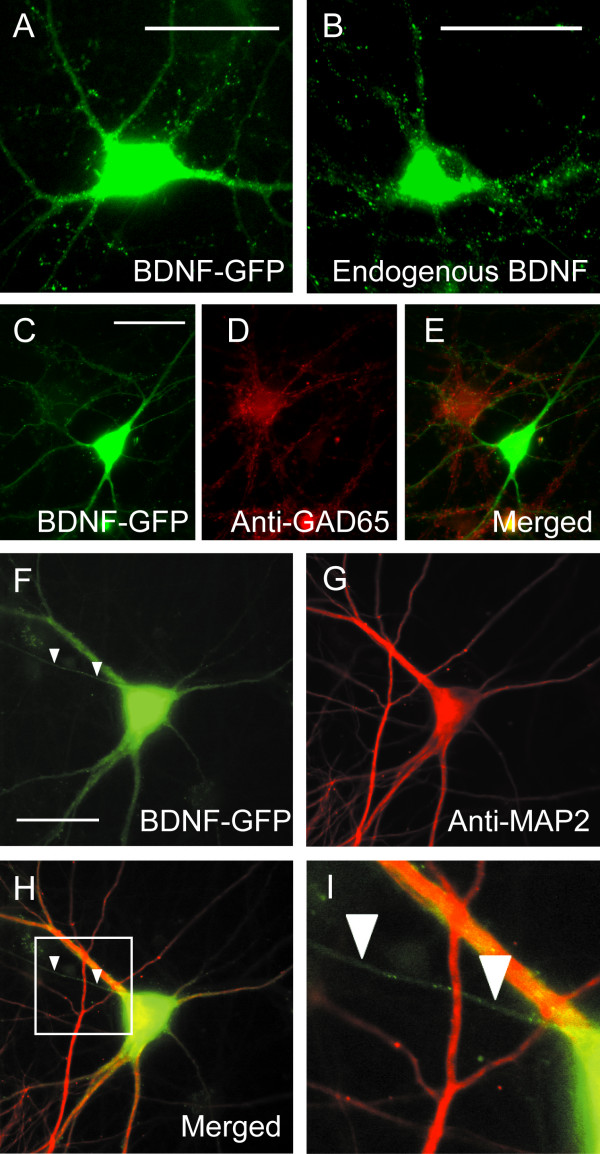
Brain-derived neurotrophic factor (BDNF), which is sorted into a regulated secretory pathway of neurons, is supposed to act retrogradely through dendrites on presynaptic neurons or anterogradely through axons on postsynaptic neurons. Depending on which is the case, the pattern and direction of trafficking of BDNF in dendrites and axons are expected to be different. To address this issue, we analyzed movements of green fluorescent protein (GFP)-tagged BDNF in axons and dendrites of living cortical neurons by time-lapse imaging. In part of the experiments, the expression of BDNF tagged with cyan fluorescent protein (CFP) was compared with that of nerve growth factor (NGF) tagged with yellow fluorescent protein (YFP), to see whether fluorescent protein-tagged BDNF is expressed in a manner specific to this neurotrophin.
We found that BDNF tagged with GFP or CFP was expressed in a punctated manner in dendrites and axons in about two-thirds of neurons into which plasmid cDNAs had been injected, while NGF tagged with GFP or YFP was diffusely expressed even in dendrites in about 70% of the plasmid-injected neurons. In neurons in which BDNF-GFP was expressed as vesicular puncta in axons, 59 and 23% of the puncta were moving rapidly in the anterograde and retrograde directions, respectively. On the other hand, 64% of BDNF-GFP puncta in dendrites did not move at all or fluttered back and forth within a short distance. The rest of the puncta in dendrites were moving relatively smoothly in either direction, but their mean velocity of transport, 0.47 +/- 0.23 (SD) microm/s, was slower than that of the moving puncta in axons (0.73 +/- 0.26 microm/s).
The present results show that the pattern and velocity of the trafficking of fluorescence protein-tagged BDNF are different between axons and dendrites, and suggest that the anterograde transport in axons may be the dominant stream of BDNF to release sites.
脑源性神经营养因子(BDNF)被分选到神经元的调节性分泌途径中,被认为可通过树突逆行作用于突触前神经元,或通过轴突顺行作用于突触后神经元。根据具体情况,BDNF在树突和轴突中的运输模式和方向预计会有所不同。为了解决这个问题,我们通过延时成像分析了绿色荧光蛋白(GFP)标记的BDNF在活体皮层神经元轴突和树突中的运动。在部分实验中,将青色荧光蛋白(CFP)标记的BDNF的表达与黄色荧光蛋白(YFP)标记的神经生长因子(NGF)的表达进行比较,以观察荧光蛋白标记的BDNF是否以该神经营养因子特有的方式表达。
我们发现,在大约三分之二注射了质粒cDNA的神经元中,GFP或CFP标记的BDNF在树突和轴突中呈点状表达,而GFP或YFP标记的NGF即使在大约70%注射了质粒的神经元的树突中也呈弥漫性表达。在轴突中以囊泡状斑点形式表达BDNF-GFP的神经元中,分别有59%和23%的斑点沿顺行和逆行方向快速移动。另一方面,树突中64%的BDNF-GFP斑点根本不移动或在短距离内来回飘动。树突中其余的斑点在任一方向上相对平稳地移动,但其平均运输速度为0.47±0.23(标准差)μm/s,慢于轴突中移动斑点的速度(0.73±0.26μm/s)。
目前的结果表明,荧光蛋白标记的BDNF在轴突和树突中的运输模式和速度不同,并表明轴突中的顺行运输可能是BDNF到达释放位点的主要途径。