Evans David W, Foster Nadine E, Underwood Martin, Vogel Steven, Breen Alan C, Pincus Tamar
School of Health and Rehabilitation, Keele University, Staffordshire, UK.
BMC Musculoskelet Disord. 2005 Jul 20;6:41. doi: 10.1186/1471-2474-6-41.
Low back pain (LBP) is a common and costly problem. Initiatives designed to assist practitioner and patient decisions about appropriate healthcare for LBP include printed evidence-based clinical guidelines. The three professional groups of chiropractic, osteopathy and musculoskeletal physiotherapy in the UK share common ground with their approaches to managing LBP and are amongst those targeted by LBP guidelines. Even so, many seem unaware that such guidelines exist. Furthermore, the behaviour of at least some of these practitioners differs from that recommended in these guidelines. Few randomised controlled trials evaluating printed information as an intervention to change practitioner behaviour have utilised a no-intervention control. All these trials have used a cluster design and most have methodological flaws. None specifically focus upon practitioner behaviour towards LBP patients. Studies that have investigated other strategies to change practitioner behaviour with LBP patients have produced conflicting results. Although numerous LBP guidelines have been developed worldwide, there is a paucity of data on whether their dissemination actually changes practitioner behaviour. Primarily because of its low unit cost, sending printed information to large numbers of practitioners is an attractive dissemination and implementation strategy. The effect size of such a strategy, at an individual practitioner level, is likely to be small. However, if large numbers of practitioners are targeted, this strategy might achieve meaningful changes at a population level.
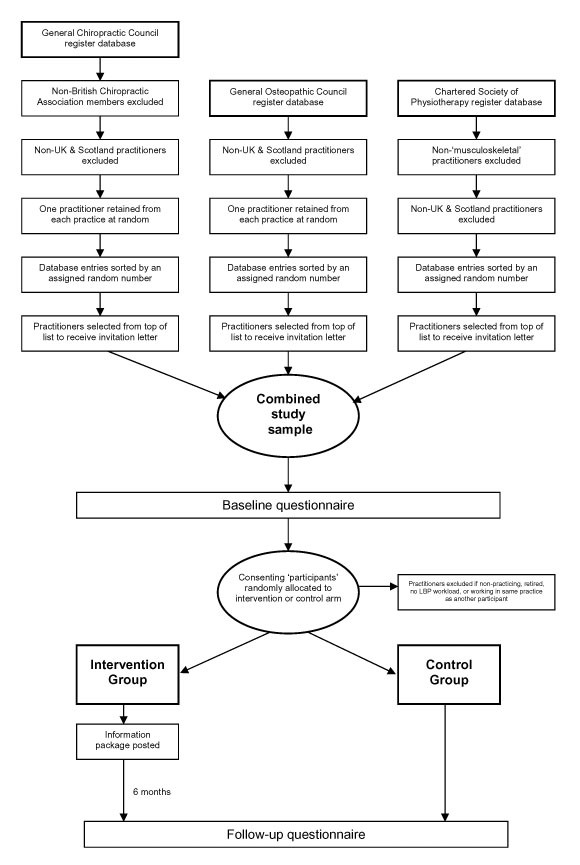
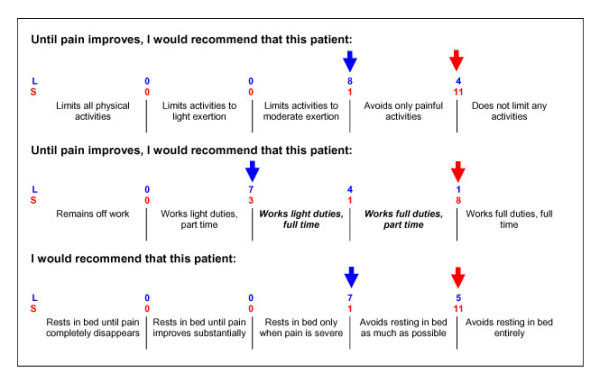
The primary aim of this prospective, pragmatic randomised controlled trial is to test the short-term effectiveness (six-months following intervention) of a directly-posted information package on the reported clinical behaviour (primary outcome), attitudes and beliefs of UK chiropractors, osteopaths and musculoskeletal physiotherapists. We sought to randomly allocate a combined sample of 1,800 consenting practitioners to receive either the information package (intervention arm) or no information above that gained during normal practice (control arm). We collected questionnaire data at baseline and six-months post-intervention. The analysis of the primary outcome will assess between-arm differences of proportions of responses to questions on recommendations about activity, work and bed-rest, that fall within categories previously defined by an expert consensus exercise as either 'guideline-consistent' and 'guideline-inconsistent'.
腰痛(LBP)是一个常见且代价高昂的问题。旨在帮助从业者和患者就LBP的适当医疗保健做出决策的举措包括印刷的循证临床指南。英国的脊椎按摩疗法、整骨疗法和肌肉骨骼物理治疗这三个专业群体在管理LBP的方法上有共同之处,并且是LBP指南的目标群体之一。即便如此,许多人似乎并未意识到此类指南的存在。此外,这些从业者中至少有一些人的行为与这些指南中所推荐的不同。很少有评估印刷信息作为改变从业者行为的干预措施的随机对照试验使用无干预对照组。所有这些试验都采用了整群设计,并且大多数都存在方法学缺陷。没有一项试验专门关注从业者对LBP患者的行为。研究其他改变从业者对LBP患者行为的策略的研究结果相互矛盾。尽管全球已制定了众多LBP指南,但关于这些指南的传播是否真的改变了从业者行为的数据却很匮乏。主要由于其单位成本较低,向大量从业者发送印刷信息是一种有吸引力的传播和实施策略。在个体从业者层面,这种策略的效应大小可能很小。然而,如果针对大量从业者,这种策略可能会在人群层面实现有意义的改变。
这项前瞻性实用随机对照试验的主要目的是测试直接邮寄的信息包对英国脊椎按摩师、整骨师和肌肉骨骼物理治疗师报告的临床行为(主要结局)、态度和信念的短期有效性(干预后六个月)。我们试图将1800名同意参与的从业者的合并样本随机分配,使其要么接收信息包(干预组),要么不接收正常执业过程中所获得信息之外的任何信息(对照组)。我们在基线和干预后六个月收集问卷数据。对主要结局的分析将评估关于活动、工作和卧床休息建议的问题的回答比例在组间的差异,这些回答类别先前由专家共识确定为“与指南一致”和“与指南不一致”。