Niihara Yutaka, Matsui Neil M, Shen Yamin M, Akiyama Dean A, Johnson Cage S, Sunga M Alenor, Magpayo John, Embury Stephen H, Kalra Vijay K, Cho Seong Ho, Tanaka Kouichi R
Department of Medicine, Harbor-UCLA Medical Center, UCLA School of Medicine, Torrance, CA, USA.
BMC Blood Disord. 2005 Jul 25;5:4. doi: 10.1186/1471-2326-5-4.
We have previously demonstrated that therapy with orally administered L-glutamine improves nicotinamide adenosine dinucleotide (NAD) redox potential of sickle red blood cells (RBC). On further analysis of L-glutamine therapy for sickle cell anemia patients, the effect of L-glutamine on adhesion of sickle RBC to human umbilical vein endothelial cells (HUVEC) was examined.
The first part of the experiment was conducted with the blood samples of the 5 adult sickle cell anemia patients who had been on L-glutamine therapy for at least 4 weeks on a dosage of 30 grams per day compared to those of patient control group. In the second part of the experiment 6 patients with sickle cell anemia were studied longitudinally. Five of these patients were treated with oral L-glutamine 30 grams daily and one was observed without treatment as the control. t-test and paired t-test were used for determination of statistical significance in cross-sectional and longitudinal studies respectively.
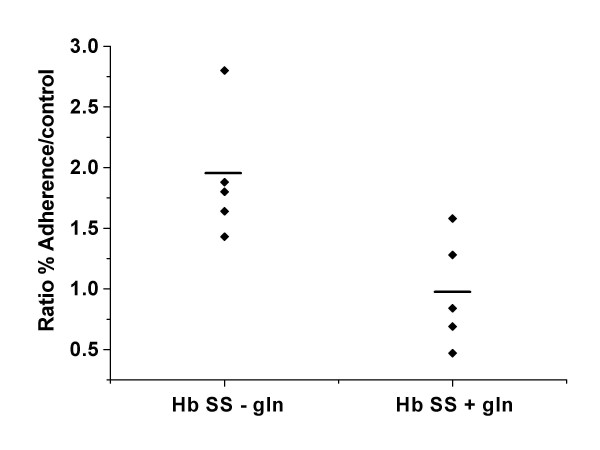
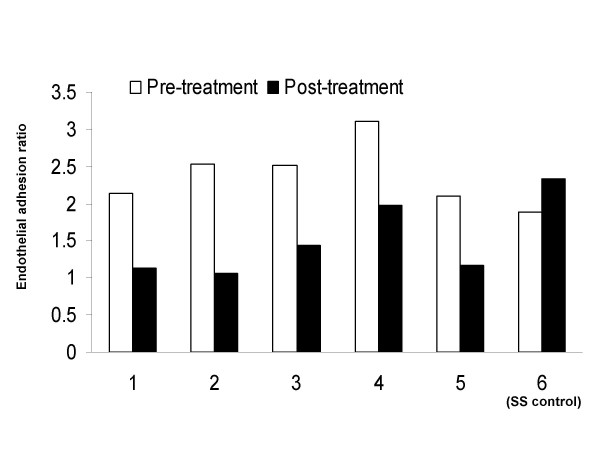
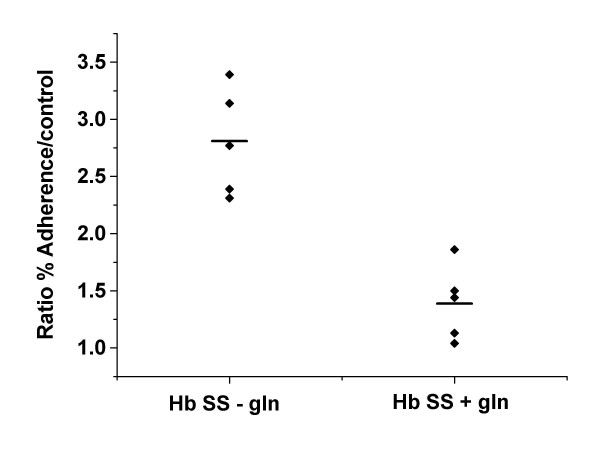
In the first study, the mean adhesion to endothelial cells with the autologous plasma incubated cells were 0.97 +/- 0.45 for the treated group and 1.91 +/- 0.53 for the nontreated group (p < 0.02). Similarly with lipopolysaccharide (LPS) incubated cells the mean adhesion to endothelial cells were 1.39 +/- 0.33 for the treated group and 2.80 +/- 0.47 for the untreated group (p < 0.001). With the longitudinal experiment, mean decrease in the adhesion to endothelial cells was 1.13 +/- 0.21 (p < 0.001) for the 5 treated patients whereas the control patient had slight increase in the adhesion to endothelial cells.
In these studies, oral L-glutamine administration consistently resulted in improvement of sickle RBC adhesion to HUVEC. These data suggest positive physiological effects of L-glutamine in sickle cell disease.
我们之前已经证明,口服L-谷氨酰胺治疗可改善镰状红细胞(RBC)的烟酰胺腺嘌呤二核苷酸(NAD)氧化还原电位。在对镰状细胞贫血患者的L-谷氨酰胺治疗进行进一步分析时,研究了L-谷氨酰胺对镰状RBC与人脐静脉内皮细胞(HUVEC)黏附的影响。
实验的第一部分使用了5名成年镰状细胞贫血患者的血样,这些患者接受L-谷氨酰胺治疗至少4周,每日剂量为30克,与患者对照组进行比较。实验的第二部分对6名镰状细胞贫血患者进行了纵向研究。其中5名患者每天口服30克L-谷氨酰胺进行治疗,1名患者未接受治疗作为对照。分别使用t检验和配对t检验来确定横断面研究和纵向研究中的统计学显著性。
在第一项研究中,用自体血浆孵育细胞时,治疗组对内皮细胞的平均黏附率为0.97±0.45,未治疗组为1.91±0.53(p<0.02)。同样,用脂多糖(LPS)孵育细胞时,治疗组对内皮细胞的平均黏附率为1.39±0.33,未治疗组为2.80±0.47(p<0.001)。在纵向实验中,5名接受治疗的患者对内皮细胞的黏附平均下降了1.13±0.21(p<0.001),而对照患者对内皮细胞的黏附略有增加。
在这些研究中,口服L-谷氨酰胺始终能改善镰状RBC与HUVEC的黏附。这些数据表明L-谷氨酰胺在镰状细胞病中具有积极的生理作用。