Ellermann-Eriksen Svend
Department of Clinical Microbiology, Aarhus University Hospital, Skejby Sygehus, Brendstrupgaardsvej 100, DK-8200 Aarhus N., Denmark.
Virol J. 2005 Aug 3;2:59. doi: 10.1186/1743-422X-2-59.
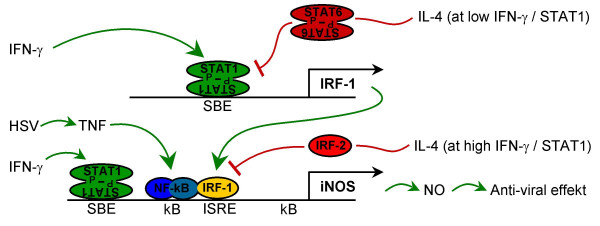
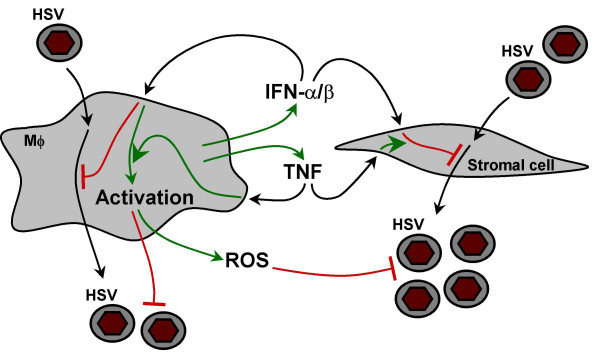
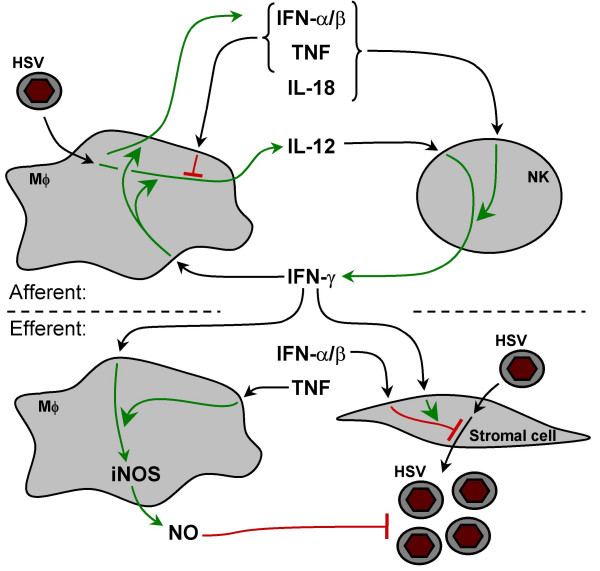
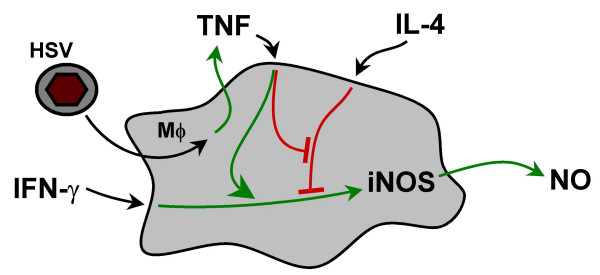
Herpes simplex virus (HSV) type 1 and 2 are old viruses, with a history of evolution shared with humans. Thus, it is generally well-adapted viruses, infecting many of us without doing much harm, and with the capacity to hide in our neurons for life. In rare situations, however, the primary infection becomes generalized or involves the brain. Normally, the primary HSV infection is asymptomatic, and a crucial element in the early restriction of virus replication and thus avoidance of symptoms from the infection is the concerted action of different arms of the innate immune response. An early and light struggle inhibiting some HSV replication will spare the host from the real war against huge amounts of virus later in infection. As far as such a war will jeopardize the life of the host, it will be in both interests, including the virus, to settle the conflict amicably. Some important weapons of the unspecific defence and the early strikes and beginning battle during the first days of a HSV infection are discussed in this review. Generally, macrophages are orchestrating a multitude of anti-herpetic actions during the first hours of the attack. In a first wave of responses, cytokines, primarily type I interferons (IFN) and tumour necrosis factor are produced and exert a direct antiviral effect and activate the macrophages themselves. In the next wave, interleukin (IL)-12 together with the above and other cytokines induce production of IFN-gamma in mainly NK cells. Many positive feed-back mechanisms and synergistic interactions intensify these systems and give rise to heavy antiviral weapons such as reactive oxygen species and nitric oxide. This results in the generation of an alliance against the viral enemy. However, these heavy weapons have to be controlled to avoid too much harm to the host. By IL-4 and others, these reactions are hampered, but they are still allowed in foci of HSV replication, thus focusing the activity to only relevant sites. So, no hero does it alone. Rather, an alliance of cytokines, macrophages and other cells seems to play a central role. Implications of this for future treatment modalities are shortly considered.
单纯疱疹病毒1型和2型是古老的病毒,与人类有着共同的进化史。因此,它们通常是适应性良好的病毒,感染我们许多人却不会造成太大危害,并且有能力在我们的神经元中潜伏终生。然而,在极少数情况下,原发性感染会扩散或累及大脑。正常情况下,原发性单纯疱疹病毒感染是无症状的,而先天免疫反应的不同分支协同作用是早期限制病毒复制从而避免感染症状出现的关键因素。早期对单纯疱疹病毒复制的轻度抑制,将使宿主在感染后期免于与大量病毒的真正战斗。由于这样的战斗会危及宿主的生命,友好解决冲突符合包括病毒在内的双方利益。本文综述了非特异性防御的一些重要武器以及单纯疱疹病毒感染最初几天的早期攻击和初期战斗情况。一般来说,巨噬细胞在攻击的最初几个小时内协调多种抗疱疹行动。在第一波反应中,主要产生I型干扰素(IFN)和肿瘤坏死因子等细胞因子,它们发挥直接抗病毒作用并激活巨噬细胞本身。在下一波反应中,白细胞介素(IL)-12与上述及其他细胞因子一起,主要在自然杀伤细胞中诱导IFN-γ的产生。许多正反馈机制和协同相互作用强化了这些系统,并产生了如活性氧和一氧化氮等强大的抗病毒武器。这导致形成了对抗病毒敌人的联盟。然而,必须控制这些强大武器,以避免对宿主造成过多伤害。通过IL-4等细胞因子,这些反应受到阻碍,但在单纯疱疹病毒复制的病灶中仍被允许存在,从而将活性集中在仅相关的部位。所以,没有英雄能独自完成任务。相反,细胞因子、巨噬细胞和其他细胞的联盟似乎起着核心作用。本文简要考虑了这对未来治疗方式的影响。