Wei Jun S, Whiteford Craig C, Cenacchi Nicola, Son Chang Gue, Khan Javed
Pediatric Oncology Branch, National Cancer Institute, 8717 Grovemont Circle, Bethesda, MD 20892-4605, USA.
Oncogene. 2005 Dec 1;24(54):7976-83. doi: 10.1038/sj.onc.1208947.
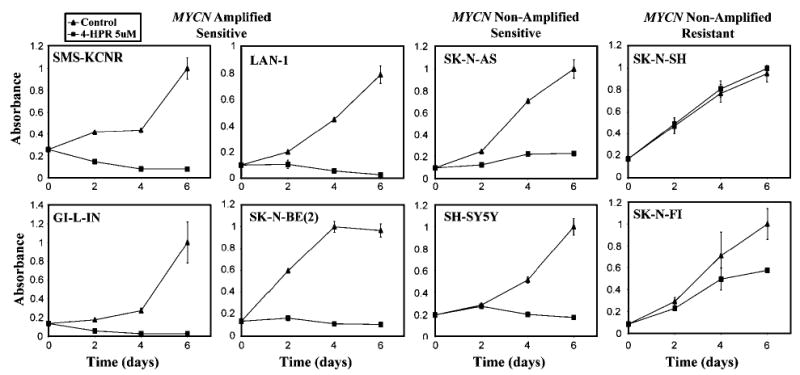
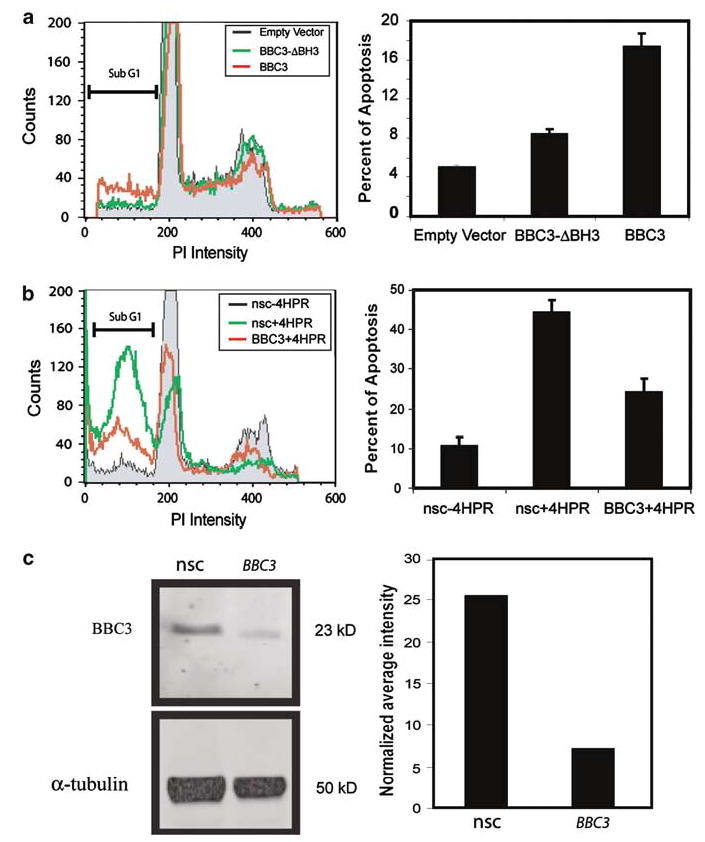
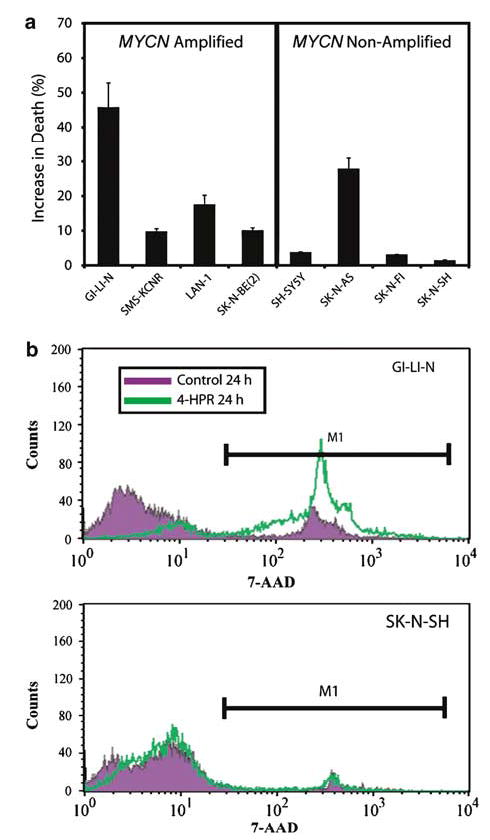
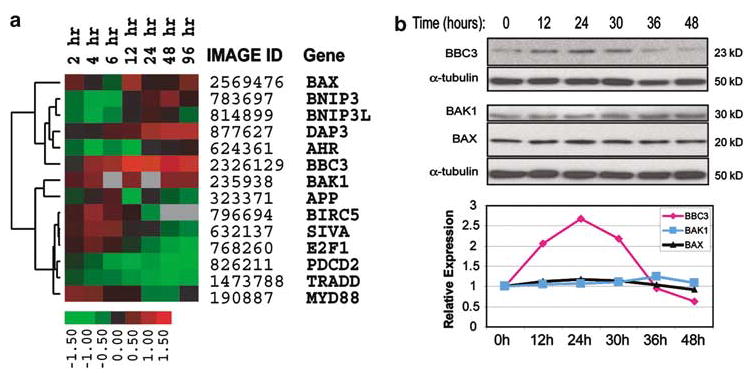
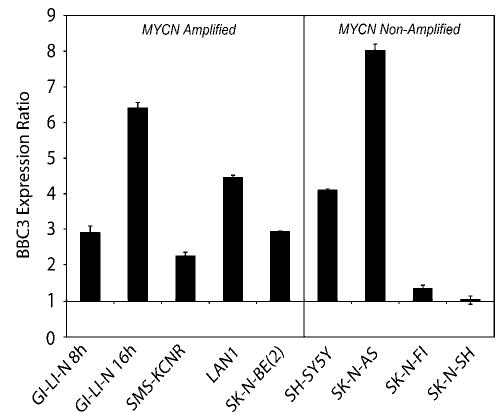
Fenretinide (4-HPR) is a synthetic retinoid whose apoptosis-inducing effects have been demonstrated in many tumor types. The precise mechanism of its apoptotic action is not fully understood. To further study the mechanism by which 4-HPR exerts its biological effects in neuroblastoma (NB) and to identify the genes that contribute to the induction of apoptosis, we determined the sensitivity of eight NB cell lines to 4-HPR. Additionally, cDNA microarray analysis was performed on a 4-HPR-sensitive cell line to investigate the temporal changes in gene expression, primarily focusing on the induction of proapoptotic genes. BBC3, a transcriptionally regulated proapoptotic member of the BCL2 family, was the most highly induced proapoptotic gene. Western analysis confirmed the induction of BBC3 protein by 4-HPR. Furthermore, the induction of BBC3 was associated with the sensitivity to this agent in the cell lines tested. Finally we demonstrated that BBC3 alone is sufficient to induce cell death in the 4-HPR-sensitive and resistant NB cell lines, and that siRNA against BBC3 significantly decreases apoptosis induced by 4-HPR. Our results indicate that BBC3 mediates cell death in NB cells in response to 4-HPR.
维甲酸(4-HPR)是一种合成类视黄醇,其诱导凋亡的作用已在多种肿瘤类型中得到证实。其凋亡作用的确切机制尚未完全明确。为了进一步研究4-HPR在神经母细胞瘤(NB)中发挥生物学效应的机制,并确定参与诱导凋亡的基因,我们测定了8种NB细胞系对4-HPR的敏感性。此外,对一种对4-HPR敏感的细胞系进行了cDNA微阵列分析,以研究基因表达的时间变化,主要关注促凋亡基因的诱导情况。BBC3是BCL2家族中受转录调控的促凋亡成员,是诱导程度最高的促凋亡基因。蛋白质印迹分析证实4-HPR可诱导BBC3蛋白表达。此外,在测试的细胞系中,BBC3的诱导与对该药物的敏感性相关。最后我们证明,单独的BBC3足以在对4-HPR敏感和耐药的NB细胞系中诱导细胞死亡,并且针对BBC3的小干扰RNA(siRNA)可显著降低4-HPR诱导的凋亡。我们的结果表明,BBC3介导NB细胞对4-HPR的反应性细胞死亡。